What Is Topical Medication Allergy?
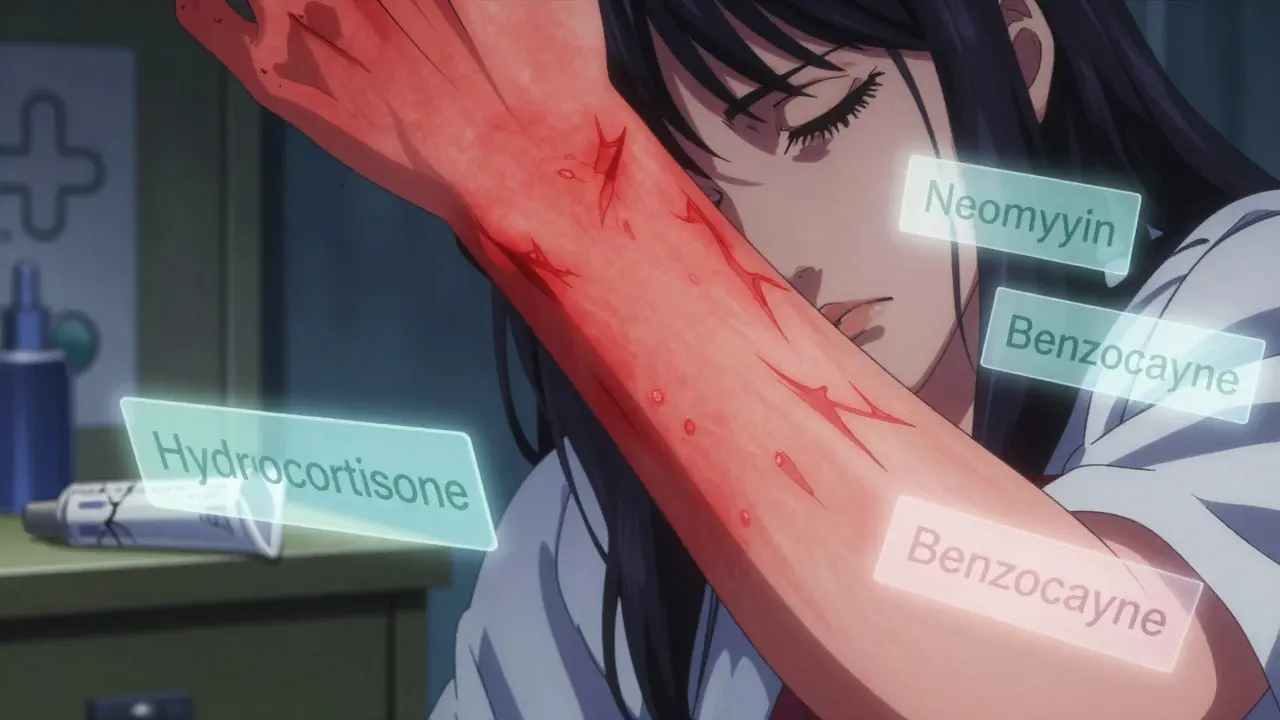
It’s not just a rash. If you’ve applied a cream, ointment, or lotion for eczema, a cut, or a bug bite-and your skin got worse instead of better-you might be dealing with a topical medication allergy. This isn’t irritation from soap or dirt. It’s your immune system reacting to something in the medicine itself. This reaction is called allergic contact dermatitis, and it’s more common than most doctors admit.
Unlike irritant contact dermatitis, which happens when a substance burns or chafes the skin (like strong cleansers), allergic contact dermatitis is a delayed reaction. You might use the product for days or weeks without issue, then suddenly, your skin turns red, itches like crazy, and starts oozing or peeling. The worst part? It often looks just like the condition you’re trying to treat.
Studies show that 10% to 17% of people who get patch tested for stubborn rashes are reacting to topical medications. That means for every 10 people told their eczema isn’t improving, one of them is actually allergic to the cream they’ve been using.
Which Medications Cause the Most Allergies?
Not all topical drugs are created equal when it comes to triggering allergies. Some are far more likely to cause trouble. According to data from the North American Contact Dermatitis Group, the top offenders are:
- Antibiotics: Neomycin (found in 9.9% of positive patch tests), bacitracin (7.5%), and gentamicin (3.2%) are the most common. These are in everything from first-aid ointments to prescription creams.
- Corticosteroids: Ironically, these are the go-to treatment for rashes-but they can also cause them. About 0.5% to 2.2% of people using steroid creams develop an allergy to them. Hydrocortisone, the most common OTC option, is a frequent culprit.
- Local anesthetics: Benzocaine, found in numbing sprays and hemorrhoid creams, triggers reactions in 2.1% of tested patients.
- NSAIDs: Ketoprofen, used in pain-relief gels, causes allergic reactions in 1.8% of cases.
Here’s the twist: if you’re allergic to one steroid, you might still be able to use another. Steroids are grouped into six categories (A-F) based on chemical structure. Someone allergic to hydrocortisone (Group A) can often safely use triamcinolone (Group B) or methylprednisolone aceponate (Group D). Knowing this can save you months of trial and error.
How Is It Diagnosed?
Most doctors won’t think to test for this unless you bring it up. That’s why so many people suffer for months or even years. The gold standard is patch testing. It’s not a skin prick or a blood test. You wear small patches containing common allergens-including 20-30 different medications-on your back for 48 hours. Then, you return at 72 hours and sometimes even 96 hours to see if your skin reacts.
Why wait that long? Allergic contact dermatitis is a Type IV hypersensitivity reaction. It takes time for immune cells to gather and trigger inflammation. A reaction at 48 hours is common, but some show up only after four days.
When done right, patch testing identifies the culprit in about 70% of cases. But here’s the problem: many clinics don’t include enough medication allergens in their standard panels. A 2023 study from Johns Hopkins found that using diluted versions of topical medications (10-fold less concentrated) improved detection rates in patients with damaged skin, cutting false negatives from 32% down to just 9%.
Don’t assume your doctor will know what to test for. Bring all your creams, ointments, lotions-even the ones you think are “just moisturizers.” Thirty percent of allergens come from products you don’t consider medications.

What Does Treatment Look Like?
First rule: stop using the thing that’s causing the reaction. Sounds obvious, but many patients keep applying their steroid cream because they think the rash is just flaring up. That’s like pouring gasoline on a fire.
Once you’ve identified the allergen, treatment depends on how bad the rash is:
- Mild cases: Over-the-counter 0.5%-1% hydrocortisone can help, but if you’re still itching after a week, you likely need something stronger-or you’re allergic to hydrocortisone itself.
- Localized moderate cases: Doctors often prescribe mid- to high-potency steroids like triamcinolone 0.1% or clobetasol 0.05%. These work fast, but they’re not safe for long-term use on the face, eyelids, or groin. Skin thinning can happen in up to 35% of users after just two weeks.
- Thin skin areas: Use low-potency steroids like desonide ointment. Or better yet, try a non-steroid option.
- Severe or widespread cases: If more than 20% of your body is affected, you’ll need oral prednisone. Most people feel relief within 12-24 hours, and 85% of severe cases clear up with a 2-3 week taper.
For patients who can’t use steroids-or who’ve had bad reactions-topical calcineurin inhibitors like pimecrolimus (Elidel) and tacrolimus (Protopic) are strong alternatives. They’re not FDA-approved specifically for contact dermatitis, but they’re widely used off-label. RealSelf data shows 82% of users report “significant improvement” within two weeks. The downside? A burning or stinging sensation at first, which fades after a few days.
Why Do So Many People Get Misdiagnosed?
Doctors are trained to think: “Rash? Give a steroid.” They’re not trained to suspect the treatment is the problem. A 2023 review in Dermatology Times found that 40% to 60% of topical medication allergies are missed on the first visit. Patients often see three or more doctors before someone considers patch testing.
And it’s not just patients. Healthcare workers are at higher risk. A 2022 JAMA Dermatology study found that 18% of nurses and doctors develop contact dermatitis from the creams and antiseptics they use daily. Many keep working with the same products because they assume it’s just dry skin.
Even more surprising: 15% to 20% of people who think they have a medication allergy actually have irritant dermatitis. That’s why patch testing is so important. It separates true allergies from simple irritation.
What Happens If You Don’t Find the Cause?
Ignoring a topical allergy doesn’t make it go away. It makes it worse. A 2022 survey by the National Eczema Association found that people with undiagnosed medication allergies take an average of 8.3 weeks to find a treatment that works-and they change medications an average of three times in that period.
Chronic cases can turn into long-term skin damage: thickened, cracked, or discolored skin. On Reddit’s r/Dermatology, one user wrote: “I used hydrocortisone for six months. My skin looked like it had been burned. I thought I was healing. I was destroying it.” That story isn’t rare.
Without proper diagnosis, you’re stuck in a loop: rash → steroid → worse rash → stronger steroid → more damage. It’s a trap.

How to Prevent Future Reactions
Once you know your allergens, avoidance is everything. Here’s how to stay safe:
- Read labels: Look for neomycin, bacitracin, benzocaine, ketoprofen, and hydrocortisone in ingredient lists-even in “natural” or “herbal” products.
- Use the ACDS app: The American Contact Dermatitis Society offers a free mobile app with a database of 3,500+ products and their allergen content. It’s used by over 40% of patch-tested patients.
- Ask for alternatives: If you’re allergic to neomycin, ask for mupirocin instead. If you can’t use steroids, request tacrolimus.
- Test new products: Apply a small amount to your inner forearm for three days before using it widely.
Also, be aware of cross-reactivity. If you’re allergic to one steroid, don’t assume all are off-limits. Work with a dermatologist to map out which ones are safe based on chemical groups.
The Future of Diagnosis and Treatment
Things are changing. In 2023, the European Society of Contact Dermatitis rolled out a new diagnostic tool called the “Topical Medication Allergy Score,” which uses 12 clinical clues to improve accuracy from 65% to 89%. The American Academy of Dermatology launched a national registry in January 2023 and has already logged over 1,200 cases-revealing new patterns of cross-reactivity between biologic drugs and old-school creams.
Researchers are also testing skin barrier creams that reduce allergen penetration by 73%. Three of these products are in Phase 3 trials as of mid-2023. And the NIH has invested $4.7 million into molecular tests that could one day predict your risk of reacting to a topical drug before you even use it.
For now, the best defense is awareness. If your skin isn’t improving-or it’s getting worse-don’t just reach for a stronger cream. Ask: Could this be the medicine itself?”
Frequently Asked Questions
Can you be allergic to hydrocortisone cream?
Yes. Hydrocortisone is one of the most common causes of topical medication allergy. Even though it’s mild and sold over the counter, it can trigger allergic contact dermatitis in up to 2% of users. If your rash gets worse after using it, stop immediately and see a dermatologist for patch testing.
How long does contact dermatitis take to heal?
With proper treatment and avoidance of the allergen, most cases clear up in 2-4 weeks. Itching usually improves within 48-72 hours of stopping the trigger. If the rash lasts longer than a month, you’re likely still exposed to the allergen or misdiagnosed.
Is patch testing painful?
No. Patch testing is not painful. Small patches containing allergens are taped to your back and left for 48 hours. You might feel slight itching or tingling if you react, but there’s no needles, no blood, and no burning. It’s a simple, non-invasive test.
Can I use Neosporin if I have a skin allergy?
Probably not. Neosporin contains neomycin and bacitracin-two of the top three allergens in topical medications. Up to 10% of people who get patch tested react to neomycin. If you’ve had a rash after using Neosporin, avoid it. Try a non-antibiotic barrier ointment like petroleum jelly instead.
Are natural or organic creams safer?
No. Natural doesn’t mean non-allergenic. Many plant extracts like tea tree oil, lanolin, and fragrance oils are common allergens. In fact, 30% of allergens are found in products people don’t consider “medicines”-like lotions, sunscreens, and makeup. Always check ingredient lists, even on “clean” brands.



Comments (15)
Rachel Liew
I had no idea hydrocortisone could make your rash worse. I used it for months thinking it was healing. My skin looked like burnt paper. I just stopped using it and started with plain petroleum jelly. Took 3 weeks but now it's finally calm. 🤕
Angel Fitzpatrick
This is all a Big Pharma distraction. They want you to think it's your cream causing the problem so you buy their $200 'hypoallergenic' alternatives. The real culprit? Glyphosate in your food. It wrecks your skin barrier and makes you hypersensitive to everything. Patch testing? That's just a money grab for dermatologists who get paid per test. Look up the 2022 CDC data on glyphosate exposure and eczema spikes. It's all connected.
Lilliana Lowe
The assertion that '10% to 17% of people who get patch tested are reacting to topical medications' is statistically misleading without context. The North American Contact Dermatitis Group's data set is skewed toward refractory cases-this is not representative of the general population. Furthermore, the claim that '30% of allergens come from non-medication products' is substantiated only by anecdotal clinic reports, not peer-reviewed epidemiology. One must distinguish between clinical prevalence and population prevalence.
Naresh L
It's interesting how we blame the medicine but rarely ask why our skin became so fragile in the first place. Maybe the problem isn't just what we put on it, but what we've taken away-moisture, microbial balance, sunlight. We treat skin like a broken machine, not a living ecosystem. What if the answer isn't more testing, but less intervention?
franklin hillary
STOP USING STEROIDS IF IT’S NOT GETTING BETTER. I’M TELLING YOU THIS AS SOMEONE WHO SPENT 18 MONTHS IN RASH HELL. I THOUGHT I WAS FIXING IT. I WAS BURNING MY SKIN. I SWITCHED TO TACROLIMUS AND MY SKIN CAME BACK TO LIFE. NO MORE STEROIDS. NO MORE TRAP. YOU CAN DO THIS. JUST STOP. AND GET PATCH TESTED. IT’S NOT SCARY. IT’S YOUR ONLY WAY OUT.
Aditya Gupta
Neosporin is a trap. I used it on every cut. Then my hands got red and cracked. Turns out I was allergic to neomycin. Switched to plain Vaseline and boom-no more drama. Simple stuff works best.
Nancy Nino
How charming. A 17-page treatise on how doctors are incompetent, while the author-presumably a dermatologist-has clearly never met a patient who doesn’t read every word of their prescription label. Truly, the most enlightened medical professional in history.
June Richards
LMAO at people who think patch testing is the answer. I did it. Got zero positives. Still itchy. Guess what? I’m just sensitive. Stop overcomplicating it. Use CeraVe. Done.
Jaden Green
The entire premise here is built on a foundation of confirmation bias. You cherry-pick studies that support your narrative while ignoring the fact that most topical allergies are transient and self-resolving. The real epidemic isn’t medication allergy-it’s internet self-diagnosis. People read one Reddit thread and immediately assume they’re allergic to everything. Then they stop using everything, and their skin improves because they stopped over-treating it. The placebo effect isn’t just real-it’s the only thing keeping this whole theory afloat.
Lu Gao
Natural doesn't mean safe? 😂 I’ve been using tea tree oil for years and my skin’s never been better. Also, patch testing is just a fancy way to make you pay for a 48-hour nap. 🤷♀️
Nidhi Rajpara
I am a nurse and I have developed contact dermatitis from chlorhexidine wipes. I reported this to my supervisor, but they said it is 'common' and 'just dry skin'. I am now using gloves, but I am concerned about long-term effects. Should I pursue patch testing?
Chris & Kara Cutler
We tried everything. Steroids. Antibiotics. Natural creams. Then we found out my kid was allergic to bacitracin in the diaper rash cream. 🤯 One change. One week. Skin like new. You’re not crazy. It’s probably the cream.
Jamie Allan Brown
I’ve been patch tested twice. First time, they missed ketoprofen. Second time, they used diluted samples like the Johns Hopkins study mentioned. That’s when I finally found it. Don’t let a clinic skip the dilution step. It’s not extra-it’s essential. Especially if your skin’s already damaged.
Lisa Rodriguez
I used to think 'fragrance-free' meant safe. Then I found out my 'clean' lotion had lanolin. My face looked like a tomato. Patch test saved me. Now I use the ACDS app religiously. It’s free. Use it. Don’t be like me and waste two years.
Nicki Aries
I’m not sure why this article is so surprised that doctors don’t think to test for topical allergies. They’re trained to fix symptoms, not trace root causes. It’s systemic. The system rewards speed, not depth. And patients? We’re conditioned to believe that more treatment = better care. So we keep applying. And keep suffering. It’s not ignorance. It’s institutional inertia.