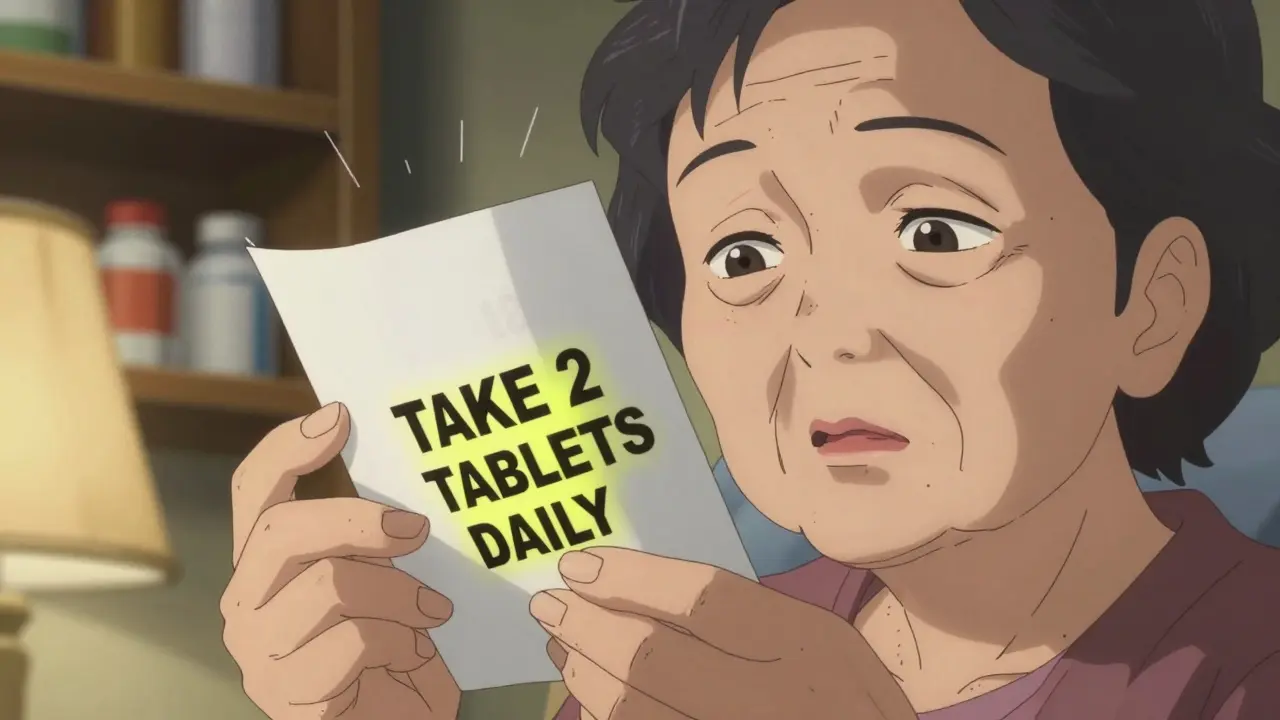
Imagine opening your medicine cabinet and not being able to read the label on your pill bottle. Not just a little blurry - completely unreadable. The name of the drug? Unclear. The dose? Hidden. The time to take it? A mystery. For over 8 million Americans with low vision, this isn’t a hypothetical. It’s daily reality. And it’s dangerous.
Why Accessible Prescription Labels Matter
Taking the wrong medication, at the wrong time, in the wrong amount - these aren’t just mistakes. They’re life-threatening. According to the American Foundation for the Blind, people with low vision often take incorrect doses because they can’t read standard pharmacy labels. Studies show that up to 67% of visually impaired medication users have experienced a medication error because of inaccessible labels. That’s nearly two out of three people. The good news? There are solutions. And they’re not just nice to have - they’re legally required. The FDA Safety and Innovation Act of 2012 made it clear: prescription labels must be accessible to people with vision impairments. This isn’t charity. It’s civil rights.What Counts as a Large Print Prescription Label?
Not all big text is created equal. A label with 12-point font might look big to you, but to someone with low vision, it’s still too small. The gold standard? 18-point font - and even 24-point is better. The American Foundation for the Blind and the Access Board both recommend using sans-serif fonts like Arial, Verdana, or APHont™ - a free font designed specifically for low vision readers by the American Printing House for the Blind. These fonts have wider letter spacing and cleaner shapes, making them easier to distinguish. Contrast matters too. Black text on a white background works best. Avoid gray text, colored backgrounds, or glossy paper - glare makes reading impossible. Labels should be printed on matte, durable stock that won’t smudge or fade. Layout is just as important. Instructions should be left-aligned, not centered. Use all lowercase letters for the drug name and instructions, but keep numbers in uppercase (e.g., “take 2 TABLETS daily”). Highlight critical info - like “take with food” or “do not crush” - with a yellow background or bold text.How Large Print Labels Are Made
Standard prescription labels are tiny. There’s just not enough space to fit everything in 18-point font. So pharmacies use a simple workaround: duplicate labels. Instead of replacing the original label, the pharmacy prints a second, larger version and attaches it next to the original. Some pharmacies use colored stickers - like a green tab - to make the large print label easy to find. Others include a QR code that links to an audio version of the label when scanned with a smartphone. This method works because it doesn’t require changing the pharmacy’s existing systems. It just adds an extra step - one that takes less than a minute once staff are trained.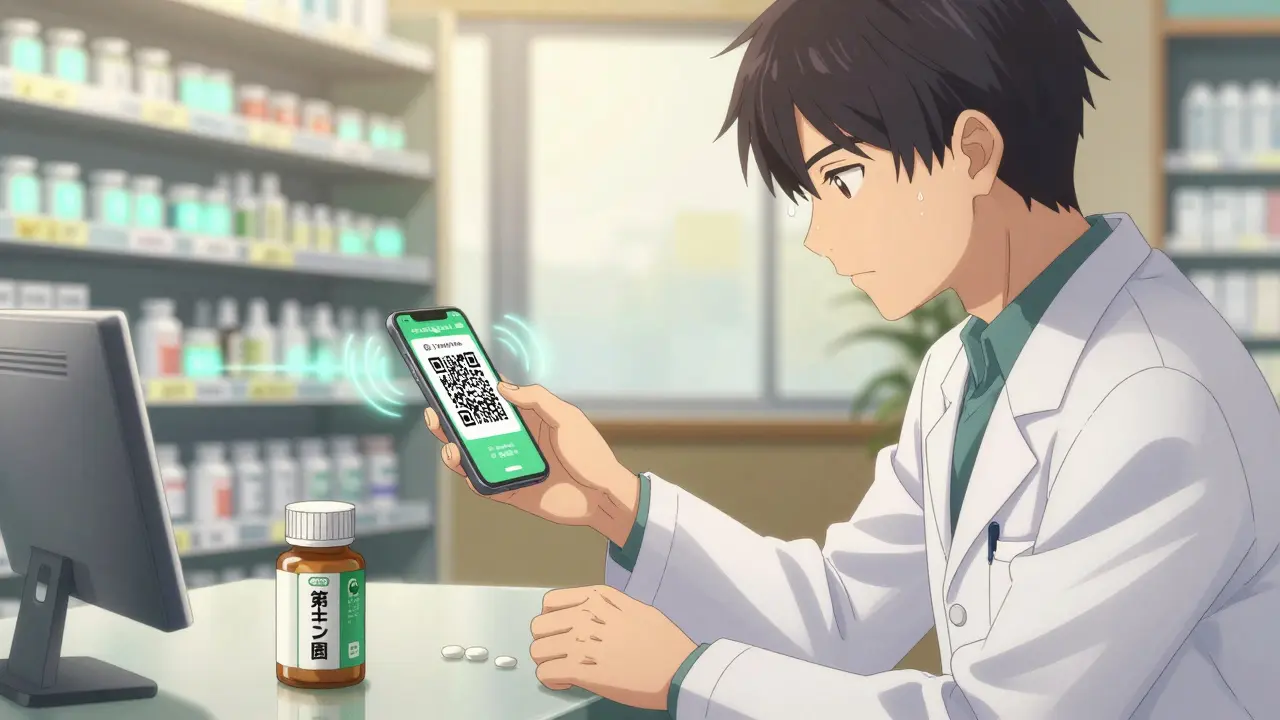
Other Accessible Options Beyond Large Print
Large print isn’t the only option. For people who can’t read even large text, there are other tools:- ScripTalk: A small RFID tag is attached to the bottle. When you tap it with a handheld reader or smartphone app, it plays the label information aloud. Used by CVS, Walgreens, and other major chains, ScripTalk delivers full details - drug name, dose, instructions, expiration date, and refill info.
- Braille labels: These are tactile and useful for people who read Braille. But only about 10% of people with low vision are Braille readers, so this option serves a smaller group.
- QR code audio labels: Systems like UK HealthCare’s ScriptView let you scan a code with your phone to hear the label. Some even let you choose the voice, speed, or language.
- AI-powered reading apps: Tools like Be My Eyes connect you to a volunteer via live video call. They read your label in real time. Over 1.2 million labels have been read this way since 2023.
What Pharmacies Offer - and What They Don’t
Big chains like CVS, Walgreens, and Walmart have been rolling out accessible labels for years. As of 2023, 98% of CVS locations, 95% of Walgreens, and 92% of Walmart pharmacies offer at least one option - usually large print or ScripTalk. But independent pharmacies? Not so much. A 2022 survey by the American Pharmacists Association found that only 52% of independent pharmacies offer any form of accessible labeling. Many don’t know the law. Others say they don’t have the supplies or training. Here’s the problem: if you walk into a small pharmacy and ask for a large print label, they might say, “We don’t do that.” Or worse - “We’ll call you when it’s ready.” That delay can be dangerous. Medication errors don’t wait.How to Get Accessible Labels
You don’t have to wait for your pharmacy to offer it - you can request it. Here’s how:- Ask your pharmacist directly: “Do you offer large print or audible prescription labels?” Don’t say “Can you make it bigger?” Be specific.
- Ask for the label format you need: “I need 18-point Arial font,” or “I’d like a ScripTalk tag.”
- If they say no, ask for a manager. Many pharmacists aren’t trained on this.
- Request it for every prescription - not just new ones. Labels change with refills.
- If your pharmacy refuses, file a complaint with the state board of pharmacy or the Department of Justice. Failure to provide accessible labels is a violation of the Americans with Disabilities Act.
Real Stories, Real Impact
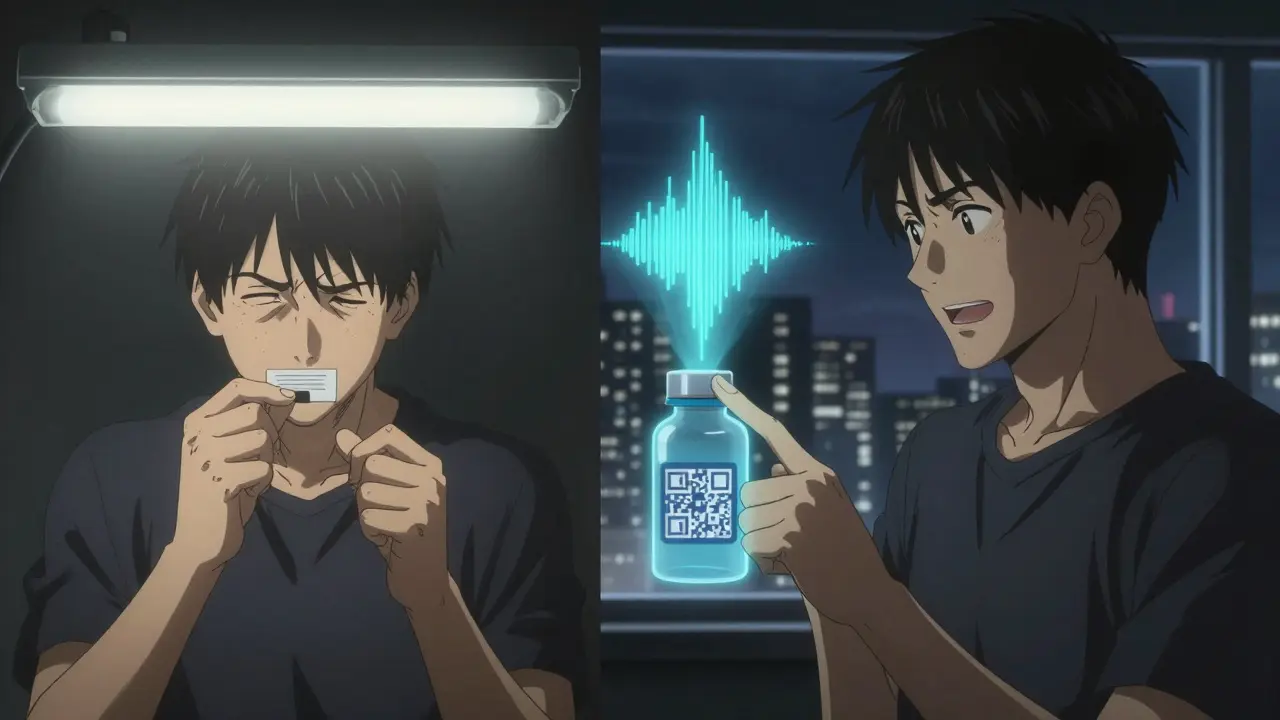
One 78-year-old woman in Kentucky, living with diabetic retinopathy, was having hypoglycemic episodes almost every week. She couldn’t tell which insulin bottle was which. After switching to ScriptView large print labels with QR code audio, her episodes dropped by 75% in three months. A Reddit user named VisionLiberation wrote: “Since my pharmacy started offering 18pt Arial labels, I stopped taking the wrong pills twice a week. It’s literally life-changing.” On Healthgrades, accessible labeling services average a 4.7 out of 5 rating. The most common praise? “I finally feel safe taking my meds.”What’s Coming Next
The FDA is moving fast. By 2026, accessible labeling will be required for electronic prescriptions and patient portals. CVS is investing $15 million to expand ScripTalk to all 9,900 of its U.S. locations by late 2024. AI tools are getting smarter. Apps that can read labels in real time are now available for free on smartphones. The future isn’t just bigger print - it’s voice, video, and instant access.What You Can Do Today
If you or someone you care about has low vision:- Don’t assume your pharmacy has it. Ask.
- Request large print (18-point or larger) with high contrast.
- Ask about ScripTalk or QR code audio labels.
- Keep a spare large print label at home in case the one on the bottle gets damaged.
- Help others. Share this info with friends, family, or senior centers.
Are large print prescription labels free?
Yes. Major pharmacies like CVS, Walgreens, and Walmart offer large print, ScripTalk, and QR code audio labels at no extra cost. Even independent pharmacies are required by law to provide them for free under the Americans with Disabilities Act. You should never be charged for accessible labeling.
Can I get large print labels for over-the-counter medicines?
Pharmacies are only legally required to provide accessible labels for prescription medications. However, many pharmacies will print large print labels for OTC drugs if you ask - especially if you’re a regular customer. Some also offer free label templates you can print at home and stick on bottles.
What if my pharmacist says they don’t have large print labels?
That’s not acceptable. Ask to speak with a manager. If they still refuse, contact your state’s board of pharmacy or file a complaint with the U.S. Department of Justice. Under the ADA, pharmacies must provide reasonable accommodations - including accessible labels - and failure to do so is illegal. You can also ask to transfer your prescription to a pharmacy that does offer the service.
Can I use a magnifying glass instead of large print labels?
Magnifiers help, but they’re not reliable. Many people with low vision can’t use handheld magnifiers effectively - especially if they have tremors, arthritis, or poor hand-eye coordination. Large print and audio labels remove the need for extra tools and reduce the chance of misreading. They’re faster, safer, and more independent.
How do I know if my pharmacy offers ScripTalk?
Look for a small silver or black RFID tag on the bottle - it looks like a sticker with a tiny antenna pattern. You can also ask the pharmacist directly: “Do you offer ScripTalk?” or check the pharmacy’s website. CVS and Walgreens list it under their accessibility services. If you don’t see it, ask for it - many locations have the equipment but don’t advertise it.


Comments (11)
Akshaya Gandra _ Student - EastCaryMS
i just asked my local pharmacy for large print labels and they looked at me like i asked for a unicorn. like... its 2024? i have diabetic retinopathy and i still use a magnifying glass bc no one ever told me this was a thing. why is this even a debate??
Angie Rehe
Let me be clear: this isn't about 'convenience.' It's about Title III of the ADA, 42 U.S.C. § 12182(b)(2)(A)(ii). Pharmacies are public accommodations. Failure to provide auxiliary aids and services - including accessible labeling - constitutes discrimination. Period. If your pharmacist doesn't know this, they're not just negligent - they're violating federal civil rights law. File a complaint. Now.
Enrique González
My grandma started using ScripTalk last year. She used to miss doses because she couldn’t tell the difference between her blood pressure meds and her thyroid pills. Now she just taps the bottle and hears it all. She says it’s the first time in 10 years she’s felt in control. Honestly? This is the kind of thing that should be standard everywhere. No excuses.
Aaron Mercado
I can't believe people are still acting like this is optional. Seriously?? People are DYING because they can't read their labels. And some pharmacist says 'we don't have that'? That's not a business problem - that's a moral failure. You're not just being inconvenient - you're endangering lives. And if you're reading this and you're a pharmacist? You have a duty. Do better. Or get out of the business.
Dee Humprey
Just a quick tip: if you ask for 18-point Arial, make sure they don’t just enlarge the existing label - that often cuts off the expiration date or refill info. Ask for a full reprint on a separate sticker. Also - if they give you a QR code, test it before you leave. Some don’t work. I’ve had three that just loaded a 404. 😞
John Wilmerding
It is worth noting that the Access Board’s guidelines under Section 508 of the Rehabilitation Act explicitly recommend a minimum font size of 18 points for low-vision accessibility, with 24-point being optimal. Furthermore, the use of sans-serif typefaces such as Arial, Verdana, or APHont™ has been empirically validated in peer-reviewed studies to improve character recognition by up to 42% compared to serif fonts. These are not preferences - they are evidence-based standards.
Peyton Feuer
my aunt lives in a small town and her pharmacy told her they 'don't have the equipment.' she showed up with her phone and scanned the ScripTalk QR code on a CVS bottle - then asked if they could just do the same. they were so embarrassed they printed her a label the next day. sometimes all it takes is someone who won’t take no for an answer.
Siobhan Goggin
My mum used to cry because she couldn’t read her meds. Now she has a big label on every bottle and she says it’s like getting her independence back. I wish more people knew this was possible. It’s not magic - it’s just care. And it costs nothing.
Vikram Sujay
There is a philosophical dimension here beyond mere accessibility. The ability to independently interpret one's own medical instructions is foundational to autonomy. When a person must rely on another to read their medication label, they are not merely inconvenienced - they are disempowered. Accessible labeling is not an accommodation; it is the restoration of agency. To deny it is to deny personhood. This is not a technical issue. It is an ethical imperative.
Jay Tejada
so the pharmacy says 'we don't do that'... and you're like 'cool, i'll just die slowly then'?? 🤡 i mean... you could literally just print a label on your home printer and tape it on. it's not rocket science. why are we still talking about this in 2024?
Shanna Sung
you know what’s really happening? Big Pharma and the pharmacy chains are hiding this because if people could read their labels, they’d realize how many of these drugs are useless or dangerous. this is a cover-up. they want you dependent. don’t trust them. check your pills against the FDA’s MedWatch database. they’re lying to you.