
Why Oral Corticosteroids Are No Longer the Go-To for Severe Asthma
For decades, oral corticosteroids (OCS) like prednisone were the default rescue tool for severe asthma flare-ups. They work fast-often cutting hospital visits in half within days. But today, doctors are rethinking their role. The truth is, OCS aren’t just a quick fix. For many with severe asthma, they’ve become a slow-burning problem.
Take a patient on long-term OCS. Even at low doses-like 5 mg daily-they’re at higher risk for weight gain, diabetes, bone thinning, eye pressure, mood swings, and even heart problems. And it’s not just long-term use. A 2025 study found that 93% of severe asthma patients on OCS experienced serious side effects, even after just a few short courses. That’s not a side effect-it’s a pattern.
And it’s not just health. The cost adds up. In Italy, each asthma patient on chronic OCS racks up nearly €2,000 a year in extra medical bills from complications. That’s double what non-asthma patients pay. OCS may cost pennies at the pharmacy, but the hidden toll on the body and the system is massive.
What Counts as OCS Dependence? It’s More Common Than You Think
Dependence isn’t just about taking pills for months. The medical definition is clear: using oral steroids for six months or longer, even if it’s just a few milligrams a day. But many patients don’t realize they’re dependent. They think, “I’m just taking it when I feel worse.” But if you’re on OCS every few months-whether for flare-ups or to avoid them-you’re already in the danger zone.
Doctors now see OCS use as a red flag. It’s not the solution-it’s a sign that something else isn’t working. If someone needs OCS more than twice a year, their asthma isn’t controlled. The real goal isn’t to manage flares with steroids. It’s to stop the flares from happening in the first place.
Biologics: The Real Game-Changer
There are six FDA-approved biologic drugs for severe asthma: omalizumab, mepolizumab, reslizumab, benralizumab, dupilumab, and tezepelumab. These aren’t pills. They’re injections or infusions, usually given every few weeks or months. But they work differently. Instead of broadly suppressing inflammation like steroids, they target specific parts of the immune system that drive asthma in certain patients.
Here’s the kicker: about half to two-thirds of people with severe asthma have what’s called “type 2 inflammation.” That’s the exact kind these drugs are built to block. And the results? Dramatic.
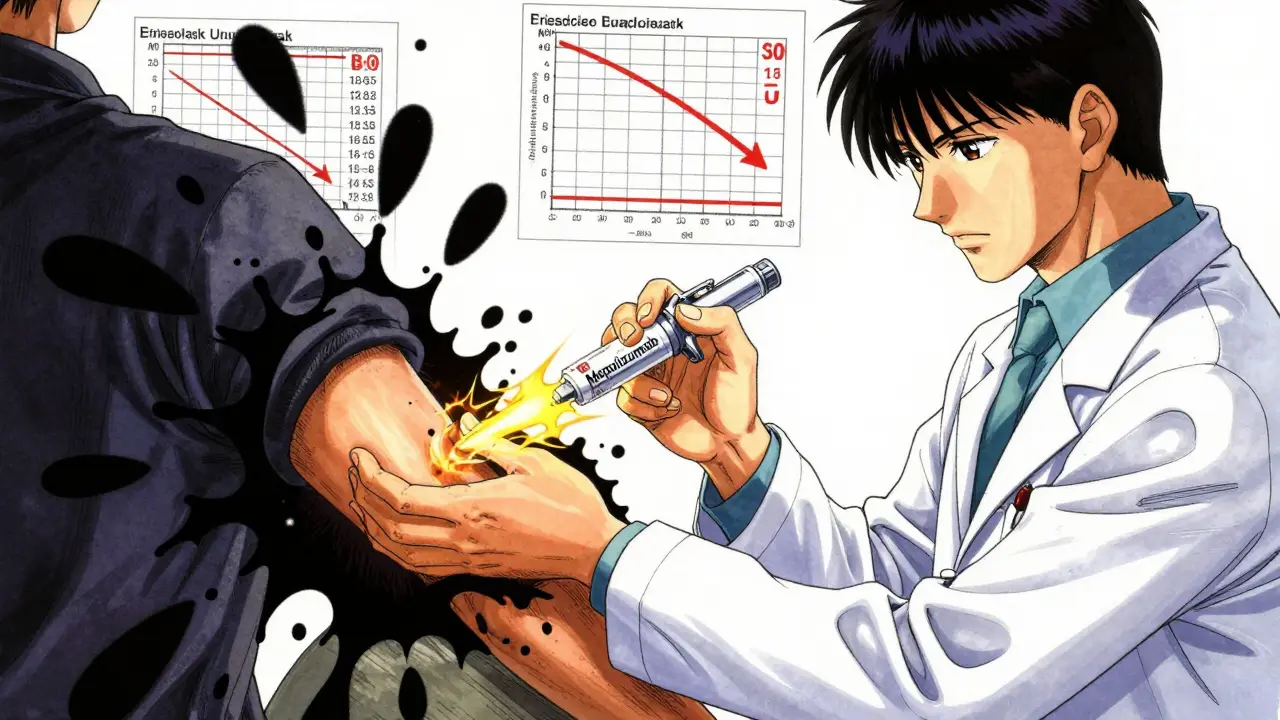
In a 2023 study of 106 Italian patients, those on mepolizumab went from needing OCS 79% of the time down to just 31%. Their steroid dose dropped by nearly 5 mg per day. Exacerbations fell from over four per year to less than one. Hospitalizations dropped from 4 in 10 patients to just 6 in 100. And these weren’t outliers. Similar results showed up with dupilumab and other biologics in multiple trials.
Patients report feeling like they got their lives back. Less coughing. Fewer missed workdays. No more waiting for the next steroid course. And critically, their long-term health risks dropped-bone density stabilized, blood sugar improved, and anxiety lessened.
Why Aren’t More People Using Biologics?
If biologics work this well, why aren’t they first-line? The answer is simple: access.
These drugs cost thousands per year. Insurance often requires proof of failure on multiple inhalers, blood tests to confirm type 2 inflammation, and sometimes even a prior authorization from a specialist. Many primary care doctors don’t know how to start the process. And for patients on public insurance or without coverage, the cost can be a wall.
But here’s what’s changing: the long-term math is shifting. While a biologic might cost $20,000 a year, chronic OCS use adds up to $10,000-$15,000 in hidden costs-hospital stays, ER visits, diabetes meds, osteoporosis treatments, mental health care. When you add it all up, biologics often pay for themselves in under two years.
GINA, the global asthma guidelines, now says biologics should be considered before maintenance OCS in Step 5 treatment. That’s a huge shift. It means doctors should be asking: “Can we prevent this steroid dependence?” not “How do we manage it?”
Other Alternatives? Limited, But Worth Knowing
Biologics are the main alternative, but not the only one. Bronchial thermoplasty is a procedure where a doctor uses heat to reduce excess muscle in the airways. It’s done in three sessions via bronchoscopy. It can reduce flare-ups and improve quality of life-but only for a small group: those with severe asthma who’ve tried everything else. And it comes with a catch: for six weeks after treatment, asthma symptoms often get worse before they get better. That’s not for everyone.
What about vitamins? Many patients try vitamin D. It sounds logical-low levels are common in asthma. But multiple studies, including a 2021 review, show it doesn’t prevent flare-ups or reduce steroid use. Same goes for omega-3s, magnesium, or herbal supplements. None have proven benefit in high-quality trials.
And while newer inhalers with better delivery systems help, they don’t replace the need for targeted therapy in severe cases. If you’re still on OCS despite using multiple inhalers, you likely need more than just a stronger inhaler-you need a different strategy.

How to Start the Transition Off OCS
Stopping OCS isn’t like turning off a switch. You can’t just quit cold turkey. Your body gets used to it. Abruptly stopping can trigger adrenal crisis-dangerously low blood pressure, fatigue, nausea. Tapering has to be slow, monitored, and personalized.
Here’s what works in practice:
- Confirm you have type 2 inflammation. Blood tests for eosinophils or FeNO (fractional exhaled nitric oxide) can help.
- Start a biologic. Don’t wait until you’re on the highest steroid dose. The earlier, the better.
- Work with your doctor to reduce OCS slowly-usually by 1-2.5 mg every 2-4 weeks.
- Monitor closely. Watch for worsening symptoms, fatigue, or dizziness. These could mean you’re tapering too fast.
- Keep using your controller inhalers. Biologics don’t replace them-they support them.
Patients who’ve done this report that the first few months of tapering are the hardest. But after six months, most say they feel better than they have in years.
The Future Is Already Here
The asthma treatment landscape has changed. We’re no longer stuck choosing between flares and side effects. Biologics offer a real path out of steroid dependence. The barriers aren’t scientific-they’re systemic. Cost, access, awareness, and outdated protocols are holding people back.
But the evidence is clear: reducing OCS use isn’t just about avoiding side effects. It’s about saving lives, reducing hospital stays, and giving patients back their daily freedom. And with more biologics in development and insurance policies slowly catching up, the door is opening wider than ever.
If you’re on oral steroids for asthma, ask your doctor: “Is this the best long-term plan?” The answer might surprise you-and change everything.
Can I stop oral corticosteroids on my own if I start a biologic?
No. Stopping oral corticosteroids suddenly can cause adrenal insufficiency, which can be life-threatening. Even if you feel better on a biologic, you must taper steroids slowly under medical supervision. Your doctor will create a personalized plan, usually reducing the dose by 1-2.5 mg every few weeks while monitoring your symptoms and adrenal function.
Are biologics covered by insurance for asthma?
Many insurance plans cover biologics for severe asthma, but they often require prior authorization. You’ll typically need proof that you’ve tried and failed at least two or three standard asthma controllers (like high-dose inhalers), and evidence of type 2 inflammation (like high eosinophils or FeNO levels). Some insurers still limit access based on cost, but the long-term savings from fewer hospitalizations are pushing more plans to approve them.
Do biologics work for all types of severe asthma?
No. Biologics target type 2 inflammation, which is present in about 50-70% of severe asthma cases. If your asthma is driven by non-type 2 pathways-like obesity-related or neutrophilic inflammation-biologics may not help. Blood tests (eosinophils) and FeNO measurements help determine if you’re a candidate. Tezepelumab is the only biologic approved for all severe asthma types, regardless of inflammation pattern.
How long before I see results from a biologic?
Most patients start noticing fewer flare-ups and reduced steroid needs within 3-6 months. Some feel better sooner-within 8-12 weeks-especially if they had high eosinophil counts. But full benefits, like stable lung function and major steroid reduction, usually take 6-12 months. Patience is key. This isn’t a quick fix-it’s a long-term reset.
Is bronchial thermoplasty a good alternative to OCS?
It’s an option, but only for a small group. Bronchial thermoplasty is reserved for severe asthma patients who don’t respond to maximum medical therapy-including biologics. It reduces flare-ups modestly but causes temporary worsening of symptoms for up to six weeks after treatment. It’s invasive, requires multiple procedures, and isn’t widely available. For most, biologics are a safer, more effective first step.
Can vitamin D or diet help reduce steroid dependence?
No. Despite popular belief, multiple high-quality studies-including one published in 2021-show vitamin D supplements don’t reduce asthma exacerbations or steroid use, even in people with low vitamin D levels. The same goes for omega-3s, magnesium, or herbal remedies. While a healthy diet supports overall health, it doesn’t replace targeted asthma therapy like biologics.



Comments (15)
Wendy Lamb
This is the kind of post that should be mandatory reading for every asthma patient. I've seen too many people stuck on prednisone for years, thinking it's just 'part of the deal.' It's not. Biologics aren't magic, but they're the closest thing we've got to a real reset button.
And yeah, the cost sucks-but so does spending your 30s in and out of ERs because your bones are crumbling and your blood sugar's through the roof.
Stop normalizing steroid dependence. It's not management. It's surrender.
Prajwal Manjunath Shanthappa
Ah, yes-the classic biologic evangelism. How quaint. You speak of "type 2 inflammation" as if it's some divine revelation, yet you ignore the fact that 30% of severe asthmatics don't fit that mold. And let's not pretend tezepelumab is some panacea-it's still a $30k/year drug with unknown long-term immunological consequences.
Meanwhile, we're dismissing decades of clinical experience with OCS because...? Because a 2023 study? Please. The real problem isn't steroids-it's lazy diagnostics and pharmaceutical marketing masquerading as progress.
Antwonette Robinson
So let me get this straight. We’re going to spend $20k a year on an injection to avoid $2k in steroid side effects? And you call this a cost-saving strategy?
Also, who approved this narrative? Did Big Pharma hire your ghostwriter? I’ve seen patients on biologics still on OCS-just now they’re also paying for a monthly infusion and a therapist to deal with the anxiety of being ‘not good enough’ to be steroid-free.
Coy Huffman
i just wanna say... i started dupilumab 8 months ago and holy crap. i haven't needed a steroid burst since.
my anxiety dropped. my sleep got better. i actually went on a hike last weekend without coughing the whole time.
it wasn't instant. it was messy. i cried during the taper. but man. it was worth it.
if you're scared? talk to your doc. don't let fear keep you stuck. you deserve to breathe. :)
Nathan King
The paradigm shift from reactive to preventive care in asthma management is long overdue. The persistence of oral corticosteroid dependence reflects systemic failures in both clinical education and healthcare economics. Biologics are not merely alternatives; they represent a redefinition of therapeutic success.
It is not sufficient to merely reduce exacerbations-we must eliminate the physiological burden of chronic glucocorticoid exposure. The data is unequivocal. The moral imperative is clear. The question is no longer whether biologics work-it is whether our institutions are willing to remove the barriers to their access.
rahulkumar maurya
Let’s be real. You think biologics are the answer? You’re ignoring the fact that most patients can’t even get a proper spirometry test, let alone an eosinophil count.
Meanwhile, in rural India, people are still using nebulizers with expired albuterol and calling it asthma control.
Stop preaching to the converted. The real crisis isn’t steroid dependence-it’s the fact that 80% of severe asthmatics globally have zero access to *any* advanced therapy. Biologics? That’s a luxury for the West.
Fix the system first. Then we’ll talk about your fancy injections.
Demetria Morris
I’m not against biologics. I just hate how this narrative makes people feel guilty for needing steroids.
I’ve been on low-dose prednisone for 7 years. My lungs are stable. My bones are thin, sure. My blood sugar? A little high. But I’m alive. I work. I take care of my kids.
And now you’re telling me I’m failing because I didn’t jump on a biologic?
Some of us aren’t lucky enough to have access, insurance, or doctors who even know how to start the process.
Don’t shame us. Just help us.
Geri Rogers
YESSSSS this is everything 😭 I was on 10mg daily for 3 years. Felt like a zombie. Then we tried dupilumab.
First month? Still shaky. Second? Better sleep. Third? I went on vacation without packing my steroid pack.
My doctor said ‘we’ll taper slow’-I cried. Not from sadness. From relief.
If you’re on OCS and scared? You’re not alone. But you don’t have to stay like this.
Ask for the test. Ask for the biologic. You’re worth more than a pill that’s slowly eating you alive 💪❤️
Susheel Sharma
Ah yes, the usual suspects. Biologics = savior. OCS = villain.
Let’s not forget that biologics require IV access, clinic visits, cold storage, and a PhD to navigate insurance. Meanwhile, prednisone? One pill. One bottle. One pharmacy.
And yes, side effects exist-but so does the fact that 17% of patients on biologics still have exacerbations.
It’s not a binary. It’s a spectrum.
But hey, if you’re a 30-something with good insurance and a wellness blog, sure. Go for it.
For the rest of us? We’re just trying to breathe. Without a spreadsheet.
Janice Williams
I find it profoundly disturbing that this post frames steroid dependence as a failure of the patient.
Let me be clear: the failure is not in the patient’s adherence. The failure is in the medical system that has offered no better option for decades.
Biologics are not a moral upgrade. They are a financial upgrade-for those who can afford them.
Until we decouple life-saving treatment from wealth, we are not healing. We are curating.
Joy Johnston
I’m a nurse who works in pulmonary. I’ve watched patients taper off OCS with biologics. It’s not easy. It’s not quick. But it’s possible.
One woman, 62, went from 7.5mg daily to zero in 14 months. Her bone density improved. She started gardening again.
It’s not about ‘being strong.’ It’s about having the right support.
If your doctor isn’t talking about this? Find someone who will. You’re not alone.
Shelby Price
so... if i have non-type-2 asthma, am i just screwed?
like... what’s the plan for me?
my doc says ‘try biologics’ but i don’t even know if i qualify.
and bronchial thermoplasty sounds like a horror movie.
is there anything... else?
or am i just stuck with the pills?
Jesse Naidoo
I’m the guy who’s been on OCS for 12 years. I read this. I cried. Not because I’m inspired. Because I realized I’ve been lied to.
I thought I was ‘managing.’ Turns out I was just surviving.
My wife says I’m ‘different’ now that I’m on mepolizumab. I didn’t know I’d forgotten what it felt like to not be tired all the time.
Thanks for writing this. I’m going to my doctor tomorrow.
Lorena Druetta
I want to say thank you to whoever wrote this.
My daughter is 14. She’s been on 5mg of prednisone since she was 9.
We didn’t know there was another way. We thought it was just part of living with asthma.
She’s starting biologics next week.
I’m scared. But I’m also hopeful.
For the first time in years, I feel like we’re not just holding on.
We’re moving forward.
Zachary French
OCS is the devil. Biologics are angels. Bronchial thermoplasty? That’s Satan’s rave party.
And vitamin D? HA. Like taking a gummy bear to stop a tsunami.
Look-I get it. You want to feel like you’re doing something. But here’s the truth: if you’re still on OCS and haven’t tried a biologic? You’re not being brave. You’re being reckless.
And if your doc doesn’t know this? Find a new one. Your lungs aren’t a negotiation.