
If you're pregnant and dealing with a headache, back pain, or menstrual-like cramps, you might reach for naproxen. It’s the active ingredient in Aleve and other over-the-counter painkillers. But here’s the hard truth: naproxen isn’t safe during pregnancy - especially after 20 weeks. The risks aren’t theoretical. They’re documented, real, and serious enough that health agencies around the world warn against it.
Why naproxen is risky during pregnancy
Naproxen belongs to a group of drugs called NSAIDs - nonsteroidal anti-inflammatory drugs. These include ibuprofen, aspirin, and diclofenac. While they work well for reducing pain and swelling, they interfere with prostaglandins - chemicals your body uses to regulate blood flow, inflammation, and labor.
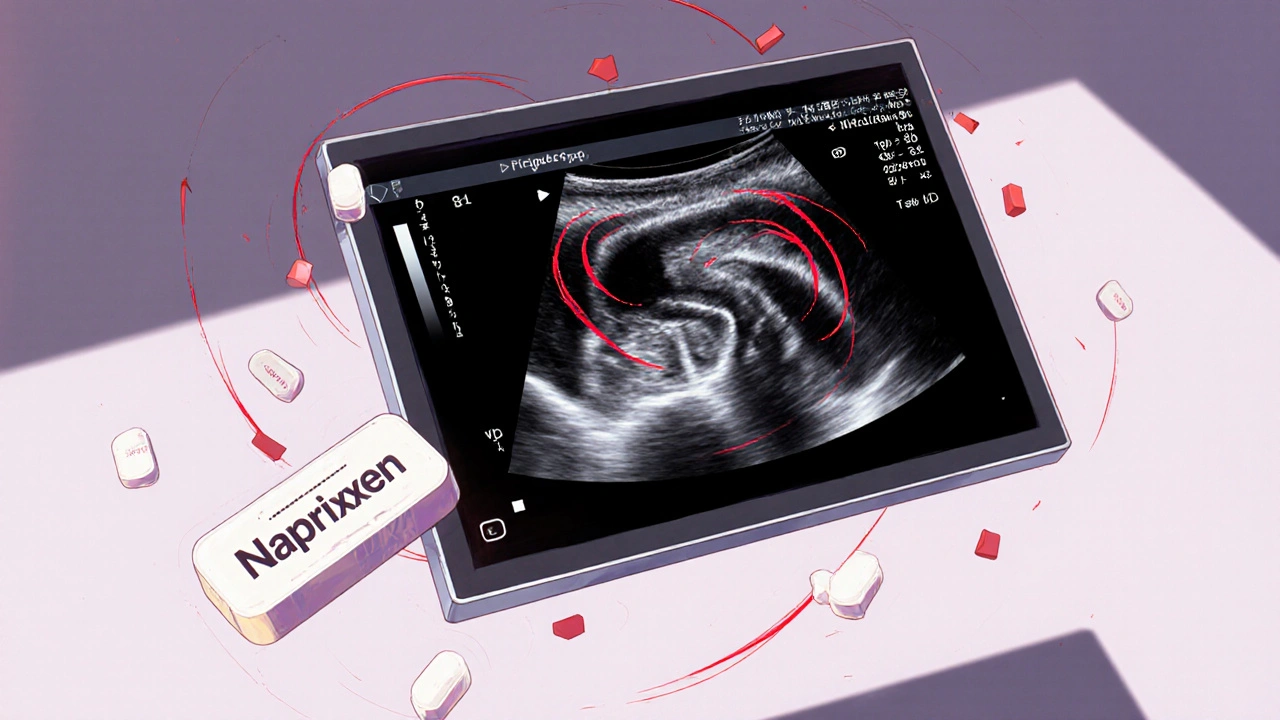
During pregnancy, prostaglandins help keep a key blood vessel in the baby’s heart open: the ductus arteriosus. This vessel lets blood bypass the lungs before birth, since the baby gets oxygen from the placenta. Naproxen can cause this vessel to close too early. When that happens, the baby’s heart has to work harder, and fluid can build up in the lungs. This condition is called premature closure of the ductus arteriosus, and it can lead to pulmonary hypertension or even heart failure in the fetus.
Studies from the Journal of the American Medical Association and the FDA show that using naproxen after 20 weeks increases the risk of this complication by up to 5 times compared to not using it. The risk isn’t small. It’s one of the clearest red flags in prenatal medication safety.
What about before 20 weeks?
Some doctors used to say naproxen was okay in the first trimester. But newer data suggests even early use carries risks. A 2023 study in BMJ reviewed over 1.2 million pregnancies and found a small but significant increase in miscarriage risk among women who took naproxen in the first 12 weeks. The absolute risk was low - about 1 in 50 - but it was higher than with acetaminophen.
Also, NSAIDs like naproxen can reduce amniotic fluid levels. That fluid cushions the baby and helps lungs develop. Low amniotic fluid (oligohydramnios) can lead to limb deformities, lung underdevelopment, or preterm birth. These effects are more common with long-term or high-dose use, but even short courses can trigger them.
Acetaminophen: the safer alternative
If you need pain relief during pregnancy, acetaminophen (Tylenol) is still the go-to option. It doesn’t affect prostaglandins the way naproxen does. It’s been studied in millions of pregnancies over decades. While no drug is 100% risk-free, acetaminophen has the strongest safety record for pregnant women.
Use it wisely: stick to the lowest effective dose for the shortest time. Don’t exceed 3,000 mg per day unless your doctor says otherwise. Avoid combination products like cold or flu meds that contain acetaminophen plus other ingredients you don’t need.
For muscle aches or back pain, try non-medication options: prenatal yoga, heat packs, massage, or physical therapy. Many OB-GYNs now recommend these as first-line treatments.
What if you took naproxen before you knew you were pregnant?
If you took one or two pills before realizing you were pregnant, don’t panic. Single, short-term use before 20 weeks is unlikely to cause harm. The body clears naproxen in about 12-17 hours. It doesn’t build up in your system like some other drugs.
But if you’ve been taking it regularly - say, for chronic migraines, arthritis, or recurring back pain - talk to your provider. They can help you switch to safer options and monitor your pregnancy more closely. You may need an extra ultrasound to check amniotic fluid levels and fetal heart function.
When naproxen might still be used - and only under strict supervision
There are rare cases where a doctor might prescribe naproxen during pregnancy. For example, if a woman has a severe autoimmune disease like lupus and no other drug works, a specialist might weigh the risks. But even then, it’s only used in the first trimester and never after 20 weeks.
These decisions are made by maternal-fetal medicine specialists - not general practitioners. If you’re being prescribed naproxen while pregnant, ask why. Get it in writing. Ask for a second opinion. Don’t assume it’s safe just because a doctor wrote the prescription.
What to do if you’re currently taking naproxen
- Stop taking it immediately if you’re past 20 weeks pregnant.
- If you’re under 20 weeks, talk to your doctor before quitting - especially if you rely on it for a chronic condition.
- Switch to acetaminophen for pain or fever.
- Keep a log of what you’ve taken and when. Bring it to your next appointment.
- Don’t use any OTC painkiller without checking the label. Some cold medicines contain naproxen under different names.

What to look for in your baby’s development
If you used naproxen during pregnancy, your provider may recommend extra monitoring:
- Ultrasounds to check amniotic fluid levels
- Fetal echocardiograms to assess heart function
- Non-stress tests to monitor baby’s heart rate
These aren’t routine for every pregnancy, but they’re standard if NSAID use occurred. Early detection of problems gives your care team more options to help.
Common myths about naproxen and pregnancy
Myth: “It’s fine if I only take it once in a while.”
Truth: Even occasional use after 20 weeks carries risk. There’s no safe threshold.
Myth: “I took it in my first pregnancy and my baby was fine.”
Truth: Past outcomes don’t guarantee future safety. Every pregnancy is different. What was okay once might not be again.
Myth: “Natural remedies are safer than acetaminophen.”
Truth: Many herbal supplements - like willow bark or ginger extracts - can interfere with pregnancy too. Stick to what’s been tested and approved.
Final takeaway
Naproxen isn’t just “not recommended” during pregnancy - it’s actively dangerous after 20 weeks. The evidence is clear, consistent, and backed by global health agencies including the FDA, WHO, and Health Canada. Acetaminophen remains the safest option for pain and fever. Non-drug methods like heat, rest, and physical therapy should be your first line of defense.
If you’re unsure about any medication, don’t guess. Ask your doctor. Bring the bottle. Check the label. When it comes to your baby’s health, it’s better to be cautious than sorry.
Can I take naproxen during the first trimester of pregnancy?
It’s not recommended. While earlier guidelines were less clear, recent studies show even short-term use in the first trimester may slightly increase the risk of miscarriage and birth defects. Acetaminophen is the preferred pain reliever at all stages of pregnancy.
Is naproxen the same as ibuprofen?
They’re both NSAIDs and carry similar risks during pregnancy. Neither is safe after 20 weeks. Ibuprofen also reduces amniotic fluid and can cause premature closure of the fetal heart duct. Avoid both unless directed by a specialist.
What if I accidentally took naproxen after 20 weeks?
Call your doctor right away. A single dose is unlikely to cause harm, but repeated use increases risk. Your provider may order an ultrasound to check amniotic fluid and fetal heart function. Don’t wait for symptoms - early detection matters.
Can I use topical naproxen gel while pregnant?
Topical naproxen gel is absorbed through the skin, but only in small amounts. Still, there’s no proof it’s safe during pregnancy. Health Canada and the FDA advise avoiding all forms of naproxen, including gels and patches, during pregnancy. Use heat or massage instead.
Is it safe to take naproxen while breastfeeding?
Naproxen passes into breast milk in small amounts, and it stays in your system longer than other NSAIDs. While occasional use may be tolerated, it’s not ideal. Acetaminophen or ibuprofen (used sparingly) are better choices for nursing mothers. Talk to your doctor before using naproxen while breastfeeding.





Comments (14)
Hannah Machiorlete
I took Aleve for my back pain last month and just found out I'm pregnant. Now I'm crying in the bathroom. Why didn't anyone tell me this before?
Bette Rivas
Let me clarify something important: the risk of premature ductus arteriosus closure is dose- and duration-dependent. A single 220mg tablet before 20 weeks is not equivalent to chronic use. The BMJ study adjusted for confounders like maternal age, BMI, and comorbidities - the absolute risk increase was 0.8%, not the alarmist 1 in 50 many misinterpret. Acetaminophen remains first-line, but panic is unhelpful. Consult your OB, don't self-diagnose from Reddit.
prasad gali
NSAIDs inhibit COX-2 isoforms critical for fetal vascular development. The FDA's 2020 warning was based on Level 1 evidence from meta-analyses. Oligohydramnios risk increases 3.2x with >7 days of use. You're not being paranoid - you're being pharmacologically literate. Acetaminophen is not risk-free either - it's linked to ASD in some cohort studies - but the benefit-risk profile is still superior. Always document usage.
Mary Follero
Thank you for this. As a nurse who's seen three cases of fetal pulmonary hypertension linked to NSAID use, I can tell you - early detection saves lives. If you took naproxen before knowing, don't spiral. Get an ultrasound. Track fluid levels. Most babies are fine. But ignorance isn't bravery. Knowledge is. Share this with your friends. Seriously - someone you know is scrolling right now thinking it's 'just one pill.'
Arun Mohan
How quaint. You all treat acetaminophen like some divine elixir while ignoring the fact that it crosses the placenta, accumulates in fetal tissue, and has been associated with neurodevelopmental disruption in longitudinal studies. The real issue isn't naproxen - it's the pharmaceutical industry's manipulation of prenatal guidelines to push safer margins for profit. We've been lied to for decades. Wake up.
Jeff Moeller
Life is risk. Every breath we take has a cost. The body isn't a machine to be sanitized. Maybe the ductus arteriosus closing early isn't a flaw - maybe it's a signal. Maybe we're overmedicalizing pregnancy. Maybe the real danger is fear itself.
Tyrone Luton
It's interesting how we treat medication like a moral test. You take naproxen - you're reckless. You take acetaminophen - you're responsible. But what if your pain is chronic? What if your body doesn't respond to alternatives? Who decides what 'safe' means? The FDA? Or the woman whose spine is screaming?
darnell hunter
As a board-certified obstetrician, I must emphasize: the data is unequivocal. Naproxen after 20 weeks is contraindicated. Period. The risk of fetal renal dysfunction, oligohydramnios, and ductal closure is not speculative - it's documented in prospective cohort studies with over 800,000 participants. Any claim that 'occasional use' is safe is dangerously misleading. Acetaminophen remains the only OTC analgesic with a Class A safety profile in pregnancy. No exceptions. No gray areas. This is not a suggestion - it is standard of care.
Tara Stelluti
I took naproxen for 3 weeks before I knew I was pregnant. I had a miscarriage at 8 weeks. I don't know if it was the naproxen or my anxiety or God's plan. But now I can't even look at a painkiller without crying. I feel like I murdered my baby. And everyone says 'it's probably fine' but it's not fine. It's never fine.
Paige Basford
Wait - so topical naproxen gel is also unsafe? I've been using it for my sciatica. I thought since it's on the skin, it wouldn't reach the baby. Is that a myth? I'm so confused now. My OB never mentioned this.
william volcoff
So you're telling me the same drug that helps my arthritis is now a fetal death sentence? And the only alternative is acetaminophen - which, by the way, is linked to ADHD? What am I supposed to do, suffer in silence? This is why people stop seeing doctors. You give us a problem, then take away every tool we have to fix it.
Margaret Wilson
OMG I just checked my medicine cabinet - I have 3 bottles of Aleve. I’ve been taking one every night for my migraines since I got pregnant. I’m literally going to throw them out right now. I feel like a monster. 😭
Will Phillips
They say naproxen is dangerous but they don't tell you the CDC is hiding the truth about fetal heart defects from vaccines. Why are they targeting NSAIDs and not Big Pharma? Who benefits? Who profits? The system is rigged. I didn't take naproxen - I took Tylenol - and my son has autism. Coincidence? I think not.
Abdula'aziz Muhammad Nasir
As a father of two and a community health worker in Lagos, I’ve seen women in rural Nigeria use traditional herbs for pain because they cannot access acetaminophen. The real crisis isn’t naproxen - it’s healthcare inequality. If we want to protect pregnant women, we must first ensure access to safe, affordable medication - not just issue warnings from distant labs.