
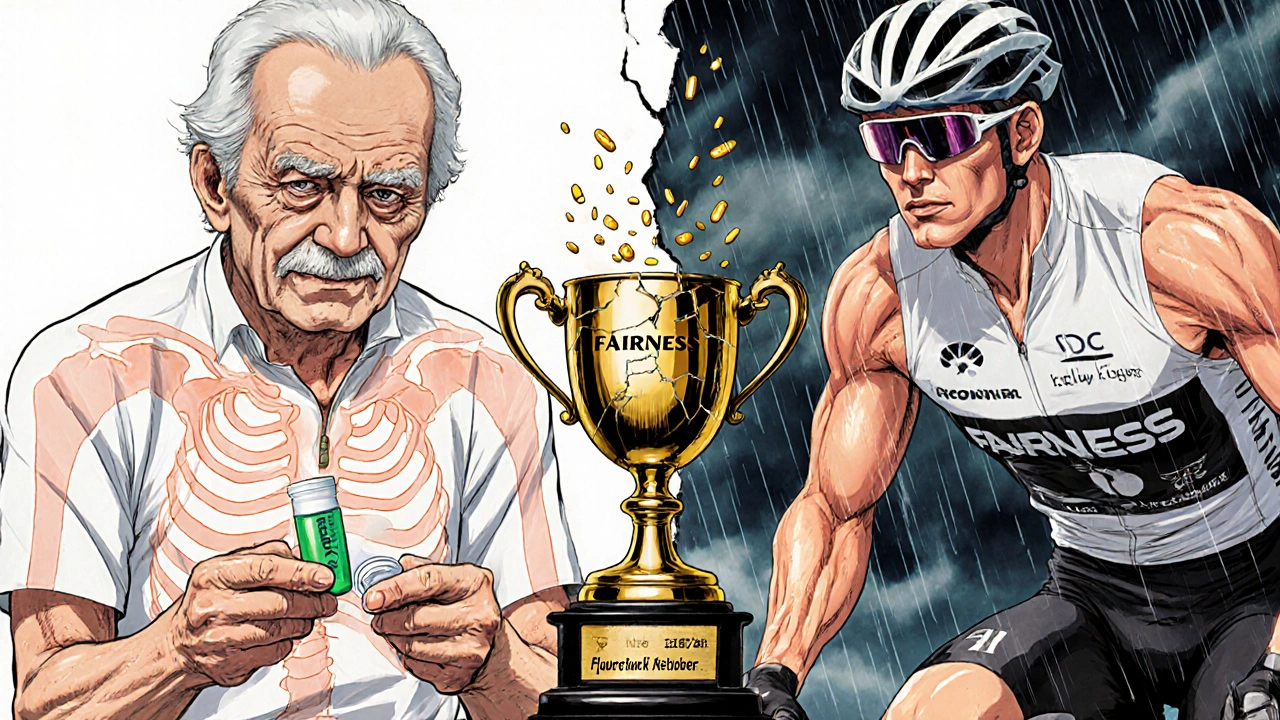
Fludrocortisone isn’t a name you hear at the Olympics or in sports headlines. But behind the scenes, it’s been quietly shaping performance - and stirring up serious ethical questions. This synthetic steroid isn’t used to build muscle like testosterone. It doesn’t make athletes faster in a straight sprint. Yet, in endurance sports, it can be the difference between finishing and folding. And that’s exactly why it’s banned - not because it’s dangerous, but because it’s unfair.
What Fludrocortisone Actually Does
Fludrocortisone is a mineralocorticoid. That means it works on your kidneys, not your muscles. It tells your body to hold onto sodium and water. In simple terms, it helps you retain fluids. For most people, that’s useful if they have Addison’s disease - a condition where the adrenal glands don’t make enough natural steroids. But for athletes? It’s about blood volume.
More fluid in your bloodstream means more oxygen can be carried to your muscles. That’s why endurance athletes - cyclists, marathoners, cross-country skiers - have been drawn to it. A 2018 study in the British Journal of Sports Medicine found that athletes using fludrocortisone increased their plasma volume by up to 12% within 72 hours. That’s like getting a natural blood transfusion without the needle. No one sees it. No one tests for it directly. And until recently, many didn’t even know it was banned.
Why It’s Banned by WADA
The World Anti-Doping Agency (WADA) added fludrocortisone to its prohibited list in 2010. Not because it’s harmful - it’s actually used safely in millions of patients worldwide. But because it gives an artificial advantage. WADA’s rule is simple: if a substance enhances performance and isn’t medically necessary, it’s banned. Fludrocortisone fits that definition perfectly in sports.
Think of it this way: if you’re a cyclist racing up a mountain, your body is fighting dehydration and low blood pressure. Your heart struggles to pump enough blood to your legs. Fludrocortisone fixes that. It doesn’t make you stronger. It just makes your body work better under stress. And that’s the problem. It’s not about training harder. It’s about cheating the body’s natural limits.
The Ethical Gray Zone
Here’s where it gets messy. Some athletes argue they’re just treating a medical condition. Maybe they have low blood pressure naturally. Maybe they sweat too much. Maybe they’re prone to fainting after races. If fludrocortisone is prescribed for that, isn’t it just leveling the playing field?
WADA allows therapeutic use exemptions (TUEs) for exactly this reason. But here’s the catch: there’s no reliable way to prove whether someone’s low blood pressure is natural or artificially created by years of training. Endurance athletes often have lower resting heart rates and blood pressure - that’s normal. So how do you tell if someone needs fludrocortisone or is just trying to game the system?
Take the case of a Canadian cross-country skier who tested positive in 2022. He claimed he had orthostatic hypotension - dizziness when standing up. His doctor prescribed fludrocortisone. He had a TUE. But his plasma volume was 18% higher than the average elite athlete. The anti-doping panel had to decide: was this medicine or manipulation? They suspended him for two years. Not because he was sick. But because his body looked too optimized.

The Slippery Slope of Medical Enhancement
Fludrocortisone isn’t the only drug in this gray area. EPO, caffeine, beta-blockers - all have medical uses and performance effects. But fludrocortisone is unique because it doesn’t feel like cheating. You don’t inject it. You don’t feel a rush. You just feel… normal. That’s what makes it dangerous.
Imagine if every athlete could legally take a pill to increase their blood volume. Would that be fair? Or would it become a race to see who can tolerate the highest dose? That’s not sport. That’s pharmacology.
And it’s not just about fludrocortisone. It’s about where we draw the line. If we allow drugs that fix “natural” conditions, what stops someone from using insulin to recover faster? Or thyroid meds to burn fat? The line between therapy and enhancement is vanishing - and sports are caught in the middle.
How Athletes Get Caught
Fludrocortisone is hard to detect in urine. It breaks down quickly. So WADA doesn’t test for the drug itself. They test for its effect: abnormal blood profiles.
The Athlete Biological Passport (ABP) tracks an athlete’s blood markers over time. If their plasma volume suddenly jumps - especially after a race or during a training camp - it raises a red flag. That’s how most fludrocortisone cases are caught now. Not by finding the drug. By finding the unnatural change.
In 2023, a group of elite triathletes in Europe were flagged because their hemoglobin concentration dropped while their reticulocyte count spiked. That’s a classic sign of fluid dilution - likely from fludrocortisone. They all denied using it. But their data didn’t lie. One athlete admitted to taking it for “low blood pressure.” Another said he was “just trying to stay hydrated.” Neither had a valid TUE.
The Real Cost of Using It
Even if you avoid getting caught, fludrocortisone isn’t harmless. Long-term use can lead to high blood pressure, potassium loss, muscle weakness, and even heart rhythm problems. Athletes who use it without medical supervision often ignore these risks. They think, “I’m healthy. I’ll be fine.” But health isn’t just about not feeling sick. It’s about not breaking down later.
One former professional cyclist, who used fludrocortisone for two seasons before retiring at 28, now has chronic low potassium. He needs daily supplements. He says he didn’t know the long-term cost. “I just wanted to finish the race,” he told a Canadian sports magazine in 2024.
What Should Be Done?
There’s no easy answer. Banning fludrocortisone entirely punishes athletes with real medical needs. Allowing it opens the door to widespread abuse. The current system - TUEs with strict monitoring - is the best we have. But it’s flawed.
Here’s what could help:
- Require athletes to submit full medical histories before getting a TUE - not just a doctor’s note.
- Use AI to analyze blood patterns over time and flag outliers that match fludrocortisone use.
- Publicly explain why certain TUEs are approved. Transparency builds trust.
- Invest in research to find a biomarker that detects fludrocortisone use directly - not just its effects.
The goal isn’t to catch cheaters. It’s to protect the spirit of sport. And that spirit is built on fairness, not chemistry.
Final Thought: Is It Cheating If Everyone Does It?
Some say, “If fludrocortisone is so effective, why isn’t everyone using it?” The answer: because it’s risky, hard to dose right, and easy to get caught. But that’s changing. As detection gets better, so do the workarounds. And as athletes push their bodies harder, the temptation to use anything that helps grows.
Fludrocortisone isn’t the villain. It’s a mirror. It shows us how far we’re willing to go to win - and how thin the line between healing and hacking has become.
Is fludrocortisone banned in all sports?
Yes. Fludrocortisone is prohibited in-competition by the World Anti-Doping Agency (WADA) for all Olympic and professional sports. It’s listed under S4.2 (Other Hormones and Metabolic Modulators). Even if an athlete has a medical reason, they must apply for a Therapeutic Use Exemption (TUE) - and approval isn’t guaranteed.
Can you buy fludrocortisone over the counter?
No. Fludrocortisone is a prescription-only medication in Canada, the U.S., and most countries. It’s not available in pharmacies without a doctor’s authorization. Athletes who use it illegally often obtain it through unregulated online suppliers or by misrepresenting their medical condition to get a prescription.
Does fludrocortisone make you stronger?
Not directly. It doesn’t increase muscle mass or power. Instead, it increases blood volume by helping your kidneys retain sodium and water. This improves circulation and oxygen delivery to muscles - especially helpful in endurance sports. The effect is subtle but measurable: better stamina, less fatigue, faster recovery between efforts.
How long does fludrocortisone stay in your system?
Fludrocortisone has a half-life of about 18-36 hours, meaning it clears from your bloodstream in about two days. But its effects on blood volume can last up to a week. Anti-doping tests don’t look for the drug itself - they look for abnormal changes in your blood profile. That’s why athletes can be caught weeks after stopping use.
Are there natural ways to increase blood volume without drugs?
Yes. Endurance training naturally increases plasma volume over time. Drinking more water, consuming adequate sodium, and training in heat (like saunas or hot weather) can also help. These methods take weeks or months, but they’re legal and safe. Unlike fludrocortisone, they don’t carry the risk of side effects or disqualification.





Comments (13)
Victoria Short
Wow, I just skimmed this and now I’m tired.
Jessica M
Fludrocortisone’s classification under S4.2 by WADA is scientifically sound. The drug alters plasma volume-a measurable physiological variable-thereby creating an artificial advantage that cannot be replicated through training alone. The absence of direct detection does not negate its pharmacological impact; the Athlete Biological Passport was designed precisely to account for such indirect doping methods. Medical exemptions must be held to the highest evidentiary standard, not merely a physician’s note.
Transparency in TUE approvals is not optional-it is foundational to public trust in sport. When an athlete’s plasma volume increases by 18% without a documented history of orthostatic hypotension, the burden of proof shifts. The system is not perfect, but it is the best we have until a direct biomarker is validated.
Comparing this to caffeine or EPO is misleading. Caffeine is a mild stimulant with widespread non-athletic use; EPO directly stimulates erythropoiesis. Fludrocortisone manipulates fluid dynamics in a way that is not naturally achievable through diet or training without extreme, prolonged adaptation. That distinction matters.
The notion that ‘everyone does it’ is a dangerous myth. Most athletes don’t use it because the risks outweigh the marginal gains, and the consequences of detection are career-ending. This isn’t about fairness-it’s about integrity.
Eric Gregorich
Let me tell you something profound: we’ve turned athletes into lab rats in spandex. We don’t care if they’re healthy-we care if they win. Fludrocortisone isn’t the problem. The problem is that we’ve created a system where the human body is seen as a machine that needs tuning, not a miracle that needs respect. We ban the drug because we’re scared of what happens when we stop pretending that sport is pure. It’s not. It never was. We just like the fairy tale.
That Canadian skier? He didn’t cheat. He just stopped believing in the myth that ‘natural’ means ‘better.’ He took a pill to stop feeling dizzy after a race. Is that really doping? Or is it just… surviving in a system that demands you perform beyond human limits?
And let’s be real-how many of us would take it if we could? If you’re climbing a mountain, and someone hands you a magic pill that lets you breathe easier… would you say no? Or would you just say ‘thank you’ and keep going?
We’re not policing doping. We’re policing truth.
Rebekah Kryger
Okay but let’s be real-this is just WADA’s way of controlling the narrative. They don’t want athletes optimizing their physiology because then they’d have to admit that ‘natural’ is a myth. Blood volume manipulation? Please. We’ve been doing this since the 1970s with altitude tents and saline IVs. Fludrocortisone is just the next evolution. The real scandal is that they let you use EPO but ban this? That’s not science-that’s hypocrisy dressed in a lab coat.
And don’t get me started on TUEs. You think the guy with the 18% plasma volume didn’t have a doctor who knew how to write the right letter? Of course he did. The system is rigged. The ‘abnormal’ blood profile? That’s just the new ‘positive test.’ They don’t need the drug-they just need a curve that looks suspicious.
Meanwhile, the real dopers are out there using gene therapy and designer peptides no one’s even testing for. But hey, let’s ban a steroid that’s prescribed to people with Addison’s. That’s the fight we’re choosing.
Koltin Hammer
This whole debate is a mirror. We don’t hate fludrocortisone. We hate what it reveals about us. That we’ve outsourced our limits to chemistry. That we’ve stopped trusting sweat and started trusting pills. That we’ve turned sport into a contest of who can best manipulate biology without getting caught.
There’s a quiet beauty in endurance sports-the raw, unvarnished struggle against gravity, time, and fatigue. Fludrocortisone doesn’t make you faster. It makes you less tired. And that’s the real sin: it removes the suffering. But isn’t suffering what we’re watching for? Isn’t that the drama? The grit? The humanity?
I don’t know if it’s cheating. But I know this: when I watch a cyclist climb a mountain, I want to see them break. Not because they’re strong-but because they’re human. And fludrocortisone? It lets them stay whole.
Maybe the real question isn’t whether it’s banned. Maybe it’s whether we still want to watch athletes who need help just to finish.
Phil Best
Oh my god, someone finally wrote about this. I’ve been screaming into the void about this for years. Fludrocortisone is the quiet assassin of endurance sports. No buzz. No needles. Just a little pill that says, ‘Hey, your body’s failing? Here’s a Band-Aid made of sodium.’
And yet? We act like it’s the devil. Meanwhile, athletes are chugging electrolyte drinks like they’re energy drinks and calling it ‘natural hydration.’ Same effect. Different label. The hypocrisy is staggering.
Let’s be real-if you can train in a sauna for 45 minutes a day to increase plasma volume, that’s fine. But take a pill that does the same thing in 24 hours? That’s ‘doping.’
WADA doesn’t want to catch cheaters. They want to preserve the illusion that sport is pure. Spoiler: it’s not. And pretending otherwise is the real betrayal.
Parv Trivedi
As someone from India where endurance running is growing rapidly, I find this discussion deeply important. Many young athletes here train in extreme heat with little access to medical care. They don’t know about fludrocortisone-but they suffer from dehydration and fainting after races.
Instead of banning, we should educate. We should create affordable, accessible medical support for athletes who truly need it. A TUE should not be a privilege for the wealthy or well-connected. It should be a right for anyone who needs it.
Let’s not punish the sick. Let’s fix the system that leaves them vulnerable to exploitation.
And yes-natural methods like heat training and hydration work. But they take time. And in competitive sports, time is often the one thing you don’t have.
Willie Randle
Let’s clarify one thing: fludrocortisone is not performance-enhancing in the way people think. It doesn’t give you more strength or speed. It gives you stability. For athletes with low blood pressure, it’s the difference between collapsing and competing. That’s not cheating-that’s medical necessity.
The real issue is the lack of clear, standardized criteria for TUEs. Right now, it’s a gray zone where doctors and panels guess. We need objective biomarkers-baseline blood profiles, longitudinal data, genetic predisposition records. That’s how we separate medical need from manipulation.
And we need to stop calling athletes who use it ‘cheaters’ unless we can prove intent. Many don’t even know they’re breaking rules. They just want to finish the race without blacking out.
Let’s fix the system. Not the athletes.
Connor Moizer
You’re all overthinking this. Fludrocortisone is a cheat. Period. If you need it to finish a race, you’re not an athlete-you’re a patient. And if you’re a patient, go get treated. Don’t go compete in the Olympics.
Endurance sports are about pushing your body past its limits. Not fixing them with a pill. If you can’t handle the heat, don’t race in the heat. If you can’t hold your blood pressure, don’t be a pro athlete. Simple as that.
Stop crying about ‘fairness.’ Sport isn’t fair. It never was. You train harder, you win. You take a pill, you get banned. That’s the rule. Learn it. Follow it. Or get out.
kanishetti anusha
I’ve been a distance runner for 12 years. I’ve trained in 40°C heat, drank saltwater after races, slept in altitude tents. I never took fludrocortisone. But I know athletes who did-and they looked different. Not faster. Just… steadier. Like they weren’t fighting their own bodies anymore.
I’m not angry. I’m sad. Because I used to believe sport was about grit. Now I wonder if it’s just about who has the best doctor.
Maybe the answer isn’t more bans. Maybe it’s more support. More access. More understanding. Not every athlete has the luxury of training in a lab. Some just need to survive the race.
roy bradfield
This is all a cover-up. Fludrocortisone is banned because the pharmaceutical companies that make blood tests and detection kits are owned by the same people who run WADA. They don’t want you to know that the real doping is in the labs-not the athletes’ medicine cabinets.
The Athlete Biological Passport? A scam. They track your blood like a GPS. They don’t care if you’re healthy-they care if you’re profitable. If your numbers look ‘off,’ they suspend you. If they look ‘perfect,’ you get a medal and a sponsor deal.
And the TUE system? That’s how insiders get away with it. The Canadian skier? He was targeted because he didn’t have the right connections. The ones with the right doctors? They’re still winning.
They don’t ban fludrocortisone because it’s unfair. They ban it because they can’t control it. And control is the only thing they care about.
Erika Lukacs
Is it cheating to use a drug that mimics a physiological adaptation we already accept as normal? If endurance training increases plasma volume, and fludrocortisone does the same in 72 hours-is the difference one of time, or of essence? Perhaps the real ethical violation is not the drug, but our refusal to acknowledge that biology is malleable, and that ‘natural’ is a social construct.
What if the future of sport is not about who has the strongest heart, but who has the most intelligently managed physiology? Would that be a tragedy-or an evolution?
Koltin Hammer
That last comment… that’s the quiet truth. We’re not fighting over a pill. We’re fighting over what we believe sport should be. Do we want heroes who bleed, sweat, and break? Or do we want perfect machines that never falter?
Fludrocortisone doesn’t make you a better athlete. It makes you a more consistent one. And consistency is the new dominance.
Maybe the real question isn’t whether it’s banned. Maybe it’s whether we still want to watch humans-or just their optimized shadows.