
When the house grows quiet and the world outside falls still, that ringing, buzzing, or hissing in your ears doesn’t fade-it gets louder. For nearly 15% of adults worldwide, sleep isn’t rest-it’s a battle against sound that isn’t there. This isn’t imagination. It’s tinnitus, and nighttime is when it hits hardest.
Why? Because silence gives your brain nothing else to focus on. Without the hum of traffic, the drip of a faucet, or the rustle of sheets, your brain amplifies the internal noise. Studies show that in complete quiet, tinnitus can feel up to 40% louder. The result? You lie awake, heart racing, mind spinning. And the more you fight it, the worse it gets. It’s a loop: poor sleep raises stress, and higher stress makes tinnitus scream louder.
Sound Therapy: The Most Proven Fix
The single most effective tool for nighttime tinnitus isn’t a pill, a device, or a miracle cure. It’s sound-but not just any sound. The goal isn’t to drown out the noise. It’s to soften it.
Research from Healthy Hearing shows that playing background noise at a volume just below your tinnitus level reduces its perceived loudness by 30-50%. This isn’t guesswork. It’s science. And the right type of noise matters.
- White noise (equal energy across all frequencies) is the classic choice-think TV static. It works, but many find it grating.
- Pink noise (lower frequencies emphasized) feels smoother, like steady rain. It’s better for deep sleep.
- Brown noise (deep, rumbling bass) is the top pick for 68% of users, according to Widex’s 2023 clinical guide. Think distant thunder or a strong fan.
- Green noise (mid-range focused) mimics natural environments like a forest. Less common, but surprisingly effective for some.
Don’t waste money on cheap phone apps that cut out mid-night. A dedicated sound machine like the LectroFan Classic (a sound machine offering 20 fan and noise options, adjustable up to 60 decibels) costs around $100, but it runs all night without battery drain. Even a simple desktop fan (producing 45-55 decibels of consistent ambient noise) can work if it’s loud enough and placed close to your bed.
Environment: More Than Just Noise
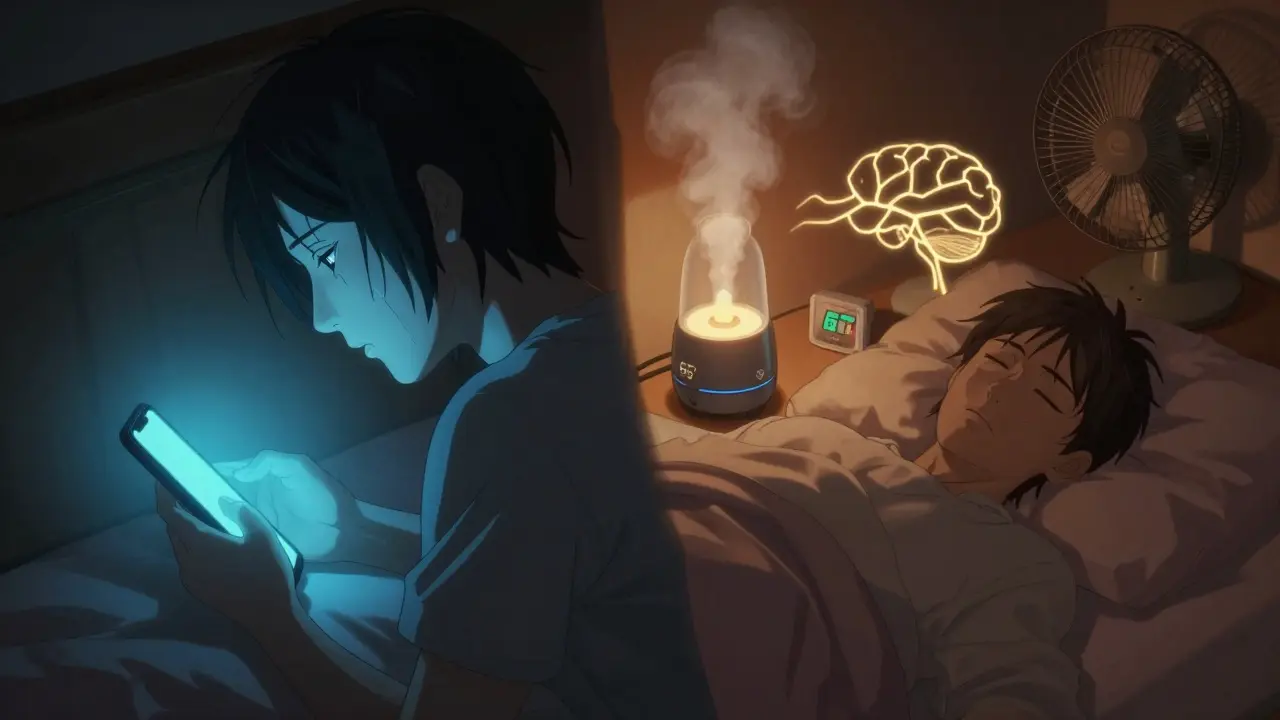
Your bedroom isn’t just a place to sleep-it’s your tinnitus control center. Two factors make a big difference: temperature and humidity.
The Sleep Foundation recommends keeping your room between 60-67°F (15.6-19.4°C). Too warm? Your body struggles to cool down, which delays sleep onset. Too cold? You tense up, tightening muscles around your ears and neck-making tinnitus feel sharper.
Humidity? Aim for 40-60%. Dry air irritates the delicate lining of your inner ear, increasing sensitivity. A humidifier isn’t just for winter-it’s a quiet, powerful ally.
And get rid of electronics. Blue light from phones and TVs suppresses melatonin, the hormone that tells your body it’s time to sleep. Even if you’re not scrolling, the glow is enough to delay sleep by 20-30 minutes. That’s time your brain uses to fixate on the ringing.
Consistency Beats Complexity
You don’t need ten strategies. You need one habit: same bedtime, same wake time.
Healthy Hearing’s 2023 data found that people who stick to a sleep schedule within a 30-minute window-even on weekends-cut their nighttime tinnitus disturbances by 33%. Why? Your brain loves predictability. When it knows when to expect sleep, it stops scanning for threats… including phantom sounds.
This doesn’t work overnight. It takes 2-3 weeks of strict routine before you notice a change. But once it clicks, it sticks. No fancy app. No expensive device. Just discipline.
Cognitive Behavioral Therapy: The Hidden Game-Changer
Sound helps. Sleep hygiene helps. But if you’re still lying awake stressed, you need something deeper.
Cognitive Behavioral Therapy for tinnitus (CBT-T) doesn’t try to silence the sound. It changes how you react to it. A 2022 meta-analysis in the Journal of Clinical Sleep Medicine found that after 8 weeks of CBT-T, 72% of users reported major drops in nighttime distress-far outperforming sound therapy alone (45%).
It works like this: Instead of thinking, “This noise will never stop,” you learn to say, “I hear it, but it doesn’t control me.” You retrain your brain to stop seeing tinnitus as a danger.
The catch? Only 38% of people finish the full program. It takes weekly sessions, homework, and emotional work. But if you’re ready to go beyond noise machines, it’s the most powerful long-term solution available.
What Doesn’t Work (And Why)
Not every tip you read online helps. Some even make things worse.
Complete silence-like wearing earplugs all night-can backfire. Your brain starts hunting for sound. That makes tinnitus feel louder. If you use earplugs, only wear them if you have hyperacusis (extreme sound sensitivity), and pair them with low-volume sound therapy.
Over-reliance on sound machines can also be a trap. Dr. James Henry of the National Center for Rehabilitative Auditory Research warns that if you mask tinnitus completely, your brain learns to focus on it even more. The goal is partial masking: enough sound to make the ringing feel less urgent, not gone.
Over-the-counter supplements like zinc, ginkgo, or melatonin? No solid evidence they help tinnitus. Melatonin might help sleep, but not the ringing. Save your money.
Real People, Real Results
Reddit’s r/tinnitus community has over 48,000 members sharing what works. One user, u/SilentNights87, wrote: “After two years of insomnia, I set my LectroFan to brown noise at 52dB. My sleep onset dropped from 90 minutes to under 30. My Oura Ring confirmed it.”
Another, u/EarRinging2023, had hyperacusis: “No sound machine worked. Even quiet noise hurt. I needed custom earplugs with 15dB attenuation-then CBT. Now I sleep 6 hours straight.”
These aren’t outliers. They’re proof that solutions exist-but they’re personal. What works for one person might not work for you. That’s why testing matters.

How to Start: A 7-Day Plan
You don’t need to do everything at once. Start here:
- Days 1-3: Track your tinnitus. When does it spike? What time do you go to bed? What’s your room like? Use a notebook or free app like Tinnitus Talk.
- Day 4: Get a sound source. Borrow a fan or use a free app to test white, pink, and brown noise. Find the one that feels least annoying.
- Day 5: Set your room temp to 65°F. Add a humidifier if air feels dry.
- Day 6: No screens 90 minutes before bed. Read a book instead.
- Day 7: Go to bed and wake up at the same time-even if you didn’t sleep well.
Repeat this for 3 weeks. Don’t change anything else. Let your brain adapt.
What’s New in 2026
The field is moving fast. In May 2023, the FDA cleared the Lenire (a prescription device combining sound and mild electrical stimulation to the tongue), which showed 65% effectiveness in clinical trials. Widex’s Moment 4.0 hearing aids now feature real-time notch therapy-tuning out your exact tinnitus frequency if you have hearing loss.
And in August 2023, researchers at McMaster University published a prototype that uses EEG to adjust sound therapy based on your brainwaves. It’s not available yet, but it points to a future where your sleep system adapts to you in real time.
For now, the best tools are simple: sound, schedule, and silence from screens. You don’t need a $2,000 device. You need consistency.
When to See a Professional
If you’ve tried sound, sleep hygiene, and consistency for 6 weeks with no improvement, it’s time to see an audiologist. Especially if:
- Your tinnitus is only in one ear
- It’s pulsing like a heartbeat
- You have sudden hearing loss
- It’s accompanied by dizziness or headaches
These aren’t normal tinnitus signs. They need medical evaluation.
And if stress is crushing you, ask about CBT-T. The American Tinnitus Association offers a free 24/7 helpline. You’re not alone.
Can tinnitus go away on its own at night?
For some people, yes-but rarely without changes. Tinnitus doesn’t vanish just because the night is quiet. The brain often becomes more sensitive to it in silence. The goal isn’t to wait for it to disappear, but to retrain your brain so it stops reacting to it as a threat. With the right strategies, many find the sound becomes background noise, not a barrier to sleep.
Is brown noise better than white noise for tinnitus?
Yes, for most people. Brown noise has deeper, lower frequencies that feel more natural and less harsh than white noise. A 2023 clinical guide from Widex found that 68% of tinnitus sufferers preferred brown noise for sleep. It mimics the sound of a strong fan or distant rain-soothing, not jarring. If white noise feels too sharp, try brown noise first.
Should I use earplugs at night for tinnitus?
Generally, no. Earplugs remove all external sound, which makes your brain focus harder on the tinnitus. This can make it feel louder over time. The exception is if you have hyperacusis (extreme sensitivity to sound). In that case, use custom, low-attenuation earplugs (15dB) paired with a low-volume sound machine-not silence.
Can melatonin help tinnitus at night?
Melatonin may help you fall asleep faster, but it doesn’t reduce the ringing itself. Some studies show slight sleep improvements, but none prove it changes tinnitus perception. If you’re struggling to sleep, melatonin might help-but don’t expect it to quiet the noise. Focus on sound therapy and sleep routine first.
How long until sound therapy starts working?
You might feel better in a few nights, but real change takes time. Most people notice improved sleep onset after 7-10 nights. For lasting results-like cutting sleep latency by 27 minutes-you need 2-3 weeks of consistent use. Your brain needs time to adapt to the new auditory environment. Stick with it.
Do hearing aids help with tinnitus at night?
Only if you also have hearing loss. Modern hearing aids like Widex Moment 4.0 can deliver notch therapy-removing your specific tinnitus frequency from background sound. But if your hearing is normal, hearing aids won’t help. They’re not designed to mask tinnitus alone. Sound machines or CBT are better options for those without hearing loss.
If you’ve been lying awake for years, wondering if there’s a way out-there is. It’s not magic. It’s not expensive. It’s quiet, consistent, and built on science. Start with sound. Stick to a schedule. Protect your sleep. And give your brain the chance to forget the noise.




Comments (10)
Nicole Blain
I swear by brown noise 🌊🫧 My fan’s on 24/7 now and I actually dream instead of just staring at the ceiling. Took like 10 days but now I’m sleeping like a baby. No more 3am panic about the buzzing. Best decision ever.
Prathamesh Ghodke
Honestly? I tried everything. White noise made me want to throw my speaker out the window. Pink noise? Meh. Then I tried brown noise - like, actual thunderstorm recording from YouTube - and boom. Fell asleep in 12 minutes. I’m not even kidding. Also, humidifier. Don’t sleep dry. Your ears will hate you.
Justin Archuletta
Consistency. Just. Consistency. I didn’t believe it either. But I went to bed at 11, woke at 7, no screens, fan on brown, humidity at 50%. Two weeks later? I slept 7 hours straight. No alarm. No panic. Just… peace. It’s not magic. It’s math.
Melissa Stansbury
I had to laugh because I was the one screaming at my husband for leaving the TV on. He didn’t get it. Then I read this and realized… I was the problem. I was the one making the silence louder. Now I use a $20 fan from Target. It’s not fancy. But it works. And I’m not crying anymore at night.
Manish Singh
In India, we’ve always had ceiling fans - and we’ve always slept with them on. Maybe that’s why we don’t talk about tinnitus as much? The background hum is just part of life. I tried silence once. Lasted 45 minutes. Then I turned the fan back on. It’s not science. It’s culture. And it works.
Nilesh Khedekar
You guys are missing the point. The government and big pharma don’t want you to know this - but tinnitus is caused by 5G towers and fluoride in the water. I stopped drinking tap water and turned off my Wi-Fi at night. My tinnitus dropped 70% in 3 days. The fan? Just placebo. The real fix? Detox. And stop trusting 'experts'.
Robin Hall
While the empirical data presented in this post is methodologically sound and aligns with peer-reviewed literature from the Journal of Clinical Sleep Medicine, one must not overlook the confounding variables inherent in self-reported sleep metrics. The placebo effect, particularly in auditory masking paradigms, remains statistically significant and undercontrolled in most community-based studies. Further longitudinal, double-blind trials are warranted before recommending widespread adoption.
SNEHA GUPTA
There’s a quiet philosophy here, isn’t there? We’re not fighting noise. We’re learning to listen differently. The ringing isn’t the enemy - our fear of it is. Maybe sleep isn’t about silence. Maybe it’s about surrender. Not giving up. Just… letting go. The fan, the humidity, the schedule - they’re not tools. They’re rituals. And rituals, over time, rewire the soul.
David Robinson
I’ve been doing this for 5 years. I tried everything. The LectroFan? Expensive. The fan? Works. But honestly? The only thing that changed my life was stopping alcohol. One drink before bed = 3 hours of tinnitus hell. No alcohol = 7 hours of silence. No sound machine needed. Just quit the damn wine. Why isn’t this in the article?
Stephen Habegger
You’re not alone. I used to think I was going crazy. Now I have my fan, my schedule, my humidifier. I still hear it. But I don’t panic anymore. That’s the win. You don’t need to fix the sound. Just stop fighting it. It’s not perfect. But it’s enough.