
When your body makes too much prolactin, it doesn’t just mess with your periods or milk production. It can quietly steal your mood, your sleep, and your sense of self. Hyperprolactinaemia-high levels of the hormone prolactin-is often dismissed as a reproductive issue. But for many people, the real struggle isn’t infertility or irregular cycles. It’s the crushing fatigue, the unexplained sadness, and the constant worry that won’t go away-even when doctors say everything else is normal.
What Exactly Is Hyperprolactinaemia?
Prolactin is a hormone made by the pituitary gland, tucked at the base of your brain. Its main job is to trigger breast milk after childbirth. But it also talks to your brain, your ovaries, your testes, and your stress system. Normal levels are low in men and non-pregnant women-usually under 20 ng/mL. When levels climb above 25 ng/mL consistently, that’s hyperprolactinaemia.
It’s not rare. Studies show up to 1 in 5 women with unexplained infertility have high prolactin. Men are less likely to notice symptoms until they’re hit with low sex drive, breast tenderness, or erectile dysfunction. But the psychological side? That’s often overlooked.
Depression Isn’t Just ‘In Your Head’-It’s in Your Hormones
People with hyperprolactinaemia are two to three times more likely to be diagnosed with clinical depression than those with normal levels. Why? Prolactin interferes with serotonin and dopamine, the brain’s natural mood stabilizers. High prolactin doesn’t just make you feel sad-it dulls your ability to feel joy, even in things you used to love.
One 2023 study tracked 127 patients with prolactin levels over 40 ng/mL. Nearly 68% met the criteria for major depressive disorder. What stood out? Their depression didn’t improve with talk therapy alone. It lifted only after prolactin levels dropped-with medication like cabergoline or bromocriptine. That’s not coincidence. That’s biology.
Many patients describe it as a fog. Not just tired. Not just down. But emotionally numb. They cry for no reason. They stop calling friends. They lie in bed for hours, unable to get up-even though they know they should. It’s not laziness. It’s neurochemical disruption.
Anxiety Doesn’t Come From Stress-It Comes From Your Pituitary
High prolactin doesn’t just cause depression. It fuels anxiety too. People report panic attacks, racing thoughts, and a constant sense of dread. Even when life is calm, their body feels like it’s under threat.
Research shows prolactin activates the hypothalamic-pituitary-adrenal (HPA) axis-the system that controls your stress response. When prolactin is too high, your HPA axis stays stuck in overdrive. Your cortisol stays elevated. Your heart races. Your muscles tighten. You can’t relax, even when you’re asleep.
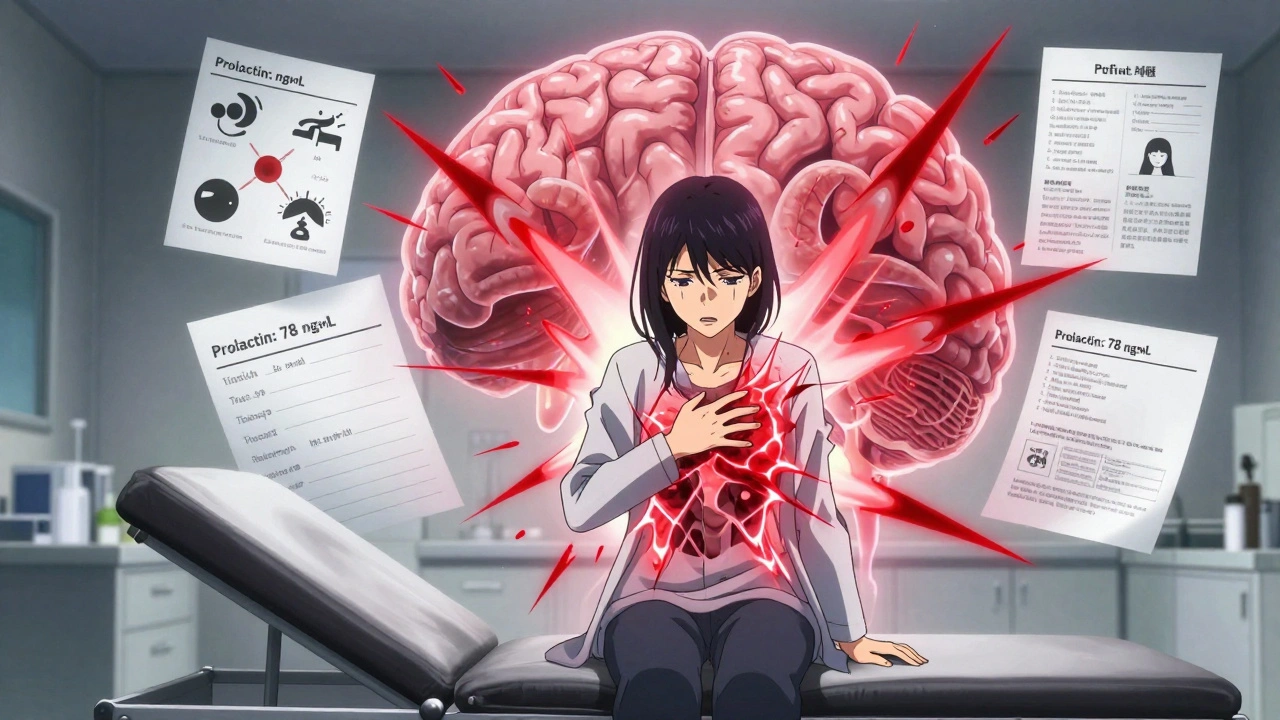
One woman in her early 30s, diagnosed after years of panic attacks and missed work, told her doctor: ‘I thought I was losing my mind. I checked my credit card statements to see if I was being robbed. I called my mom three times a day just to hear her voice. I didn’t know why I felt so unsafe.’ Her prolactin was 78 ng/mL. After three months of treatment, her panic attacks stopped. She didn’t need therapy. She just needed her hormone levels fixed.
Other Psychological Symptoms No One Talks About
Depression and anxiety are the big ones. But hyperprolactinaemia also shows up in subtler ways:
- Brain fog: Trouble remembering names, losing track of conversations, forgetting where you put your keys. This isn’t aging. It’s hormonal.
- Sleep disruption: Insomnia or waking up exhausted, even after 8 hours. Prolactin spikes at night-too much of it throws off your deep sleep cycles.
- Low motivation: You used to run marathons. Now you can’t even muster energy to walk the dog. Your dopamine is suppressed.
- Emotional volatility: Sudden anger, crying fits, feeling overwhelmed by small things. Your brain’s emotional regulators are out of sync.
These symptoms often get mislabeled as ‘stress,’ ‘burnout,’ or ‘mental weakness.’ But they’re physical. They’re measurable. And they’re treatable.
What Causes High Prolactin?
Not all cases are the same. The cause changes how you treat it-and how fast your mood improves.
- Prolactinoma: A benign tumor on the pituitary gland. It’s the most common cause. Tumors under 1 cm (microadenomas) often respond well to medication. Larger ones may need surgery.
- Medications: Antidepressants (especially SSRIs), antipsychotics, blood pressure drugs like verapamil, and even some stomach meds (like metoclopramide) can raise prolactin.
- Thyroid problems: Underactive thyroid (hypothyroidism) triggers the pituitary to overproduce prolactin as a side effect.
- Chronic stress: Long-term stress can nudge prolactin up, especially if you’re already sensitive.
- Physical irritation: Chest wall injuries, shingles on the chest, or even tight bras can stimulate prolactin release.
If you’re on antidepressants and suddenly feel worse-emotionally flat, anxious, or weepy-ask your doctor to check your prolactin. It might not be the medication failing. It might be the medication causing the problem.
How to Test and Diagnose It
There’s no single symptom that screams ‘hyperprolactinaemia.’ But if you have three or more of these, get tested:
- Unexplained depression or anxiety that doesn’t respond to therapy or meds
- Irregular periods or no periods (in women)
- Low sex drive or erectile dysfunction (in men)
- Breast milk when not pregnant or nursing
- Headaches or vision changes (signs of a pituitary tumor)
The test is simple: a blood draw in the morning, before eating, after 10 minutes of rest. Stress and exercise can spike prolactin temporarily, so timing matters. If your level is over 25 ng/mL, your doctor should repeat it. If it stays high, they’ll likely order an MRI to check for a tumor.
Treatment That Fixes More Than Just Hormones
The good news? Most cases of hyperprolactinaemia respond quickly to treatment.
Cabergoline is the first-line drug. It’s taken twice a week. In studies, it lowers prolactin by 70-90% within weeks. And mood improves fast. One patient reported feeling ‘like herself again’ after just 10 days. Her depression scores dropped by 60% in six weeks.
Bromocriptine is older and has more side effects-nausea, dizziness, low blood pressure. But it works too.
If a tumor is found, medication still comes first. Surgery is only needed if the tumor is pressing on your optic nerve or doesn’t shrink with drugs.
And if your high prolactin is from a medication? Sometimes switching drugs fixes everything. For example, switching from an SSRI like sertraline to bupropion (which doesn’t raise prolactin) can lift depression without losing the benefits of treatment.

What Happens If You Ignore It?
Leaving hyperprolactinaemia untreated doesn’t just mean ongoing sadness. Over time, high prolactin can:
- Lower bone density, increasing fracture risk
- Reduce estrogen or testosterone, leading to long-term sexual dysfunction
- Worsen anxiety into panic disorder or agoraphobia
- Trigger or deepen depression to the point of suicidal thoughts
It’s not a ‘minor’ hormonal quirk. It’s a systemic issue with mental health consequences that can last for years if missed.
When to See a Doctor-Right Now
If you’ve been struggling with:
- Depression that won’t lift, even with therapy and meds
- Anxiety that feels physical-heart racing, chest tightness, dizziness
- Unexplained fatigue, brain fog, or loss of libido
- Any breast discharge, missed periods, or erectile issues
-ask for a prolactin blood test. Don’t wait. Don’t assume it’s ‘just stress.’
Many people spend years going from therapist to therapist, trying new antidepressants, doing yoga, meditating, journaling-while their hormone levels keep poisoning their mood. Fix the hormone, and sometimes, the mind heals on its own.
What to Ask Your Doctor
Bring this list to your appointment:
- ‘Can my prolactin level be checked?’
- ‘Could any of my medications be raising it?’
- ‘If it’s high, what’s the next step-an MRI?’
- ‘If it’s a tumor, is it small enough to treat with pills?’
- ‘How long until I might feel better if we treat this?’
Doctors aren’t always trained to connect mood symptoms with prolactin. But if you ask clearly, you’ll get answers.



Comments (12)
Bonnie Youn
OMG I was diagnosed with this last year and no one believed me until my prolactin hit 82
They thought I was just depressed from work
Turns out my brain was drowning in hormones
Cabergoline changed my life like flipping a switch
I cried for three days straight but it was the good kind of crying
Finally felt like me again
Stop blaming yourself if meds aren’t working
Check your prolactin
Charlotte Collins
The clinical data here is compelling but the framing is dangerously reductive
It implies a biological determinism that absolves systemic neglect of mental health care
Yes prolactin matters but so does access to care insurance and trauma history
Reducing complex emotional suffering to a single hormone is not science it’s pharmaceutical marketing dressed as empowerment
Margaret Stearns
I had this too and my doctor dismissed it for two years
I kept saying I felt like my brain was wrapped in cotton
Finally got tested after I started leaking milk from my nipples
Turns out I had a microadenoma
Cabergoline fixed everything in six weeks
Thank you for writing this I wish I’d seen it sooner
amit kuamr
In India we dont have this problem because we dont overmedicalize everything
Women cry because life is hard not because of some hormone
Men dont get breast milk from stress
Stop making weak minds feel like they have disease
Just breathe and work harder
Scotia Corley
While the physiological correlation between elevated prolactin and mood dysregulation is statistically significant in controlled cohorts, the causal inference remains confounded by comorbid psychosocial variables including socioeconomic status, sleep hygiene, and medication adherence profiles.
Furthermore, the generalizability of the cited 2023 study is limited by its exclusion of male participants beyond libido metrics.
Caution is advised before endorsing pharmacological intervention as first-line for mood symptoms without comprehensive endocrine and psychiatric evaluation.
elizabeth muzichuk
How DARE you say this is treatable
What about people who can’t afford cabergoline
What about those whose doctors won’t test them
What about the ones who’ve been told they’re just crazy for 10 years
You make it sound like it’s easy
Like if you just asked the right question you’d be fixed
But most of us are still suffering
And you’re just another person with a blog telling us to fix ourselves
Kelly Essenpreis
Bro prolactin is just a scam to sell drugs
My cousin in Canada had high levels and she just started doing yoga and now she’s fine
Stop pushing pharma nonsense
Also why is everyone in this post white
Is this only a problem for Americans
Alexander Williams
The HPA axis dysregulation secondary to hyperprolactinemic states is a well-documented neuroendocrine phenomenon, particularly in the context of dopaminergic inhibition at the tuberoinfundibular pathway.
However, the therapeutic efficacy of dopamine agonists in mood modulation remains heterogenous due to receptor subtype specificity and blood-brain barrier permeability variances.
Further longitudinal fMRI studies are required to elucidate the neuroplastic changes associated with prolactin normalization.
Suzanne Mollaneda Padin
I’m a nurse in rural Maine and I’ve seen this over and over
Women come in with fatigue brain fog and panic attacks
Doctors give them SSRIs and tell them to meditate
They don’t even check prolactin
Then they get better after we run the test
I keep copies of this article to hand out
Thank you for giving us language for something we’ve been fighting silently
Erin Nemo
This is literally my life story.
Amber-Lynn Quinata
I’m so glad someone finally said this
But why does it take so long to get tested
I had to beg my doctor for 18 months
And when I finally got the results
I cried because I realized I wasn’t broken
I was just poisoned by my own body
And now I’m on cabergoline and I feel like I’ve been given back my soul
❤️
Lauryn Smith
Thank you for writing this with so much care
I’ve been reading about this for years but never found something that explained it so clearly
I’m sharing this with my sister who’s been depressed for three years
She’s going to her doctor next week to ask for the test
And if she’s diagnosed
I’ll go with her
Because no one should have to fight this alone