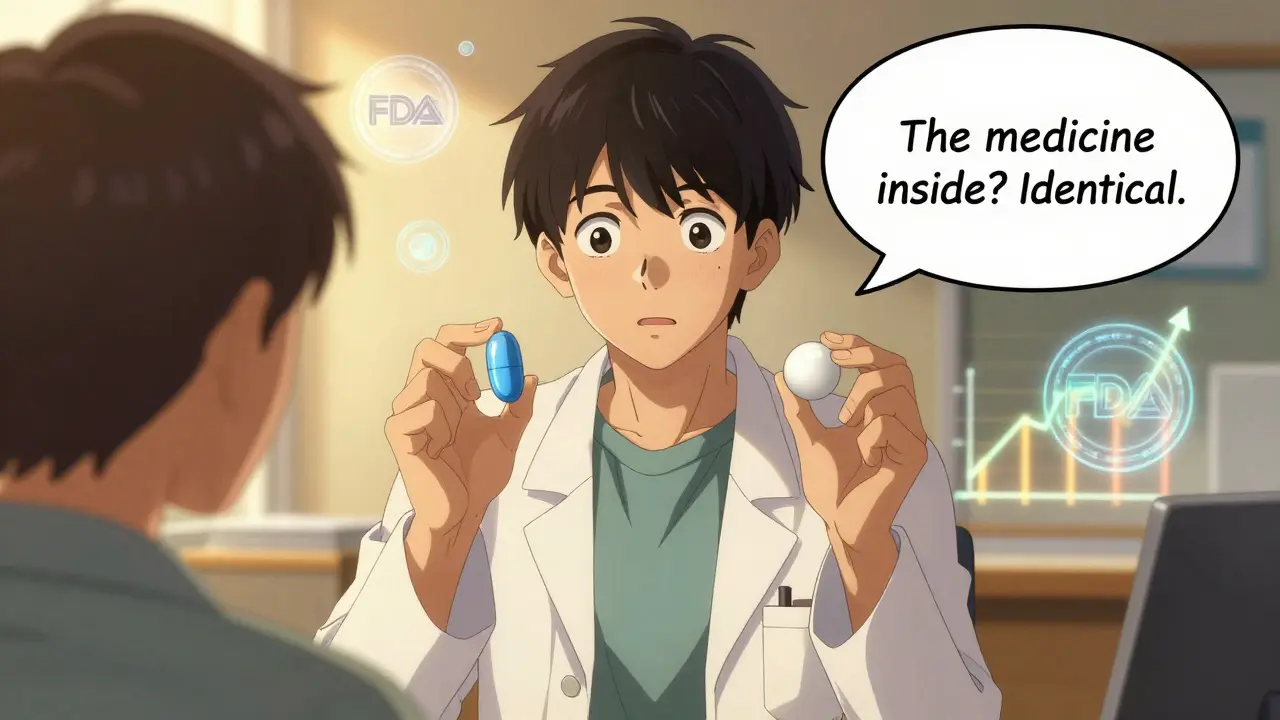
When a patient picks up a prescription and sees a pill that looks completely different from what they’ve been taking, confusion is inevitable. They might wonder: Is this the same drug? Is it weaker? Will it make me sick? These questions aren’t just about curiosity-they’re about safety, trust, and whether the patient will even take the medicine at all. For pharmacists, counseling on generic medications isn’t optional. It’s a legal requirement, a clinical necessity, and one of the most impactful moments in patient care.
Why Generic Counseling Matters More Than You Think
Generic drugs make up over 90% of all prescriptions filled in the U.S., yet they account for less than 24% of total drug spending. That’s because they’re just as effective as brand-name drugs-but many patients don’t believe it. A 2023 Consumer Reports survey found that 43% of patients think generics are less effective, 37% believe they cause more side effects, and 28% think they take longer to work. These aren’t just myths-they’re barriers to treatment. One patient on Reddit shared that they stopped taking their blood pressure medication for two weeks because the generic pill looked different. They thought it was a mistake, not a substitution. Another patient said their pharmacist showed them side-by-side pictures of the brand and generic versions. That one-minute conversation prevented them from throwing away their entire prescription. This isn’t rare. Studies show that patients who receive clear, specific counseling about generics are 68% more likely to feel confident in their medication than those who don’t. The law backs this up. Under OBRA ’90, pharmacists are legally required to counsel patients when a drug is dispensed. CMS and ASHP have reinforced this: counseling must include the name of the drug (brand and generic), its purpose, how to take it, possible side effects, and-critically-what changes to expect when switching from brand to generic. And it’s not just about checking a box. The 2024 CMS draft guidance now requires pharmacists to document what was discussed, not just that counseling happened.The Five Essential Points Every Pharmacist Must Cover
Generic counseling isn’t about giving a lecture. It’s about answering the questions patients don’t even know to ask. Based on guidelines from the BC Pharmacists Association and ASHP, here’s what every pharmacist must address:- Confirm the patient’s identity. Never assume. Always verify the name on the prescription matches the person picking it up. This isn’t just procedure-it’s safety.
- Explain that substitution happened. Say it clearly: "The pharmacy substituted the brand-name version with a generic. This is legal, safe, and approved by the FDA." Don’t wait for them to ask. Many patients don’t realize substitution even occurred.
- Describe the physical differences. "The brand was a blue oval pill. This one is white and round. The shape, color, or size changed because the manufacturer is different. But the active ingredient-the part that works-is the same." Show a picture if you can. Many pharmacies now have printed or digital comparison tools.
- Reaffirm bioequivalence. "The FDA requires generics to deliver the same amount of medicine into your bloodstream at the same rate as the brand. This isn’t a cheaper version-it’s an identical treatment, just without the brand name cost." Mention that generics go through the same testing as brand drugs.
- Verify understanding with the teach-back method. Don’t ask, "Do you have any questions?" Ask, "Can you tell me how you’ll take this pill and what you expect it to do?" If they say, "I take it once a day for my cholesterol," you know they got it. If they say, "I hope this one doesn’t make me dizzy like the last one," you’ve found a misconception to correct.
These five steps take less than three minutes. But they can prevent days, weeks, or even months of non-adherence.
What Happens When Counseling Is Skipped
The consequences aren’t theoretical. When pharmacists skip proper generic counseling, patients stop taking their meds. And that’s not just bad for their health-it’s expensive for the system. A 2022 study found that 57% of negative pharmacy reviews cited "feeling rushed" during generic substitution. Patients don’t blame the system-they blame the interaction. They feel dismissed. That erodes trust. And when trust is gone, adherence plummets. Patients with chronic conditions are especially vulnerable. Someone on warfarin, levothyroxine, or antiepileptics can experience dangerous fluctuations if they stop or skip doses because they think the generic isn’t "the real thing." In fact, the most common error pharmacists see isn’t a dosing mistake-it’s a communication failure. As Dr. Robert Johnson from NCPA put it: "The biggest problem isn’t clinical. It’s confusion over appearance."
Legal and Practical Realities Across States
Counseling rules aren’t the same everywhere. In 32 states, pharmacists must specifically notify patients when substituting a generic. In 17, they only need to talk about it if the patient asks. That creates a patchwork of expectations. California requires a checkbox on the prescription record that confirms the patient was told about the substitution. Texas just notes "counseling offered." But under the new CMS guidelines, even Texas will need to document the actual content-what was said, not just that it happened. Pharmacy chains have responded differently. CVS requires 45 minutes of annual training on generic counseling. Walgreens requires 30. Both now use electronic prompts that pop up when a generic is dispensed. These tools remind pharmacists to cover the key points, but they can’t replace human conversation. Technology helps-but it doesn’t substitute for connection.Overcoming Time Constraints and Language Barriers
The biggest obstacle? Time. Community pharmacists average 14.7 prescriptions per hour. That leaves about 4 minutes per patient for everything: scanning, labeling, checking interactions, answering questions, and counseling. In 2022, the average counseling time was just 1.2 minutes. But you don’t need a 10-minute talk to make it stick. A focused, structured approach works better than a long ramble. Use the five-point framework. Keep it simple. Be direct. And don’t assume language fluency. Federal law requires language assistance under Title VI of the Civil Rights Act. If a patient speaks limited English, use a trained interpreter-not a family member or a translation app. Many pharmacies now have multilingual handouts or video tools built into their systems.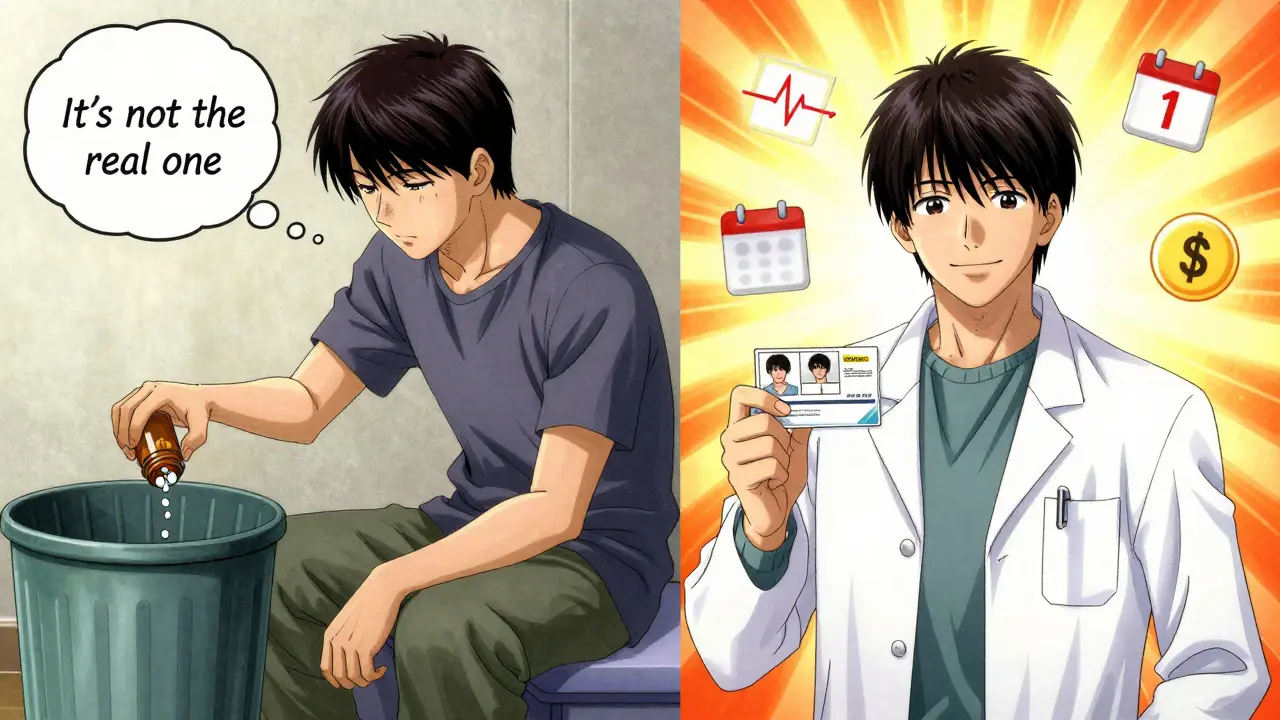
What Patients Really Want to Know
Patients don’t care about FDA regulations. They care about:- "Will this work the same?"
- "Why does it look different?"
- "Is this safe?"
- "Am I being tricked into a cheaper version?"
Address those fears head-on. Say: "I get why you’d wonder. The brand you’ve been on for years looked different. But the FDA tests these generics just as hard as the brand. The only difference? The color, the shape, and the price. The medicine inside? Identical."
One pharmacist in Ohio started carrying a small card in her pocket with a photo of her own generic blood pressure pill next to the brand. She showed it to every patient who looked confused. The result? A 40% drop in refill abandonment for that medication over six months.
The Future of Generic Counseling
By 2026, 75% of pharmacies will use AI tools to flag patients who’ve previously expressed concern about generics based on refill patterns or past interactions. These systems won’t replace pharmacists-they’ll help them focus where it matters most. Medicare is already moving toward value-based payments. Starting in 2025, pharmacies may earn bonus payments not just for filling prescriptions, but for proving they provided quality counseling on generics. Documentation will matter. Outcomes will matter. And patient trust will be the metric.Final Thought: Counseling Isn’t a Task. It’s a Responsibility.
You’re not just filling a prescription. You’re preventing hospitalizations, reducing costs, and saving lives. A patient who understands their generic medication is more likely to take it. And a patient who takes their medication is more likely to stay healthy. The next time you hand someone a pill that looks unfamiliar, don’t just say, "This is generic." Say: "This is the same medicine. The only thing that changed is the price. And I’m here if you have questions."Is it legal for a pharmacist to substitute a generic without telling the patient?
In 17 U.S. states, pharmacists can substitute a generic without notifying the patient unless the patient specifically asks. But in 32 states, including major ones like California, New York, and Florida, pharmacists are legally required to inform patients when substitution occurs. Even in states without mandatory notification, federal guidelines under OBRA '90 and CMS require counseling to be offered at the time of dispensing. Best practice is to always inform the patient-regardless of state law-to prevent confusion and non-adherence.
Are generic drugs really as effective as brand-name drugs?
Yes. The FDA requires generics to have the same active ingredient, strength, dosage form, and route of administration as the brand-name drug. They must also prove bioequivalence-meaning they deliver the same amount of medicine into the bloodstream at the same rate. Over 90% of generics are approved through this rigorous process. The only differences are in inactive ingredients like color, shape, or filler, which do not affect how the drug works. Studies show no meaningful difference in effectiveness between generics and brands for nearly all medications.
Why do generic pills look different from brand-name pills?
The appearance of a pill-its color, shape, or size-is determined by inactive ingredients and the manufacturer’s design. Brand-name companies often trademark the look of their pills as part of their marketing. Generic manufacturers can’t copy that exact appearance, so they use different colors or shapes. But the active ingredient-the part that treats the condition-is identical. For example, the brand-name pill for lisinopril might be a blue oval, while the generic is a white round tablet. Both contain the same amount of lisinopril and work the same way.
Can pharmacists be held liable if a patient has a bad reaction after switching to a generic?
Pharmacists are generally not liable for adverse reactions caused by a generic drug if the substitution was legal and appropriate. However, if counseling was not provided and the patient had a known sensitivity to an inactive ingredient (like a dye or filler), or if the pharmacist failed to check for drug interactions, liability could arise. The key is documentation: if a pharmacist documented that counseling was offered and the patient understood the substitution, they’re protected. Failure to counsel increases legal risk.
What should a pharmacist do if a patient refuses to take a generic?
If a patient refuses a generic, the pharmacist must honor their choice. The prescription must be filled with the brand-name drug if specified by the prescriber or requested by the patient. The pharmacist should document the refusal and note whether the patient was counseled on cost differences and therapeutic equivalence. In some cases, the pharmacist can suggest contacting the prescriber to discuss alternatives or financial assistance programs. Never pressure a patient to accept a generic-trust is more important than cost savings.
Do I need to counsel patients on generics every time they refill?
Yes. Federal guidelines require counseling to be offered at every fill or refill, even if the patient has taken the drug before. This is because the manufacturer of the generic may change between refills, altering the pill’s appearance. A patient who was fine with last month’s generic may be confused by this month’s version. Counseling isn’t a one-time event-it’s an ongoing part of medication safety.



Comments (8)
Zacharia Reda
Let me guess - the pharmacist handed them the generic and said, "It’s the same thing" - then walked away like they just handed out a free coffee.
Yeah, no. That’s not counseling. That’s negligence dressed up as efficiency.
Patients aren’t dumb. They see the different color, the weird shape, and suddenly they’re convinced they’re being scammed. And honestly? Sometimes they’re right - because we’ve trained them to think that way.
One minute of real talk - "This is the same medicine, just cheaper. The FDA checks it harder than your ex checks your phone" - could save someone from a hospital trip.
Also, why are we still using paper handouts in 2025? QR code to a 30-second video showing side-by-side pills? Do it.
And for god’s sake, stop treating counseling like a checkbox. It’s the moment trust is built or shattered.
I’ve seen people cry because they thought their meds stopped working. It’s not the drug. It’s the silence.
John Cyrus
People are idiots and pharmacies are lazy and no one wants to do the work anymore so they just hand out pills like candy and wonder why people stop taking them
It’s not rocket science say the word generic and explain it don’t make it complicated
It’s the same active ingredient period end of story
Stop overcomplicating everything
Also why are we even having this conversation
It’s 2025 not 1995
marjorie arsenault
I’ve been a pharmacist for 18 years and I still show patients the little card with my own pill next to the brand.
It’s not about the law.
It’s about seeing the relief on their face when they realize, "Oh. So it’s not different. It’s just cheaper."
One woman told me she’d stopped her heart meds for three months because she thought the new pill was a placebo.
Three months.
We can fix this.
It doesn’t take much. Just a little time. A little honesty. A little humanity.
That’s all.
And it changes everything.
Deborah Dennis
...and yet, despite all of this, we still have pharmacists who treat counseling like a formality... who rush through it... who don’t document it... who don’t care... who just want to move to the next patient... and then wonder why the system is broken... and then blame the patients... for not following instructions... when the instructions were never properly given... in the first place... and now we’re paying for it... in ER visits... in hospitalizations... in unnecessary deaths... and nobody’s accountable... because it’s easier to ignore... than to fix... isn’t that just... perfect...?
Diane Croft
When a patient says "I don’t trust this pill" - they’re not being irrational.
They’re responding to years of silence.
They’re reacting to being treated like a transaction.
Our job isn’t to sell pills.
It’s to rebuild trust - one conversation at a time.
And yes, it takes time.
But so does a hospital stay.
So does a stroke.
So does a life lost because no one bothered to say: "This is the same medicine. I promise."
Donna Zurick
Just say it simple
Same medicine
Same effect
Different look
Same price
Same result
That’s it
No jargon
No lecture
Just clarity
And then ask
"Does that make sense?"
Not "Any questions?"
Because people don’t know what to ask
They just feel confused
And that’s on us
Tobias Mösl
Let’s be real - this whole generic thing is a corporate scam wrapped in FDA paperwork.
Big Pharma invented the brand name to charge $500 for a pill that costs 20 cents to make.
Now they’re forcing us to pretend generics are "just as good" - but the inactive ingredients? Totally different.
Some people are allergic to dyes. Some get migraines from fillers.
And we’re just supposed to say "It’s fine"?
What about the studies that show slight bioequivalence variance in antiepileptics?
What about the patients who had seizures after switching?
Who’s documenting that?
Who’s taking responsibility?
Or are we just going to keep pretending this is science and not profit?
Ethan Zeeb
They don’t need a five-point lecture.
They need a moment.
A pause.
A look in the eye.
A hand on the counter.
"I know this looks different. I’ve seen it too. But I’ve given this to 200 people this year. Not one had a problem. I’ll check in with you next week. Just call if something feels off."
That’s all.
Not training.
Not forms.
Not AI prompts.
Just presence.
And if you can’t do that - maybe you’re in the wrong job.