Malignant Hyperthermia Treatment Cost Estimator
Total Medication Cost
-
Weight-Based Initial Dose
2.5 mg/kg 175 mg -
Approx. Vials for Initial Dose
~20mg/vial 9 vials -
Max Potential Cost (36 vials)
Worst Case $144,000
Avoid (Triggers)
- Sevoflurane
- Desflurane
- Isoflurane
- Succinylcholine
Safe Alternatives
- Propofol (TIVA)
- Rocuronium
- Local Anesthetics
- Opioids
Imagine you are sitting in a pre-op room, calm and ready for surgery. The anesthesiologist starts the gas. Within minutes, your body temperature spikes past 104°F (40°C). Your heart races uncontrollably. Your muscles lock up tight as stone. This isn't just a bad reaction; it is Malignant Hyperthermia, a rare, life-threatening genetic disorder triggered by specific anesthesia medications. If this sounds like a nightmare, that’s because it is. But here is the good news: if caught early, it is almost entirely survivable.
This condition doesn’t discriminate. It can happen to anyone, even those with no family history of the disease. In fact, nearly 30% of cases occur in people who had no idea they were at risk. Understanding what triggers this crisis, how to spot the warning signs, and exactly what doctors need to do to save a life is critical. This guide breaks down the science, the symptoms, and the emergency protocols that turn a potential tragedy into a success story.
What Is Malignant Hyperthermia?
To understand why this happens, we have to look inside your muscle cells. Normally, when your brain tells a muscle to contract, calcium ions flood into the cell from storage units called the sarcoplasmic reticulum. After the contraction, the calcium goes back where it came from, and the muscle relaxes.
In people with Malignant Hyperthermia (MH), there is a defect in the door that lets calcium out. Specifically, mutations in the RYR1 gene, located on chromosome 19, which controls the ryanodine receptor calcium channel cause this door to stay wide open. When certain trigger drugs are introduced, calcium floods out and never stops. The muscle stays contracted, burning through oxygen and energy at a furious rate. This creates massive amounts of heat, carbon dioxide, and acid, leading to a metabolic storm that can shut down organs within hours.
While about 70% of cases are linked to the RYR1 gene, a small percentage involve the CACNA1S gene, on chromosome 1q32, associated with calcium channel function in skeletal muscle. This is an autosomal dominant trait, meaning you only need one copy of the mutated gene from one parent to be susceptible. However, not everyone with the gene will react-some remain asymptomatic their whole lives unless exposed to the right combination of triggers and stress.
The Triggers: Which Anesthetics Cause MH?
Not all anesthesia is dangerous for MH-susceptible individuals. In fact, most modern techniques are safe. The danger lies in two specific categories of drugs:
- Volatile Inhalational Agents: These are gases used to keep you asleep. The primary culprits are sevoflurane, desflurane, isoflurane, halothane, and enflurane. You can often spot them by their names ending in "-flurane."
- Succinylcholine: This is a depolarizing muscle relaxant used to help intubate patients or facilitate surgery. It is the only non-inhalational trigger commonly used.
If you are MH-susceptible, these agents act like pouring gasoline on a fire. Safe alternatives exist and are widely available. Total Intravenous Anesthesia (TIVA) using propofol, along with non-depolarizing muscle relaxants like rocuronium or vecuronium, poses zero risk. Local anesthetics, opioids, and benzodiazepines are also completely safe. The key is communication. If you or a family member has had a reaction, your medical team must know before you ever enter the operating room.

Early Warning Signs: What Doctors Look For
Time is the enemy in an MH crisis. Survival rates drop significantly if treatment is delayed beyond 40 minutes. Therefore, recognizing the subtle early signs is vital. These symptoms usually appear within an hour of exposure, but can start in minutes.
The first sign is often invisible to the naked eye but glaringly obvious on the monitors. A rapid rise in end-tidal CO2 (EtCO2) is the earliest and most sensitive indicator. If EtCO2 climbs above 55 mmHg despite increased ventilation, alarms should sound. Other early physiological changes include:
- Tachycardia: Heart rate jumping unexpectedly high (over 120 bpm in adults).
- Tachypnea: Increased respiratory rate or difficulty ventilating the patient.
- Masseter Muscle Rigidity: A hardening of the jaw muscles, making it difficult to open the mouth or insert breathing tubes. This is particularly common in children.
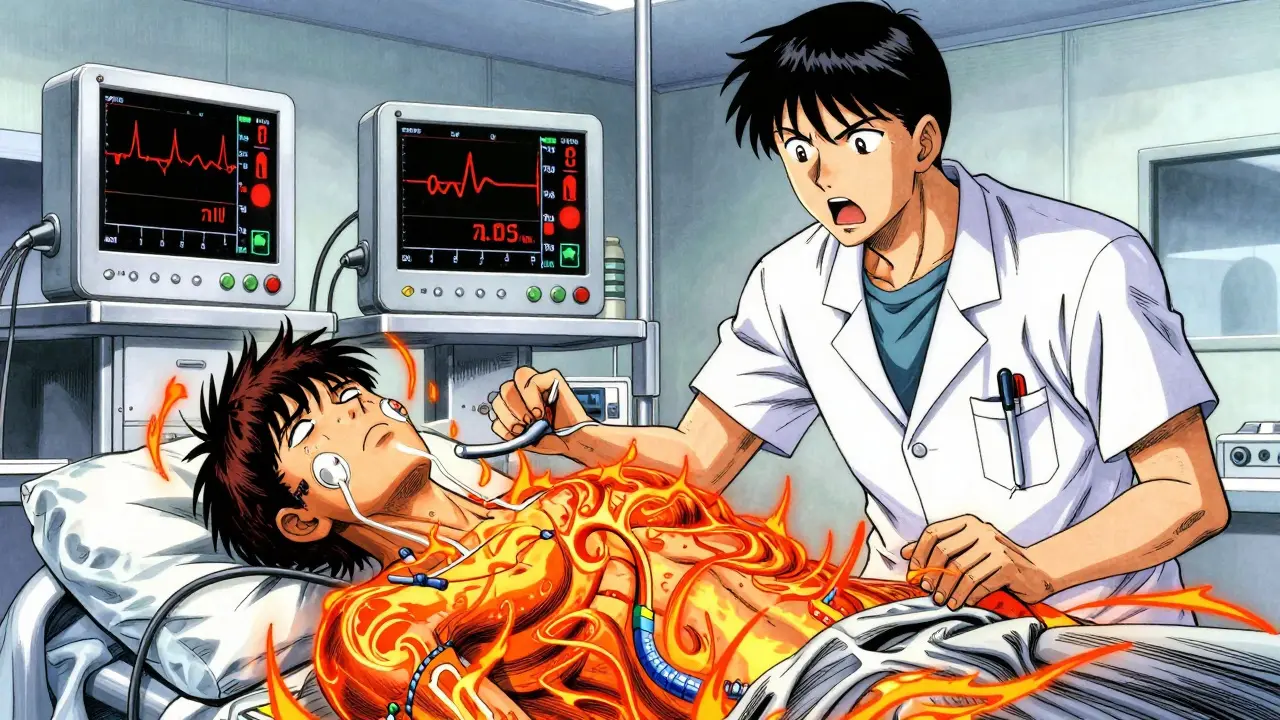
As the crisis progresses, more dramatic symptoms emerge. Body temperature skyrockets, potentially exceeding 109°F (43°C). The skin may turn dark red or purple due to poor circulation and acidosis. Urine may become dark brown or bloody-a sign of myoglobinuria, where damaged muscle tissue releases proteins that can destroy the kidneys. Blood tests would reveal severe acidosis (low pH), high potassium levels (hyperkalemia), and skyrocketing creatine kinase (CK) levels, often over 10,000 U/L.
Critical Response: The Dantrolene Protocol
When MH is suspected, the response must be immediate and aggressive. There is no time for debate. The standard protocol, endorsed by the Malignant Hyperthermia Association of the United States (MHAUS), the leading organization for MH prevention and treatment in North America, involves several simultaneous steps.
- Stop the Trigger: Discontinue all volatile anesthetics and succinylcholine immediately. Switch to 100% oxygen at high flow rates (10 L/min or more) to flush the system.
- Call for Help: Alert the entire OR team. Contact the MHAUS hotline (1-800-644-9737) for real-time expert guidance. They are available 24/7 and have helped reduce mortality by providing instant access to specialists.
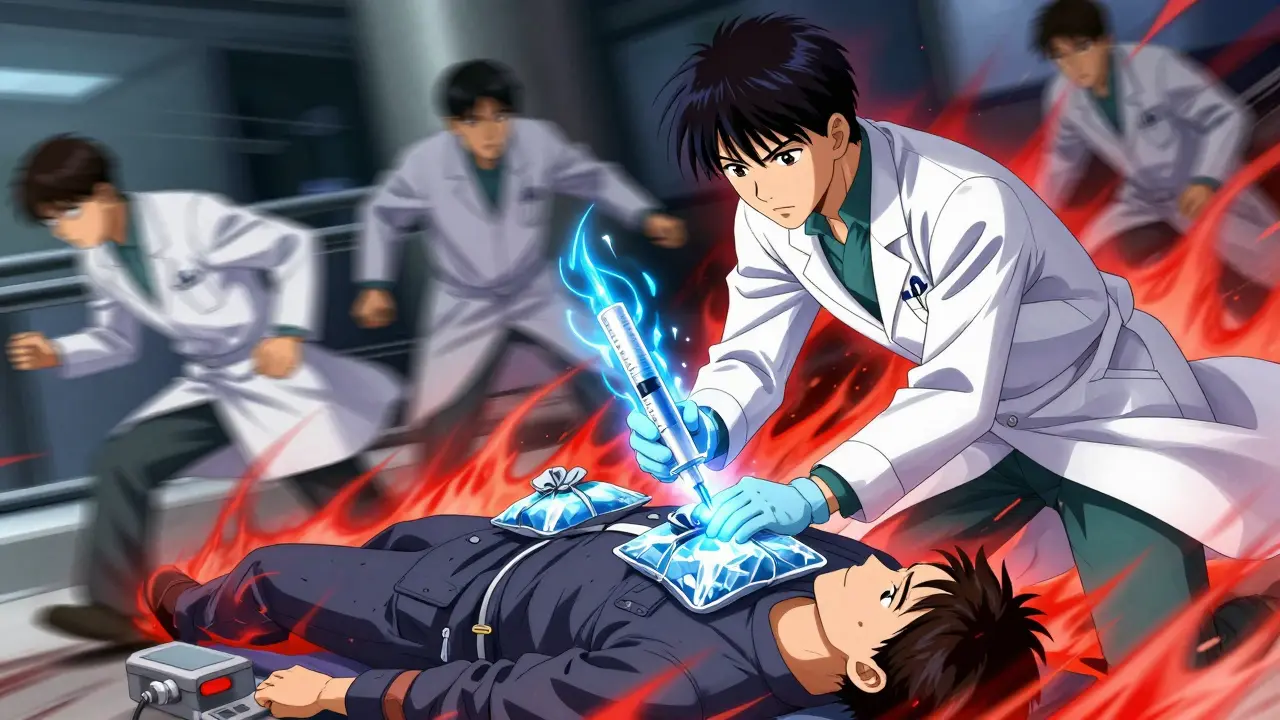
- Administer Dantrolene: This is the antidote. Dantrolene sodium, a muscle relaxant that inhibits calcium release from the sarcoplasmic reticulum works by blocking the defective receptors. The initial dose is 2.5 mg/kg IV, repeated every 5-10 minutes until symptoms resolve. A full adult treatment may require up to 36 vials.
- Cool the Patient: Active cooling is essential. Ice packs are placed in the groin, armpits, and neck. Cold IV fluids are administered. In extreme cases, cardiopulmonary bypass may be used to cool blood directly.
- Supportive Care: Treat acidosis with sodium bicarbonate. Manage high potassium with insulin and glucose. Protect the kidneys with mannitol and furosemide to flush out myoglobin.
The drug of choice has evolved. While Dantrium® was the standard for decades, its reconstitution took up to 22 minutes-too slow for a crisis. Today, Ryanodex, a faster-acting formulation of dantrolene sodium approved by the FDA in 2014 is preferred. It mixes in under one minute. Each vial costs around $4,000, so hospitals maintain expensive "MH carts" stocked with dozens of vials, syringes, and cooling gear. Having this cart ready within 30 seconds of any operating room can cut treatment time from 22 minutes to under 5 minutes, drastically improving outcomes.
| Feature | Dantrium® | Ryanodex® |
|---|---|---|
| Reconstitution Time | Up to 22 minutes | Under 1 minute |
| FDA Approval Year | 1972 | 2014 |
| Shelf Life (Reconstituted) | Short | Longer stability |
| Cost per Vial | ~$4,000 | ~$4,000 |
Diagnosis and Genetic Testing
If you survive an episode, or if you have a family history, diagnosis becomes important to prevent future incidents. Genetic testing for RYR1 and CACNA1S mutations is available through certified labs. Costs range from $1,200 to $2,500, with a sensitivity of about 95% for known mutations. However, a negative test doesn’t guarantee safety, as new mutations can arise.
For unclear cases, the In Vitro Contracture Test (IVCT) is the gold standard. Muscle tissue is biopsied and exposed to caffeine and halothane in a lab setting to see if it contracts abnormally. The European Malignant Hyperthermia Group updated criteria in 2023, lowering the threshold for a positive result to make detection more sensitive. If diagnosed, patients receive an alert card and registry notification, ensuring any hospital treating them knows to avoid triggering agents.
Prevention and Future Outlook
Prevention is the best medicine. Always disclose family history of anesthesia complications during pre-op screening. Ask your anesthesiologist about their MH protocol. Are they using TIVA? Do they have an MH cart nearby? In 2021, the FDA mandated that all facilities performing general anesthesia maintain emergency kits, covering thousands of hospitals and surgery centers.
Technology is also catching up. New anesthesia information management systems (AIMS) from companies like Epic Systems now include algorithms that automatically flag potential MH when multiple indicators (high CO2, high heart rate, rising temp) appear simultaneously. This could shave critical minutes off recognition time. Looking further ahead, researchers are exploring CRISPR-based gene editing to correct RYR1 mutations, with trials expected by 2027. Until then, awareness, preparedness, and rapid dantrolene administration remain our strongest defenses.
Is malignant hyperthermia hereditary?
Yes, it is primarily an autosomal dominant genetic disorder. This means if one parent carries the mutation, there is a 50% chance their child will inherit it. However, having the gene does not guarantee a reaction; environmental factors and specific drug exposures play a role.
What is the survival rate for malignant hyperthermia?
With immediate treatment using dantrolene, survival rates approach 100%. Historically, before dantrolene was introduced in the 1970s, mortality was as high as 80%. Delayed treatment significantly increases the risk of death or long-term organ damage.
Can local anesthesia trigger malignant hyperthermia?
No. Local anesthetics like lidocaine or bupivacaine, as well as sedatives like propofol and midazolam, are safe for individuals susceptible to malignant hyperthermia. Only volatile inhalational gases and succinylcholine are triggers.
How much does dantrolene cost?
A single vial of dantrolene (such as Ryanodex) costs approximately $4,000 USD. Treating an average adult case may require up to 36 vials, totaling around $144,000. Hospitals stock these as emergency supplies due to the life-saving nature of the drug.
What should I do if I have a family history of MH?
Inform every healthcare provider you see, especially surgeons and anesthesiologists. Consider getting genetic testing through a certified laboratory. Carry an MH alert card or wear a medical ID bracelet stating your susceptibility to ensure safe anesthesia planning.