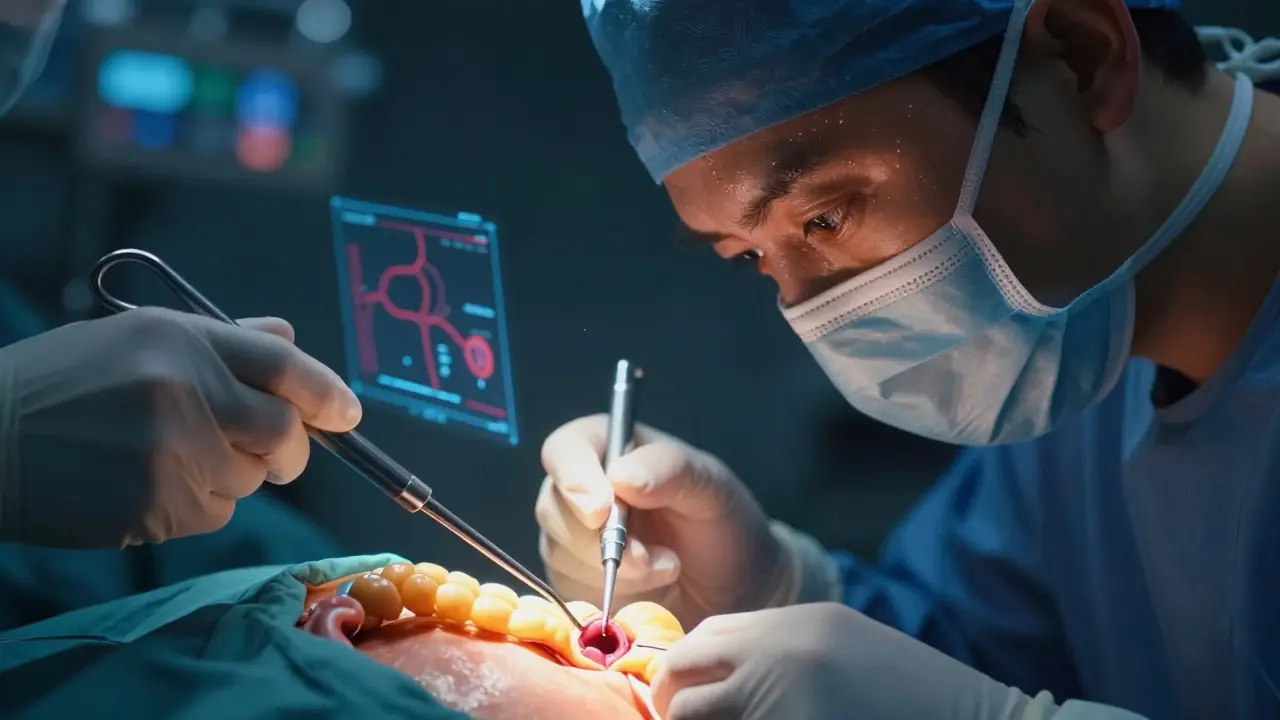
When IBD Medications Stop Working, Surgery Becomes the Next Step
If you’ve been living with Crohn’s disease or ulcerative colitis for years, you know how exhausting it is. Constant diarrhea, abdominal pain, bleeding, and the fear of sudden flare-ups can make everyday life feel impossible. For many, medications like biologics help - but not forever. When drugs stop working, or when complications like strictures, fistulas, or precancerous changes appear, surgery isn’t a failure. It’s a reset.
Up to 75% of people with Crohn’s and 15-30% of those with ulcerative colitis will eventually need surgery. That’s not rare. It’s expected. And modern IBD surgery is nothing like the open, traumatic procedures of the past. Today, most are done laparoscopically - through small incisions, with faster recovery and less pain. The goal isn’t just to remove diseased tissue. It’s to restore your life.
Resection: Removing the Damaged Part, Preserving the Rest
For Crohn’s disease, surgery usually means a bowel resection. This is when the surgeon cuts out the inflamed or scarred section of intestine - often the end of the small bowel (ileum) or part of the colon - and reconnects the healthy ends. It’s not a cure. Crohn’s can come back anywhere else in the GI tract. But removing the worst part gives you relief, often for years.
Think of it like replacing a rusted pipe in your home’s plumbing. You don’t replace the whole system. You fix the broken section. That’s why surgeons prefer resection over removing large chunks. The more bowel you keep, the better your digestion and nutrient absorption afterward. Most patients stay in the hospital 3-5 days and return to normal activities in 4-6 weeks.
For people with multiple strictures (narrowed areas) in one part of the bowel, a strictureplasty might be done instead. This widens the narrowed section without cutting anything out. It’s a bowel-sparing trick that helps avoid short bowel syndrome - a serious condition where not enough intestine is left to absorb food properly.
Ostomy: Living With a Stoma - It’s Not What You Think
An ostomy is when the end of the intestine is brought out through the abdominal wall to create a stoma - an opening where waste leaves the body. It sounds scary, but for many, it’s life-changing.
There are two main types in IBD:
- Temporary ileostomy: Used after pouch surgery to let the new connection heal. Waste collects in a bag attached to the stoma. Most last 8-12 weeks.
- Permanent ileostomy: Done when the rectum is removed and no pouch can be made. This is common in older patients or those with poor sphincter control.
The stoma itself is about the size of a quarter, sticking out 1-2 cm from your skin. You’ll need to empty the bag 4-6 times a day. It’s not messy if you use the right supplies. Modern pouches are discreet, odor-free, and stick securely. Many people forget they’re wearing one - until they realize they can finally go out without planning every trip around a bathroom.
One big myth? You can’t swim, exercise, or have sex with an ostomy. That’s false. People with ostomies hike, run marathons, and travel the world. The key? Proper fitting, skin care, and finding a good wound, ostomy, and continence nurse (WOCN) before surgery. They’ll teach you everything - from changing the bag to dealing with leaks.

J-Pouch Surgery: The Holy Grail for Ulcerative Colitis
If you have ulcerative colitis and your whole colon and rectum are diseased, the most common surgery is a proctocolectomy with ileal pouch-anal anastomosis - or IPAA. You’ve probably heard it called a J-pouch.
Here’s how it works: The colon and rectum are removed. Then, the surgeon takes the last 8-10 cm of your small intestine, folds it into a J-shape, and connects it directly to your anus. This creates an internal reservoir - your new “rectum.” You still go to the bathroom normally. No external bag needed.
Most J-pouch surgeries happen in three stages:
- First, the colon is removed and a temporary ileostomy is made.
- After 8-12 weeks, the pouch is built and connected to the anus. The ileostomy stays for another few weeks to protect the new connection.
- Finally, the ileostomy is reversed. You’re back to using your anus.
Success rates are high. About 80-90% of patients report improved quality of life. Most have 4-8 bowel movements a day - sometimes more at first, but it settles down over 6-12 months. The biggest downside? Pouchitis. About 40% of people get inflammation in the pouch. It causes diarrhea, cramps, and fever. But it’s treatable with antibiotics. Many need it once or twice a year.
Not everyone qualifies. If your anal sphincter is weak, if you’re over 70, or if you’re a woman planning to have kids (fertility drops after IPAA), your surgeon might recommend a permanent ileostomy instead.
What Happens After Surgery? The Real Recovery
Leaving the hospital is just the beginning. Recovery isn’t about just healing the incision - it’s about relearning how your body works.
For J-pouch patients, the first few months are a rollercoaster. You might go 10 times a day. Nighttime leaks are common. You’ll need absorbent pads. But slowly, your pouch stretches and learns to hold more. By year one, most are down to 5-6 movements a day.
For those with a permanent ileostomy, it’s about adaptation. You’ll learn to track your output. Too much? You’re dehydrated. Too little? You might be blocked. Drink 8-10 cups of water daily. Avoid high-fiber foods at first - broccoli, nuts, popcorn - until your system adjusts.
Watch for warning signs: fever over 101°F, sudden increase in stoma output over 1,500 mL/day, or severe pain. These mean you need to call your doctor - fast. Infections and blockages can turn serious quickly.
Pain management is tricky. IBD patients are at higher risk of becoming dependent on opioids after surgery. Ask your team about non-opioid options: acetaminophen, nerve blocks, or even acupuncture. Many hospitals now have specialized IBD recovery programs to help with this.
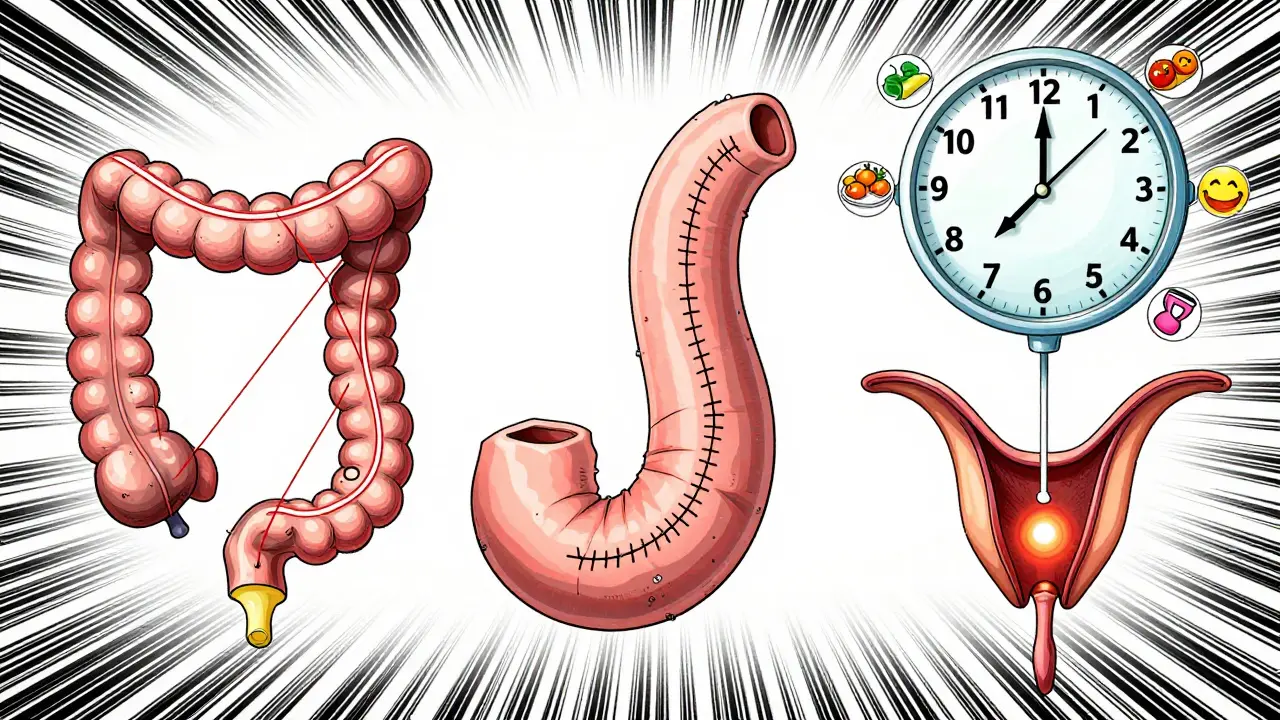
Who Should Choose What? The Decision Guide
There’s no one-size-fits-all. Your choice depends on your disease, age, goals, and health.
For ulcerative colitis:
- Choose J-pouch if you’re under 65, have good sphincter control, and want to avoid a permanent bag.
- Choose permanent ileostomy if you’re older, have weak sphincters, or want to skip the multi-stage surgery and its risks.
For Crohn’s disease:
- Resection is the go-to for isolated disease. It’s effective but not permanent - recurrence is likely.
- Never do a J-pouch for Crohn’s. The disease will attack the pouch. Studies show 50% of Crohn’s patients with pouches end up needing a permanent stoma.
Age matters. Under 40? You’re 3.2 times more likely to choose a J-pouch. Over 65? Most pick the permanent stoma because it’s simpler and safer.
And don’t underestimate support. Join a group. Talk to someone who’s been through it. The United Ostomy Associations of America and Reddit’s r/IBD have thousands of people sharing real advice - not just medical jargon.
What’s New in IBD Surgery?
Surgery isn’t standing still. Robotic-assisted J-pouch procedures are becoming more common. At Mayo Clinic, they’ve seen 20% shorter surgery times and fewer complications. The FDA just approved the first smart ostomy bag - OstoLert - that alerts you if it leaks. It’s pricey at $80, but for some, it’s peace of mind.
Researchers are also testing 3D-printed pouch designs tailored to your anatomy and microbiome transplants to prevent pouchitis. Early results show a 40% drop in inflammation after transplanting healthy gut bacteria.
Even the costs are changing. Medicare reimburses about $28,500 for a J-pouch surgery and $18,200 for reversal. The global ostomy market is growing fast - now worth over $8 billion - because technology is improving, and more people are choosing surgery.
You’re Not Alone - And This Isn’t the End
Surgery for IBD doesn’t mean giving up. It means taking back control. People who’ve had J-pouches say they finally sleep through the night. They travel without panic. They eat dinner with friends without worrying about the bathroom.
Yes, there are risks. Pouchitis, leaks, infections. Yes, there’s a learning curve. But for most, the trade-off is worth it. One patient on Reddit said: ‘I used to cry before every meal because I didn’t know if I’d make it to the toilet. Now I eat pizza on the couch. That’s freedom.’
If you’re considering surgery, talk to an IBD specialist - not just any colorectal surgeon. Centers that do 500+ IBD surgeries a year have 35% fewer complications. Ask about their pouch survival rates. Ask about their WOCN program. Ask about long-term outcomes.
This isn’t about fixing a broken organ. It’s about rebuilding your life. And it’s possible.
Is J-pouch surgery safe for Crohn’s disease?
No, J-pouch surgery is not recommended for Crohn’s disease. Crohn’s can affect any part of the digestive tract, including the newly created pouch. Studies show that about half of Crohn’s patients who get a J-pouch develop inflammation in the pouch within a few years, and 10% end up needing a permanent ileostomy. For Crohn’s, surgeons only remove the diseased section (resection), not the entire colon and rectum.
How many bowel movements a day is normal after J-pouch surgery?
In the first few months, it’s common to have 6-10 bowel movements daily. Over time, your pouch stretches and becomes more efficient. Most people settle into 4-8 movements per day after 6-12 months. Nighttime leaks can happen early on, but many use absorbent pads until their body adjusts. Drinking enough fluids and avoiding high-fiber foods helps reduce frequency.
Can I still have children after IBD surgery?
Yes, but there are risks. After J-pouch surgery, female fertility drops from about 15% to 50-70%. This is due to pelvic scarring and changes in anatomy. Men may experience erectile dysfunction in 15-20% of cases. If you plan to have children, talk to your surgeon before surgery. Some choose to freeze eggs or sperm beforehand. Pregnancy is possible after J-pouch, but it’s considered high-risk and requires close monitoring.
What’s the difference between a temporary and permanent ileostomy?
A temporary ileostomy is created to protect a new surgical connection, like a J-pouch. It’s usually reversed after 8-12 weeks. A permanent ileostomy is made when the rectum is removed and no internal pouch is possible. You’ll wear a bag for life. Temporary stomas are often used to reduce complications. Permanent ones are chosen for older patients or those with poor sphincter function to avoid the risks of multiple surgeries.
How do I know if I need surgery for IBD?
You may need surgery if medications fail after 8-12 weeks of optimized treatment, or if you have complications like bowel obstruction, perforation, uncontrolled bleeding, or precancerous changes. Emergency surgery is needed for toxic megacolon - when the colon swells over 6 cm on imaging. Surgery isn’t a last resort - it’s a valid treatment when quality of life is severely impacted. Talk to your IBD team early about your options.
Do I need to follow a special diet after IBD surgery?
Yes, especially in the first few months. Avoid high-fiber foods like raw vegetables, nuts, popcorn, and whole grains - they can cause blockages. Stick to low-residue meals: cooked vegetables, lean meats, eggs, white rice, and bananas. Drink 8-10 cups of water daily to prevent dehydration. After 6-12 months, many can slowly reintroduce more foods. Keep a food diary to track what triggers symptoms. A dietitian who specializes in IBD can help tailor your plan.
What are the biggest risks after IBD surgery?
The most serious risks include anastomotic leak (where the reconnected bowel doesn’t heal properly - happens in 5-15% of J-pouch cases), pouchitis (inflammation of the pouch - affects 40%), and bowel obstruction from scar tissue. Infections and dehydration are also common. Up to 40% of J-pouch patients are readmitted within 90 days, often for these reasons. Permanent ostomy patients have fewer complications but face skin irritation and body image challenges. Always report fever, sudden pain, or a spike in output to your doctor immediately.





Comments (12)
Sue Stone
I had my J-pouch done 3 years ago. First 6 months? Absolute chaos. Night leaks, 10+ trips a day, panic attacks before leaving the house. Now? I run 5Ks. Eat tacos. Travel to Mexico. Nobody knows. It’s not perfect, but it’s freedom.
Stacy Thomes
THIS. THIS IS THE POST I NEEDED 5 YEARS AGO. I thought surgery meant giving up on life. Now I’m 2 years post-op and I finally slept through the night last week. I cried. Not from pain. From relief.
Susannah Green
Important note: If you're considering a J-pouch, find a WOCN before surgery. Not after. They teach you how to manage leaks, skin irritation, and even how to shower without panicking. I had a nurse who walked me through changing my bag with a mirror. Life-saving.
Andrew Smirnykh
I'm from Nigeria and I read this while sitting in a clinic in Lagos. The access to care here is nothing like what you describe. I wish this info was available to people like me. Surgery isn't just a medical decision-it's a privilege.
Kerry Evans
People act like surgery is some miracle cure. But you're just trading one set of problems for another. Pouchitis? Chronic dehydration? Scar tissue blockages? You think you're getting your life back? You're just getting a new set of medical bills.
Vanessa Barber
lol yeah right. 'Freedom'? I know three people who had J-pouches. Two regretted it. One is on disability. The third? Still on Imuran. So... what exactly did the surgery fix?
dana torgersen
I just... I just want to say... thank you? For writing this? I’ve been scared to even Google "ostomy" for years... but this... this didn’t feel like a textbook. It felt like someone who’s been there. I’m going to my appointment tomorrow. I’m not running away anymore.
Kerry Moore
The statistical data presented herein is both compelling and clinically relevant. Particularly noteworthy is the 35% reduction in perioperative complications observed at high-volume centers. This underscores the necessity of centralized, specialized care delivery in complex gastrointestinal surgical interventions.
Janet King
The claim that 80-90% of J-pouch patients report improved quality of life is misleading. Studies show that 45% still report moderate to severe anxiety about bowel frequency. Quality of life isn't just about how many times you go to the bathroom. It's about whether you feel safe leaving your house.
Laura Rice
To anyone scared of the bag: I had a permanent ileostomy after 12 years of IBD. I used to wear 3 pairs of underwear to hide it. Now I wear shorts. I swim. I dance. I’m 34. I have a dog named Biscuit. I’m alive. You can be too.
charley lopez
The data on robotic-assisted IPAA shows a statistically significant reduction in intraoperative blood loss (p<0.03) and shorter length of stay (mean 4.2 vs 5.8 days). However, long-term functional outcomes remain comparable to laparoscopic approaches. The cost-benefit ratio requires further prospective evaluation.
Oladeji Omobolaji
I’m 42, had a resection last year. Still got Crohn’s. Still have pain. But I can eat a burger without sweating. That’s enough for me.