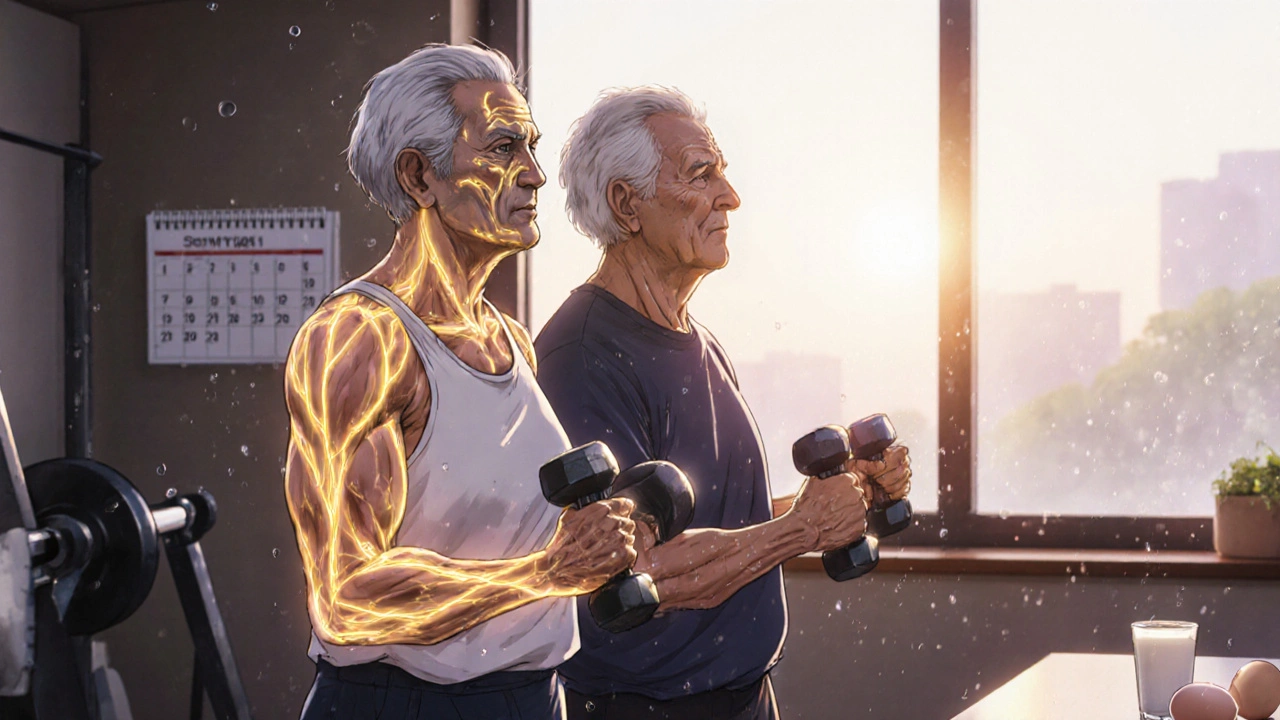
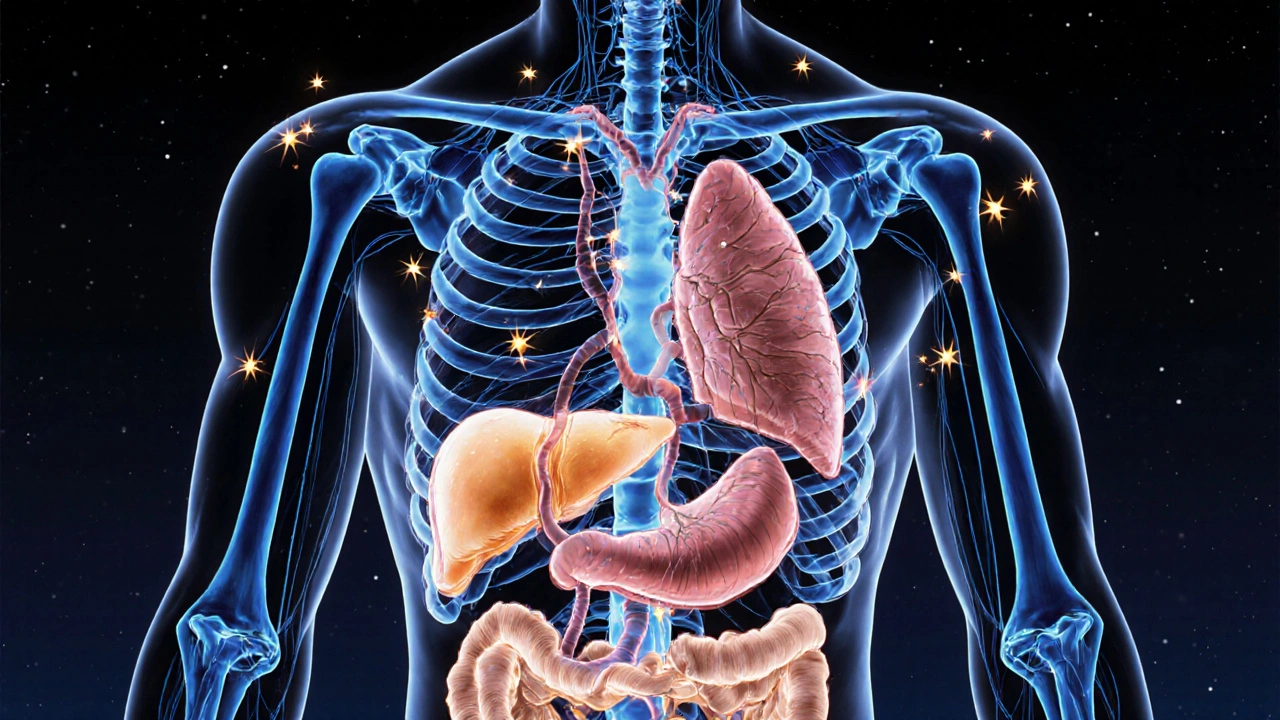
As you get older, your body doesn’t just slow down-it rewires itself. One of the quietest, most powerful changes happens inside your endocrine system. That’s the network of glands that make and send out hormones: your thyroid, adrenal glands, pancreas, ovaries, testes, and more. These chemicals don’t just control your mood or energy-they manage your metabolism, sleep, muscle mass, bone density, and even how your brain remembers things. And when they start to shift, you feel it: fatigue that won’t quit, weight that sticks no matter what you do, trouble sleeping, or a low libido that just won’t bounce back.
What Happens to Hormones as You Age?
It’s not one hormone that drops-it’s a cascade. Testosterone in men declines by about 1% per year after age 30. By 70, many men have 30-50% less than they did in their 20s. In women, estrogen and progesterone crash during menopause, usually between 45 and 55. That’s not just hot flashes-it’s increased risk of osteoporosis, brain fog, and insulin resistance. Even your thyroid, which controls your metabolism, becomes less efficient. Around 20% of people over 60 have subclinical hypothyroidism, meaning their thyroid is barely keeping up.
Then there’s cortisol, the stress hormone. As you age, your body doesn’t reset cortisol as quickly. That means chronic low-grade stress sticks around longer, which can lead to belly fat, high blood sugar, and weakened immunity. Insulin sensitivity also drops. Your muscles and liver become less responsive to insulin, so your body stores more fat and burns less glucose. That’s why many people in their 50s and 60s gain weight even if they eat the same as they did in their 30s.
And don’t forget growth hormone. It peaks in your teens and drops sharply after 30. Less growth hormone means less muscle repair, thinner skin, weaker bones, and slower recovery from injuries. Melatonin, the sleep hormone, also declines. That’s why older adults often wake up at 3 a.m. and can’t fall back asleep-even if they’re exhausted.
Why Hormonal Imbalance Feels Like a Personal Failure
Most people blame themselves. “I’m just not trying hard enough,” they think. Or, “I should be able to lose weight like I used to.” But the truth is, your body isn’t broken-it’s aging. Hormones aren’t a lifestyle choice. They’re biology. A 65-year-old woman who eats clean, walks daily, and sleeps 8 hours can still have low estrogen and high cortisol. That’s not laziness. That’s the endocrine system slowing down.
And here’s the kicker: mainstream medicine often ignores this. Doctors check your TSH (thyroid) and maybe your fasting glucose, but rarely test for free testosterone, DHEA-S, cortisol rhythm, or sex hormone binding globulin (SHBG). If your numbers are “in range,” you’re told you’re fine-even if you’re tired all the time, gaining belly fat, or losing muscle. The “normal” range for testosterone in men was set decades ago using mostly young, healthy men. It doesn’t reflect what’s optimal for a 60-year-old trying to stay strong and sharp.
What Actually Works to Support Hormonal Balance
You can’t reverse aging. But you can slow the damage and help your body stay in better balance. Here’s what science and clinical experience show works:
- Strength training, not just cardio. Lifting weights or doing resistance exercises three times a week is the single most effective way to boost testosterone, growth hormone, and insulin sensitivity. You don’t need to be a bodybuilder. Just 20-30 minutes of squats, push-ups, lunges, and rows is enough. Muscle is a hormone factory-it sends signals that tell your body to keep producing testosterone and growth hormone.
- Protein at every meal. Older adults need more protein than younger people-about 1.2 to 1.6 grams per kilogram of body weight. That’s 80-100 grams a day for a 70kg person. Protein helps preserve muscle, supports thyroid function, and stabilizes blood sugar. Eggs, lean meats, fish, tofu, and Greek yogurt are easy sources.
- Sleep like your life depends on it. Because it does. Deep sleep is when your body releases growth hormone and resets cortisol. Aim for 7-8 hours. No screens 90 minutes before bed. Keep your room cool (around 18°C). If you wake up at 3 a.m., don’t check your phone. Sit quietly or read a book in dim light. Melatonin supplements (0.3-1 mg) can help reset your rhythm, but only if taken 90 minutes before bed.
- Manage stress like a priority. Cortisol doesn’t care if your stress is from traffic or a sick parent. Chronic stress drains your adrenal glands and shuts down sex hormones. Try daily breathing exercises: inhale for 4 counts, hold for 4, exhale for 6. Do this for 5 minutes, twice a day. Walking in nature, even for 20 minutes, lowers cortisol more than caffeine or meditation apps.
- Don’t ignore fats. Your body needs cholesterol to make testosterone, estrogen, and cortisol. Avoid low-fat diets. Eat avocado, olive oil, fatty fish, nuts, and eggs. Omega-3s from salmon or algae oil reduce inflammation, which interferes with hormone signaling.
What Doesn’t Work (And Why)
There are a lot of products promising to “restore youth” with hormone supplements. Most are scams.
Over-the-counter “hormone boosters” like DHEA or pregnenolone pills? They’re unregulated. Taking them without testing can throw your system out of balance even more. Some people end up with high estrogen or liver damage.
Testosterone gels or injections? These can help men with clinically low levels-but only under medical supervision. They’re not for “feeling younger.” In older men, they can raise red blood cell count dangerously, increase heart risk, or shrink testicles. And for women? No approved hormone replacement therapy exists for low libido or fatigue unless it’s tied to clear menopausal symptoms.
Detox teas, “adrenal support” supplements, or ashwagandha pills? They might help a little with stress, but they won’t fix low testosterone or thyroid issues. They’re not magic. They’re band-aids on a broken engine.
When to See a Doctor (And What to Ask For)
If you’re over 50 and struggling with unexplained fatigue, weight gain, brain fog, or low sex drive, it’s time to ask for more than a basic blood test.
Request these tests:
- Free and total testosterone (men and women)
- Sex hormone binding globulin (SHBG)-this tells you how much testosterone is actually available
- Fasting insulin and HbA1c-to check for insulin resistance
- TSH, free T3, free T4-not just TSH, because T3 is the active thyroid hormone
- Cortisol (saliva test at 8 a.m., noon, 4 p.m., and midnight)-this shows your rhythm, not just one snapshot
- estradiol and progesterone (for women)
- DHEA-S-a precursor hormone that drops with age
Don’t accept “your numbers are normal” if you still feel awful. Ask: “What’s my optimal range based on my age and symptoms?” A functional medicine doctor or endocrinologist who specializes in aging is more likely to help than a general practitioner.
The Real Goal Isn’t Youth-It’s Vitality
You’re not trying to turn 65 into 35. That’s impossible. But you can make 65 feel like the best version of 65. Stronger. Clearer. More energetic. More present.
Hormonal balance isn’t about pills or potions. It’s about giving your body what it needs to do its job: movement, protein, sleep, calm, and good fats. It’s about listening when your body says, “I’m tired,” and not pushing through. It’s about accepting that aging changes your chemistry-and working with it, not against it.
The endocrine system doesn’t fail because you got old. It fails because we stopped giving it the right signals. Fix those signals, and your body will respond-not with a miracle, but with steady, lasting strength.
Can you reverse hormone decline with supplements?
No, you can’t reverse hormone decline with over-the-counter supplements. DHEA, pregnenolone, or herbal blends may offer minor support for stress or sleep, but they don’t restore testosterone, estrogen, or thyroid levels long-term. Taking them without testing can cause imbalances. Only prescription hormone therapy, monitored by a doctor, can safely replace missing hormones-and even then, it’s for specific symptoms, not general aging.
Why do I gain weight even though I eat less?
As you age, your metabolism slows because you lose muscle, your insulin becomes less effective, and your thyroid and cortisol levels shift. Even if you eat the same amount, your body stores more fat and burns less energy. Strength training and higher protein intake can help reverse this. It’s not about calories alone-it’s about hormones.
Is low libido just a normal part of aging?
Not necessarily. While libido often drops with age due to lower testosterone or estrogen, it’s not inevitable. Many people in their 70s have healthy sex drives. Low libido can also be caused by poor sleep, high stress, insulin resistance, or medications like antidepressants. If it’s sudden or distressing, get your hormones checked. It’s often fixable.
Does menopause cause permanent brain fog?
No. Brain fog during menopause is usually temporary and tied to estrogen drops. Estrogen helps with memory, focus, and neurotransmitter function. Once your body adjusts or you support it with sleep, stress management, and healthy fats, clarity often returns. In some cases, short-term hormone therapy helps. Long-term cognitive decline is not caused by menopause alone-it’s linked to other factors like blood sugar, inflammation, and lack of movement.
How long does it take to see results from lifestyle changes?
You’ll notice better sleep and energy in 2-4 weeks. Muscle strength and fat loss take 8-12 weeks with consistent strength training and protein intake. Hormone levels themselves don’t change overnight, but your body’s sensitivity to them improves quickly. For example, insulin sensitivity can improve in as little as 3 weeks with resistance exercise and reduced sugar. Patience and consistency matter more than speed.
Next Steps: Start Small, Stay Consistent
Don’t try to fix everything at once. Pick one thing: add two strength sessions this week. Eat an egg and some Greek yogurt at breakfast. Go to bed 30 minutes earlier. Walk outside at sunset. These aren’t grand gestures-they’re tiny acts of respect for your changing body.
Your hormones aren’t your enemy. They’re your allies, just working with outdated instructions. Give them the right signals, and they’ll help you age with strength, not surrender.

Comments (15)
Donald Sanchez
bro i tried that protein thing and still got belly fat 😭 turns out my thyroid is trash and no one told me till i was 52. now i take liothyronine and life’s kinda normal again. also stop drinking diet soda it’s worse than sugar.
Greg Knight
Let me tell you something real important here - this isn’t about willpower, it’s about biochemistry. Your body isn’t broken, it’s just doing what evolution programmed it to do: conserve energy as you age. That’s why lifting weights isn’t just ‘good for you’ - it’s a biological signal that says, ‘Hey, we still need muscle, don’t waste resources.’ When you skip leg day, your body hears that as, ‘We’re in survival mode.’ And guess what? It starts storing fat like it’s preparing for the next ice age. You’re not lazy. You’re just out of sync with your own biology. Start small - one squat a day, one extra egg at breakfast. Your hormones will thank you before you even notice it.
rachna jafri
They don’t want you to know this - but Big Pharma and the FDA are suppressing the truth. Hormone decline? It’s a scam. Your glands aren’t failing - they’re being poisoned by glyphosate in your food, fluoride in your water, and EMFs from your phone. I’ve seen women over 60 regain their periods after switching to organic meat and sleeping in a Faraday cage. They’re selling you pills because they don’t want you to fix the real problem: the system. Ask yourself - why is every ‘expert’ pushing supplements but never talking about the 500 chemicals in your toothpaste?
Bette Rivas
One thing the article doesn’t emphasize enough is circadian alignment. It’s not just about sleep duration - it’s about timing. Cortisol should peak at 8 a.m. and bottom out by midnight. If you’re scrolling at 1 a.m., you’re essentially telling your adrenal glands to keep firing. I’ve had patients improve their free T3 and testosterone levels just by getting sunlight within 30 minutes of waking and avoiding blue light after 8 p.m. No supplements needed. Your body is a clock - and most people are running it on 1990s software. Update the OS.
prasad gali
Let’s be clear - if you’re over 50 and still doing steady-state cardio, you’re wasting your time. The endocrine system responds to mechanical tension, not aerobic monotony. The data is unequivocal: resistance training elevates anabolic hormones more than any exogenous supplement. DHEA? Irrelevant. Ashwagandha? Placebo-tier. But a 3x/week full-body protocol with progressive overload? That’s the only true endocrine modulator. Your gym routine is either optimizing or sabotaging your hormonal axis. Choose wisely.
Will Phillips
They say ‘eat clean’ but never say what that means - you’re eating kale chips and drinking bone broth like it’s holy water while your insulin is screaming. You think your body gives a damn about your ‘clean eating’? No. It cares about insulin spikes. It cares about leptin resistance. It cares about whether you’re sitting 14 hours a day. You’re not ‘eating healthy’ - you’re performing wellness theater. Go lift something heavy. Stop drinking kombucha. Sleep in the dark. That’s it. No supplements. No detoxes. Just stop sabotaging your biology.
Hannah Machiorlete
i literally cried reading this. i’m 58 and i thought i was just lazy. my husband says i’m ‘not trying’ but i’ve been walking 5 miles a day and eating salads and still gaining weight. i finally got tested and my free t was below 100. they gave me a prescription and i’m already sleeping through the night. i didn’t need to be ‘stronger’ - i needed to be seen.
Danielle Mazur
Who funded this article? The supplement industry? The pharmaceutical lobby? Notice how they never mention the 2018 NIH study linking hormone replacement therapy to increased breast cancer risk in women over 65. They push ‘testing’ but avoid discussing the dangers of estrogen dominance. And why do they always target men’s testosterone but never mention that elevated testosterone in women is linked to PCOS, infertility, and cardiovascular risk? This is selective science. They want you dependent - not balanced.
Kenneth Meyer
There’s a quiet truth here that nobody wants to say out loud: aging isn’t a problem to be solved - it’s a transition to be honored. We’ve turned biology into a product line. You don’t need to ‘restore’ your hormones. You need to stop fighting your body and start listening to it. The fatigue? It’s not weakness - it’s wisdom telling you to slow down. The weight gain? It’s not failure - it’s your body holding space for what’s next. Maybe the goal isn’t to be 30 again… but to be fully 70. Not stronger. Not leaner. Just… present.
Tyrone Luton
Let’s be honest - most people reading this are already doing half of this. They lift weights sometimes. They eat protein. They sleep 6 hours. They’re not lazy - they’re confused. The real problem isn’t the hormones. It’s the noise. There are 47 ‘hormone hacks’ on YouTube, 12 ‘biohacking’ podcasts, and 37 ‘anti-aging’ gurus selling $200 moon dust. The solution is simple: move, eat, sleep, rest. No app. No powder. No ‘secret protocol.’ Just consistency. You don’t need to be perfect. You just need to show up - even when you’re tired. Even when it feels pointless. Even when the world tells you you’re too old to care.
Freddy Lopez
There’s a profound humility in accepting that your body changes - not because you failed, but because you lived. We’ve been taught to fear aging like a disease, but what if it’s simply the cost of having loved, worked, struggled, and survived? The hormones aren’t betraying you. They’re reflecting your history. The cortisol rise? From decades of stress. The muscle loss? From years of sitting at desks. The sleep disruption? From nights spent worrying about bills, kids, parents. You didn’t break. You accumulated. And now, you’re being asked to tend to the garden you’ve grown - not tear it down and plant a new one. That’s not weakness. That’s wisdom.
Lauren Hale
I’m 62. I started strength training at 58. Three years later, I can carry my grandkids up the stairs. My doctor said I’d be in a wheelchair by now. I didn’t take a pill. I didn’t join a cult. I just showed up. Three times a week. Even when I didn’t feel like it. Even when my knees hurt. Even when my husband said, ‘You’re too old for that.’ I didn’t do it to look good. I did it so I could still hug my grandchildren without gasping. That’s the real goal. Not youth. Not vanity. Just presence. Keep showing up. That’s all.
Arun Mohan
Look - if you’re still drinking ‘green smoothies’ and doing yoga for ‘hormone balance,’ you’re part of the problem. This isn’t a wellness influencer’s Instagram post. This is physiology. You need to test your SHBG, not your aura. You need to lift heavier than your ego. You need to stop listening to ‘gurus’ who’ve never held a lab report. Real change comes from data, not vibes. If you’re over 50 and haven’t had a full hormone panel done by a functional endocrinologist, you’re just guessing. And guessing won’t save you from sarcopenia, insulin resistance, or dementia. Wake up. The clock is ticking.
Paige Basford
i just started eating eggs for breakfast and i swear i’ve had more energy in 2 weeks than i have in 5 years. also i stopped drinking coffee after 2pm and i’m actually sleeping through the night?? who knew?? not me. i’m not a ‘biohacker’ or anything, i just listened. maybe the answer isn’t complicated? just… eat, move, rest. 💛
darnell hunter
It is imperative to note that the article’s recommendations, while superficially plausible, lack rigorous longitudinal validation. The assertion that resistance training directly elevates testosterone in elderly populations is based on short-term cohort studies with inadequate controls. Furthermore, the dismissal of over-the-counter DHEA as universally harmful ignores peer-reviewed literature demonstrating modest benefits in adrenal insufficiency. The conflation of correlation with causation regarding cortisol rhythms and sleep hygiene is methodologically unsound. One must exercise caution before adopting these claims as clinical gospel.