Medication Safety Risk Assessment Tool
Medication Safety Assessment
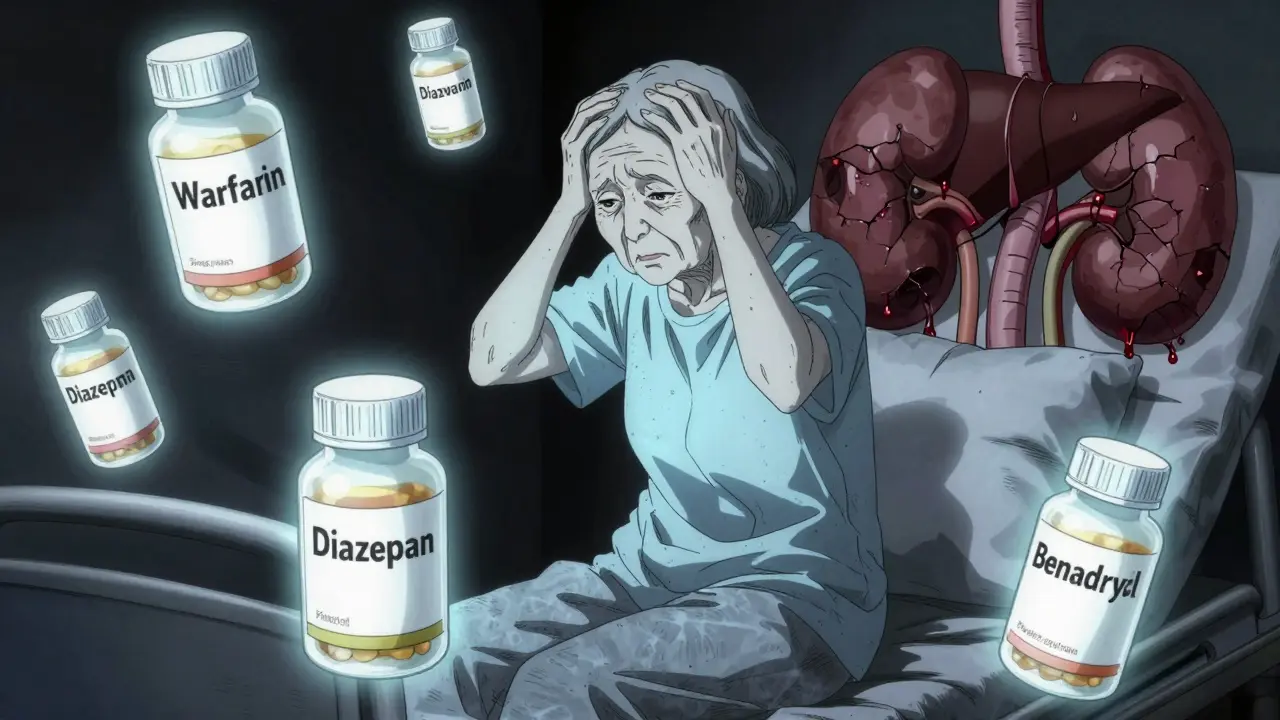
When you’re older, your body doesn’t process medications the same way it did when you were younger. A pill that once helped you sleep or manage pain might now leave you dizzy, confused, or even hospitalized. This isn’t just bad luck-it’s biology. As we age, changes in how our bodies absorb, break down, and respond to drugs turn common prescriptions into potential hazards. For many adults over 65, medication side effects aren’t just inconvenient-they’re dangerous.
Why Older Adults React Differently to Medications
Your body changes as you get older, and those changes directly affect how medicines work. Think of it like a car engine aging: parts wear out, fluids thicken, and the system just doesn’t run the same way. In older adults, four major shifts happen: how much water and fat your body holds, how well your kidneys and liver work, how proteins in your blood bind to drugs, and how sensitive your brain and heart are to medications.
Total body water drops by about 15% between ages 25 and 80. That means water-soluble drugs like digoxin or lithium build up more easily in the bloodstream. At the same time, body fat increases-especially in women-so fat-soluble drugs like diazepam or amitriptyline stick around longer, lingering in fatty tissues and slowly releasing into the blood. This isn’t just theory. Studies show older adults can have up to 50% higher drug levels than younger people taking the same dose.
Your kidneys filter about half as much blood by age 80 as they did at 30. That’s a problem because nearly half of all medications are cleared through the kidneys. If your kidneys aren’t filtering well, drugs like antibiotics, blood pressure pills, or painkillers stay in your system too long. The same goes for your liver. Blood flow to the liver drops by 20-40% after age 65, slowing down how quickly drugs like propranolol or verapamil are broken down. Even if your liver is healthy, it just can’t keep up.
Albumin, the main protein that carries drugs through your blood, also declines by 10-15% in older adults. That means more of the drug floats around unattached, free to act on your brain or heart. For drugs like warfarin, this can double the risk of bleeding-even if your lab numbers look normal.
And then there’s your brain. Older brains are far more sensitive to drugs that affect the nervous system. A 2023 study found that older adults get 50% more sedation from diazepam than younger people, even at the same blood level. That’s why a single sleeping pill can leave someone disoriented for hours, or why an antidepressant meant to ease nerve pain might trigger confusion or memory loss.
Medications That Are Riskier as You Age
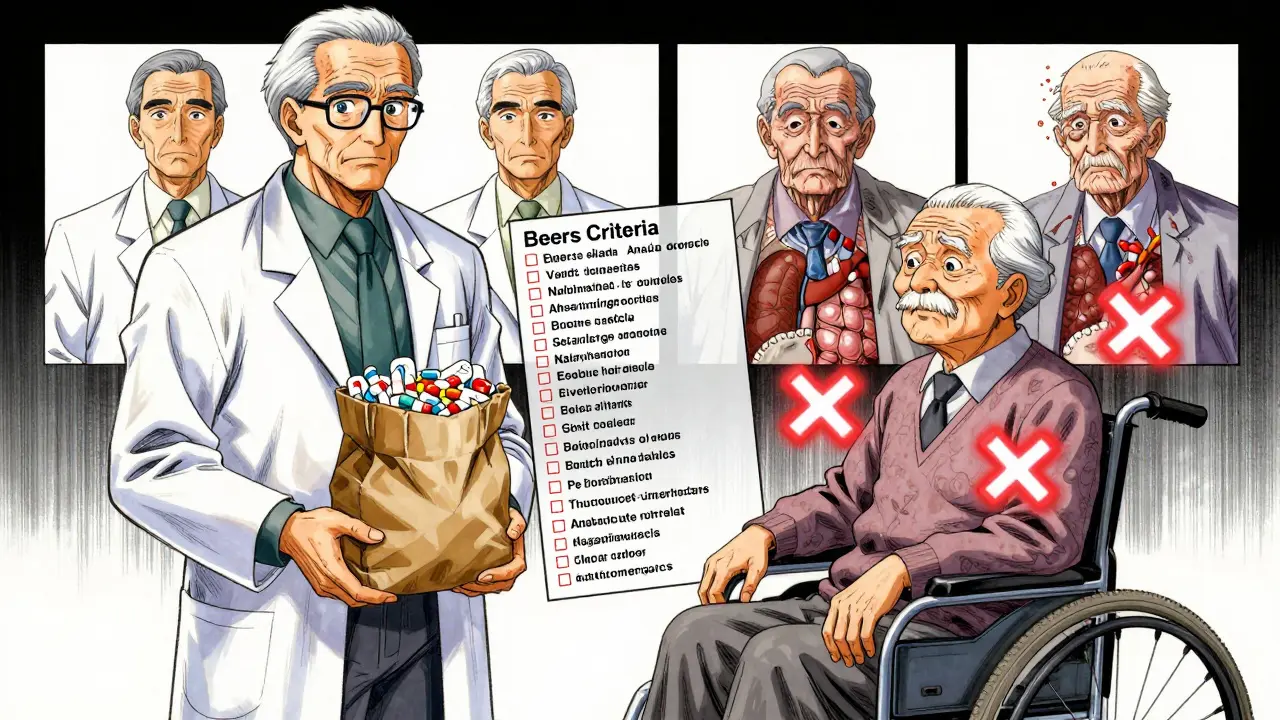
The American Geriatrics Society keeps a list called the Beers Criteria-updated every two years-that tells doctors which drugs are too risky for older adults. The 2023 version lists 56 medications to avoid or use with extreme caution. Many of these are common, over-the-counter, or even prescribed without thinking.
- Anticholinergics like diphenhydramine (Benadryl) or oxybutynin (for overactive bladder) block a brain chemical needed for memory and focus. In people over 75, these drugs cause delirium 4.2 times more often than in younger adults.
- Benzodiazepines like lorazepam or zolpidem (Ambien) increase fall risk by 2-3 times. A 2022 study found zolpidem caused next-day drowsiness in 80% of older adults, compared to 30% in younger users.
- NSAIDs like ibuprofen or naproxen raise the risk of stomach bleeding, kidney damage, and heart failure in older adults. One study showed 28% of people over 80 developed dangerous drops in blood pressure after taking NSAIDs.
- Antidepressants like amitriptyline or imipramine can cause urinary retention, especially in men with enlarged prostates. One Reddit user at age 78 was catheterized within three days of starting amitriptyline.
- Antihypertensives like doxazosin or nifedipine can cause orthostatic hypotension-sudden drops in blood pressure when standing. A 2022 JAMA study found 28% of people over 80 had symptoms, compared to just 9% of those aged 50-65.
These aren’t rare cases. The CDC reports that 48% of adults 65 and older take five or more prescription drugs a month. That’s called polypharmacy-and it’s a ticking time bomb. The more pills you take, the more they interact, the higher your risk of side effects. And many of these drugs are prescribed without ever being reviewed together.
Real-Life Consequences: Stories Behind the Stats
Numbers tell part of the story. Real lives tell the rest.
A 78-year-old woman in Florida was prescribed a standard dose of warfarin for atrial fibrillation. Her INR-a measure of blood thinning-spiked to dangerous levels within weeks. She ended up in the ER with internal bleeding. Her doctor hadn’t adjusted her dose for her declining kidney function. She was one of 35% of older adults hospitalized for medication-related reasons.
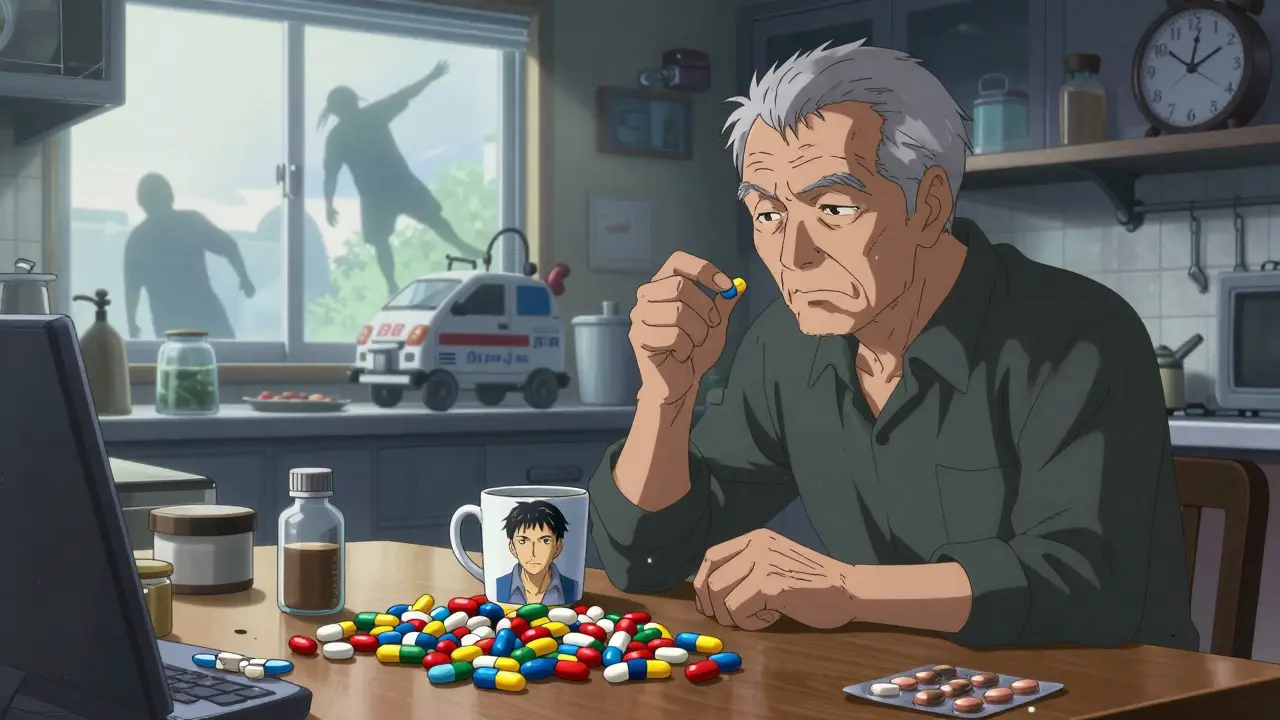
A man in his early 80s started taking a common sleep aid after his wife passed away. Within days, he was confused, wandering the house at night, and falling repeatedly. His family didn’t realize the medication was the cause. He was later diagnosed with medication-induced dementia. His doctor later admitted they hadn’t considered the Beers Criteria.
On AgingCare.com, a daughter wrote: “My 82-year-old mother’s blood pressure medication caused such severe orthostatic hypotension that she fell and fractured her hip-her doctor had prescribed the same dose he uses for 50-year-olds.” That story isn’t unusual. A 2023 University of Florida study found that 37% of adults over 80 had at least one hospital visit tied to medication side effects-and 62% of those were preventable.
And then there are the silent ones: the 68% of older adults who report dizziness or falls linked to meds, the 54% who say they’re confused or forgetful, the 41% who’ve lost or gained weight without knowing why. Many just stop taking their pills. One Merck survey found 45% of older adults quit their meds because of side effects-not because they felt better, but because they felt worse.
What Doctors Should Do (And Often Don’t)
Doctors aren’t ignoring the problem-they’re often overwhelmed. Most clinical trials exclude people over 75. That means we don’t have solid data on how drugs work in the oldest adults. A 2021 European Medicines Agency report found that 90% of drug trials leave out older patients. So doctors are guessing.
But there are proven tools. The STOPP/START criteria help doctors decide what to stop and what to start. The Beers Criteria tells them what to avoid. The CDC recommends a “Brown Bag Review”-where patients bring all their pills, supplements, and OTC drugs to an appointment. One 2022 study found patients brought an average of 3.2 medication errors to these reviews.
Experts like Dr. Michael Steinman at UCSF say we need to shift from “more is better” to “less is more.” Deprescribing-safely stopping drugs that no longer help-is now a key part of geriatric care. One study showed 30-50% of medications in nursing homes are unnecessary. Yet, only 72% of U.S. medical schools now teach geriatric pharmacology.
Dosing rules exist. For kidney-cleared drugs, start at 25-50% of the normal adult dose. Monitor kidney function with eGFR, not just creatinine. Avoid drugs with strong anticholinergic effects. Review every medication every 3-6 months. But in busy clinics, these steps often get skipped.
What You Can Do to Stay Safe
You don’t have to accept side effects as part of aging. Here’s what works:
- Bring all your meds to every appointment-even vitamins, supplements, and herbal teas. Many don’t realize ginkgo or St. John’s wort can interact with blood thinners.
- Ask: “Is this still necessary?” If you’ve been on a drug for years, ask if it still helps. Some meds are prescribed for short-term use but become lifelong.
- Check for anticholinergic burden-if you’re taking more than one drug with this effect (like Benadryl, oxybutynin, or trazodone), your risk of confusion rises sharply.
- Know your kidney function-ask your doctor for your eGFR number. If it’s below 60, ask if your meds need adjusting.
- Watch for new symptoms-dizziness, memory lapses, constipation, falls, or mood changes can all be side effects, not just “getting older.”
Pharmacists are your allies. Many offer free medication reviews. The Beers Criteria app is free and used by over 125,000 clinicians. If your doctor dismisses your concerns, ask for a referral to a geriatrician or clinical pharmacist.
The Bigger Picture: Why This Matters Now
By 2040, over 80 million Americans will be over 65. Right now, preventable drug reactions cost the U.S. $30 billion a year. That’s 15% of all medication spending for this group. Hospitals are being penalized for high readmission rates tied to medication errors. The FDA now wants 25% of clinical trial participants to be over 75 by 2026. AI tools like MedAware are cutting errors by 42% in pilot hospitals.
But progress depends on awareness. If you’re over 65, you’re not just a patient-you’re a person whose body has changed. What worked at 50 might hurt you at 80. Your health isn’t about taking more pills. It’s about taking the right ones-and stopping the ones that don’t help anymore.



Comments (9)
RacRac Rachel
This is so important. I just helped my mom cut down from 12 meds to 5 after she started falling every other week. Turns out three of them were on the Beers list. Her doctor said, "It’s just aging." I said, "No, it’s negligence." We found a geriatric pharmacist-best decision ever. She’s walking again. 🙌
Diane Croft
I wish more doctors would listen. My dad was on Ambien for three years after his wife died. He didn’t sleep better-he just got lost in his own house. We stopped it cold turkey. Within a week, he remembered his wedding anniversary. No magic pill. Just common sense.
Shivam Pawa
In India, we don’t have access to geriatric pharmacists or Beers Criteria apps. Elders just take what’s given. I’ve seen grandmas on NSAIDs for arthritis until their kidneys gave out. The system isn’t built for them. We need global awareness, not just American guidelines.
Renee Jackson
As a clinical nurse specialist in geriatrics, I can confirm the data presented here. The disconnect between prescribing practices and physiological reality is staggering. We must institutionalize medication reconciliation at every transition of care. The STOPP/START criteria are not optional-they are standard of care. Documentation, education, and interdisciplinary collaboration are non-negotiable components of safe prescribing for older adults.
Deborah Dennis
Ugh. Another "old people are fragile" article. They’re not fragile. They’re overmedicated. And yes, doctors are lazy. But so are the patients who won’t stop taking their Benadryl "for allergies" when it’s clearly making them zombified. It’s not the system’s fault-it’s the complacency.
Richard Elric5111
The metaphysical underpinning of this issue lies in the epistemological failure of modern pharmacology to account for ontological change in aging bodies. We treat aging as a disease to be managed rather than a natural state to be understood. The reductionist model of drug dosing-based on young, homogeneous trial populations-ignores the emergent complexity of senescence. True therapeutic efficacy requires a phenomenological approach: listen to the body, not the algorithm.
Tobias Mösl
This is all a scam. Big Pharma knows this stuff. They design drugs for 25-year-olds and then sell them to seniors with zero adjustments. Why? Because they’re making billions. The FDA? Complicit. The AMA? Silent. And now they’re pushing AI to "fix" it? That’s like putting a Band-Aid on a hemorrhage. They don’t want you safe-they want you dependent. Wake up.
Chris Beckman
i read this and i was like... yea but like... dont people just stop taking stuff when it makes em dizzy? like i had a neighbor on 7 pills and she just stopped 3 because she felt weird. no doc needed. maybe the real problem is people dont pay attention? not the system?
Ethan Zeeb
You’re all missing the point. The real issue isn’t the drugs-it’s the lack of accountability. Doctors get paid to prescribe, not to deprescribe. Hospitals get reimbursed for admissions caused by these errors. And patients? They’re told to "just live with it." This isn’t negligence. It’s systemic exploitation. We need lawsuits. We need class actions. We need to hold the medical-industrial complex accountable. Not just "ask your doctor."