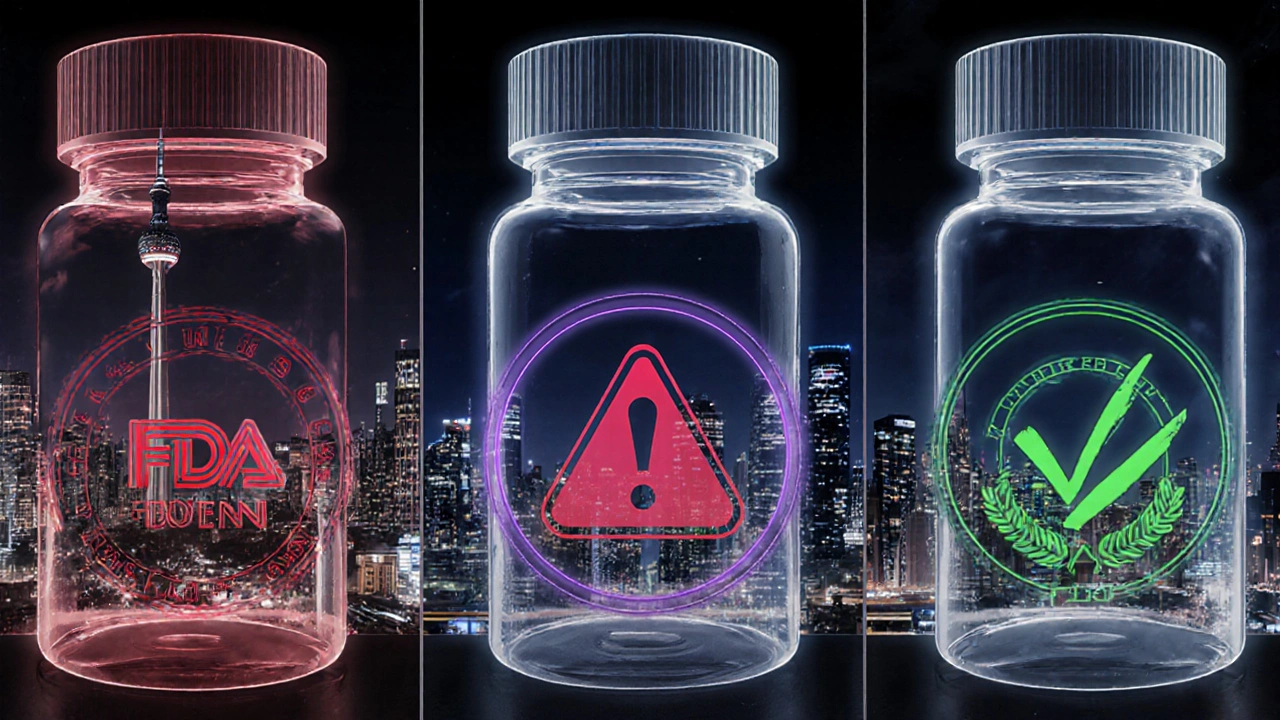
Global Drug Approval Comparison Tool
Compare Regulatory Approvals
Select agencies to compare their drug approval processes, safety standards, and key differences. See how your country's regulatory approach compares globally.
Key Insight: Regulatory differences mean a drug approved in one country might be restricted in another. Always check safety alerts from your local agency.
| Feature | U.S. FDA | EU EMA | Canada | Australia |
|---|---|---|---|---|
| Approval Timeline | 10.2 months | 12.7 months | 10.5 months | 13.4 months |
| Regulatory Model | Centralized | Hybrid (Centralized for new drugs) | Centralized | Independent assessment |
| Approvals for Rare Diseases | 18.3% more than EMA | 12.7% fewer than FDA | Lower than EU | Similar to FDA |
| Approvals for Cancer Drugs | 12.7% fewer than EMA | 12.7% more than FDA | Lower than EU | Similar to EU |
| Concordance Rate | 89.7% with EMA | 89.7% with FDA | 87.0% with EMA (MRA) | 63% with EMA |
| Safety Alert Response | 2-3 days | Up to 14 days | Up to 4 weeks | 1-2 weeks |
When you pick up a pill bottle in Toronto, Berlin, or Sydney, you might assume the drug inside was tested the same way everywhere. But that’s not true. The rules governing what drugs make it to your medicine cabinet vary wildly from country to country - and those differences can affect your safety, your access, and even whether a life-saving treatment reaches you at all.
How the U.S. FDA Approves Drugs: Speed, Clarity, and Centralization
The U.S. Food and Drug Administration (FDA) runs a tightly controlled, centralized system. One agency, one approval process. If a drug clears the FDA, it’s approved nationwide. That’s efficient - and that’s why 94% of U.S. doctors say they trust FDA safety alerts to be clear and timely.
The FDA uses Title 21 of the Code of Federal Regulations (CFR) as its legal backbone. Companies submit massive dossiers - often 15,000 to 20,000 pages - packed with clinical trial data, manufacturing details, and risk assessments. In 2022, the average approval time for a new drug was just over 10 months. That’s faster than most other major regulators.
But speed comes with trade-offs. The FDA tends to demand stronger proof of benefit before approving a drug. That means some promising treatments - especially for rare diseases - get approved faster in Europe or Australia. In 2022, the FDA approved 18.3% more rare disease therapies than the EMA. But the EMA approved 12.7% more cancer drugs, because it’s more willing to accept smaller studies or surrogate endpoints if the potential benefit is high.
And while the FDA has moved toward digital tools - using AI to review 43% of routine manufacturing inspections in 2022 - its system still feels rigid to many companies. A 2023 PhRMA survey found 78% of U.S.-based drugmakers preferred the FDA’s predictability, even if it meant longer waits.
The EU’s Hybrid System: Flexibility, Complexity, and Shared Oversight
Europe doesn’t have one regulator. It has a network. The European Medicines Agency (EMA) handles new, innovative drugs - like biologics or gene therapies - through a centralized process. But for older, generic medicines, each country’s own agency (like Germany’s BfArM or France’s ANSM) makes the call.
This creates a patchwork. A drug approved in France might take months longer to reach pharmacies in Poland if local authorities demand extra data. That’s why 68% of EU-based pharmaceutical companies say navigating national rules is a major headache.
But there’s a reason for the mess. When a safety issue pops up - like the Vioxx withdrawal in 2004 - the EU’s networked structure allowed 22 countries to act in under two weeks. The U.S. took nearly four weeks. That coordination saved lives.
The EU’s legal framework, Eudralex Volume IV, binds all 27 member states. It requires strict quality risk management under Annex 20, and inspections show a 98.7% compliance rate among EU manufacturers - higher than the FDA’s 92.3%. Yet, EMA documents are often seen as more detailed, but harder to digest. Only 63% of U.S. physicians rated FDA reports as clear, while 71% of European doctors found EMA’s benefit-risk assessments comprehensive.
Canada’s Middle Ground: MRA with the EU and a Focus on Alignment
Health Canada sits between the U.S. and EU models. It’s centralized like the FDA, but it’s also part of a Mutual Recognition Agreement (MRA) with the EU, signed in 2019. That means Canada and the EU accept each other’s inspections and manufacturing standards. No need for duplicate audits.
After the MRA, Canada’s alignment with EU safety decisions jumped to 87%. That’s huge. It means if the EMA flags a risk with a drug, Health Canada is likely to follow suit - fast. That’s a win for patients who use drugs sold on both sides of the Atlantic.
Canada’s Food and Drugs Act gives it legal teeth, and its approval timelines are close to the FDA’s - around 10-11 months. But Canada doesn’t push for the same level of innovation as the EU or the same speed as the U.S. It’s cautious. And that caution shows in its approval rates: fewer oncology drugs than the EU, fewer rare disease drugs than the FDA.

Australia’s TGA: Pragmatic, Independent, and Growing
Australia’s Therapeutic Goods Administration (TGA) is small but sharp. It operates under the Therapeutic Goods Act 1989 and has a reputation for being thorough without being slow. In 2022, it approved 79% of the same drugs the FDA did, but only 63% of those approved by the EMA.
Why the gap with Europe? Australia doesn’t automatically follow EU decisions. It does its own risk-benefit analysis. That independence means slower approvals sometimes - but also fewer surprises. When the EMA issued a warning about a diabetes drug in 2021, the TGA waited six weeks to act. The FDA acted in two. Australia didn’t rush, but it didn’t ignore it either.
The TGA also leads in digital health. It approved 45 digital therapeutics in 2022 - more than any other regulator outside the U.S. - and its guidelines for AI-based medical devices are among the clearest in the world.
Global Gaps: Where Regulation Fails Patients
Here’s the uncomfortable truth: most of the world doesn’t have an FDA, EMA, or TGA. In low- and middle-income countries, regulatory systems are underfunded, understaffed, or non-existent. Nigeria and Bangladesh, for example, have seen preventable deaths because safety alerts never reached pharmacies or patients.
The World Health Organization (WHO) tries to fill the gap with its Good Manufacturing Practice (GMP) guidelines. But these aren’t laws. They’re suggestions. Only 150+ countries adopt them - and even then, enforcement is spotty. In Africa, only 37% of drug manufacturing facilities meet even basic GMP standards.
And the data gap is real. A 2022 study by the International Alliance of Patients’ Organizations found that only 42% of patients in developing countries ever see a safety alert. That’s not just a regulatory failure - it’s a human one.

Why Concordance Rates Matter: Only 10.3% of Safety Warnings Match
Here’s the most alarming number: when the U.S., Canada, the UK, and Australia issued safety warnings on the same drugs, they agreed only 10.3% of the time.
That means a drug deemed safe in one country might be pulled in another - and patients crossing borders have no way of knowing. A Canadian taking a medication approved in the U.S. might be at risk if the FDA didn’t flag a side effect that Health Canada did. Or vice versa.
Dr. Thomas Frieden, former CDC director, called this fragmentation “dangerous.” And he’s right. When a patient in Spain takes a drug approved in the U.S., and it causes liver damage, who’s responsible? The manufacturer? The FDA? The Spanish pharmacy? No one. That’s the problem.
What’s Changing? AI, Digital Tools, and the Push for Harmonization
Regulators are starting to talk - and act. The International Council for Harmonisation (ICH) has been quietly aligning rules since the 1990s. By 2023, 89% of major regulators adopted ICH E6(R3), cutting clinical trial paperwork by 22%.
The FDA’s 2022 Modernization Act 2.0 scrapped mandatory animal testing for some drugs - a move expected to cut approval times by 18-24 weeks. The EU’s Pharmaceutical Strategy for Europe aims to cut approval timelines by 25% by 2025.
AI is the biggest game-changer. The FDA used AI to review over 40% of manufacturing inspections in 2022. EMA’s Innovation Task Force reviewed 189 advanced therapy applications that same year. By 2027, AI could cut standard approval times by 30-40%.
But harmonization is still slow. The ICH’s 2023 roadmap targets 75% alignment across the U.S., EU, Japan, and Canada by 2028. That’s ambitious. Political resistance, cultural differences in risk tolerance, and industry lobbying all get in the way.
What This Means for You
If you’re a patient: know where your drugs come from. Check the label. If you’re traveling, ask your pharmacist if your medication has been flagged in another country. Don’t assume it’s safe just because it’s sold in your local pharmacy.
If you’re a healthcare provider: stay alert. A drug approved in the U.S. might have a different warning label in Canada. Use tools like the WHO’s Global Benchmarking Tool or national databases to cross-check alerts.
If you’re in the industry: compliance isn’t optional. You need teams in place to handle FDA, EMA, TGA, and Health Canada requirements. The average cost to set up global compliance? $1.2 million per company. The average approval cost? $2.6 billion per drug. That’s not just a business expense - it’s a barrier to life-saving treatments reaching the people who need them.
Global medication safety isn’t about who’s better. It’s about who’s connected. The systems we have work - for some. But until we close the gaps between them, patients everywhere are playing a dangerous game of regulatory roulette.
Why do different countries approve different drugs for the same condition?
Each country weighs risk and benefit differently. The U.S. FDA often demands stronger proof of effectiveness before approval, while the EU’s EMA may approve drugs based on smaller studies if the unmet medical need is high. Australia and Canada take their own independent assessments. Even with similar science, different policies lead to different outcomes.
Is a drug approved in the U.S. automatically safe in Canada or Europe?
No. Even with agreements like the EU-Canada MRA, each regulator makes its own final decision. A drug approved by the FDA might be rejected or carry different warnings in Europe. For example, the EMA rejected a diabetes drug in 2021 that the FDA approved - citing cardiovascular risk data the FDA considered insufficient. Always check local regulatory status.
How do I know if a drug I’m taking has safety alerts in other countries?
Check your country’s regulatory agency website - Health Canada, FDA, EMA, or TGA. Many publish safety communications in English. For international drugs, use the WHO’s Global Benchmarking Tool or databases like MedSafety. If you’re traveling, ask your pharmacist to compare your prescription with alerts from other countries.
Why are drug approval times so different between countries?
It’s about structure and priorities. The U.S. FDA has a single agency with streamlined processes - approvals average 10.2 months. The EU uses a hybrid model: centralized for new drugs (12.7 months) but decentralized for generics, which can take longer. Canada is similar to the U.S., while Australia’s TGA takes a methodical, case-by-case approach. Less centralized systems mean more steps, more reviews, and longer waits.
Are generic drugs regulated differently than brand-name drugs?
Yes. Brand-name drugs require full clinical trials proving safety and efficacy. Generics only need to prove they’re bioequivalent - meaning they work the same way in the body. But even here, rules differ. In the EU, generics go through national agencies, which may require extra data. In the U.S., the FDA accepts standardized bioequivalence data. In India and Africa, generic quality varies widely due to weaker oversight.
Can I trust a drug made in another country?
It depends. Drugs made in countries with strong regulatory systems - like the U.S., EU, Canada, Australia, Japan - are generally safe. But if the drug comes from a country with weak oversight - like parts of Africa, South Asia, or Latin America - quality control is less reliable. Look for the manufacturer’s name and check if it’s listed on your country’s approved drug database. Avoid buying medicines online from unknown sources.




Comments (13)
Dana Dolan
So basically, if I take my meds in Dublin and fly to Texas, I’m playing Russian roulette with my liver? 🤯 I didn’t even realize my prescription could be a liability abroad. This post blew my mind.
Angela Gutschwager
Ugh. More bureaucracy. Can’t we just let pharma do what they want? 🙄
seamus moginie
It is an absolute disgrace that regulatory fragmentation endangers lives. The FDA’s rigidity is not safety-it is institutional arrogance. The EMA’s decentralized model, while messy, is more adaptive. This is not a debate. It is a crisis.
Zac Gray
Let’s be real-no one’s gonna read all this, but I did. The fact that Australia approved 45 digital therapeutics while the EU is still arguing over whether a PDF counts as ‘clinical data’ is hilarious. The TGA’s just out here building the future while everyone else is stuck in 2008. Also, the 10.3% agreement rate on safety warnings? That’s not a glitch. That’s a feature of a broken system. We’re treating medicine like it’s a Netflix subscription: ‘Hey, this works in Canada, so why is it banned here?’ It’s madness. And the worst part? The people who pay the price aren’t CEOs. They’re the grandma in rural Ohio who can’t get her heart med because the FDA and EMA had a disagreement over a p-value. We need global standards, not national ego trips.
Steve and Charlie Maidment
Wait, so if I’m a drug manufacturer and I have to satisfy the FDA, EMA, TGA, and Health Canada, I’m spending over a billion dollars just to get approved? And you’re telling me Nigeria can’t even track if a pill is fake? This isn’t regulation-it’s a tax on human survival. Someone’s making bank off this mess, and it ain’t the patients.
Michael Petesch
It’s fascinating how cultural attitudes toward risk shape pharmaceutical policy. The U.S. prioritizes efficacy certainty, the EU accepts probabilistic benefit, and Australia balances pragmatism with caution. This isn’t merely technical-it’s philosophical. One might argue that the lack of harmonization reflects deeper societal values: individualism versus collectivism, innovation versus precaution. The WHO’s GMP guidelines, while noble, remain toothless because they lack enforcement mechanisms rooted in sovereignty. Perhaps the real barrier isn’t science-it’s politics.
Richard Risemberg
Bro, imagine if we treated vaccines like we treat blood pressure meds-no country gets to say ‘nah, I don’t like that one.’ We’d be dead. This system is a disaster waiting to happen. Someone gets a drug in Germany, it works, then they go to Florida and it nukes their kidneys because the FDA didn’t flag it? That’s not a regulatory difference-that’s a death sentence with a receipt. We need a global drug passport. Scan the QR code, see every country’s warning. Done. Why is this so hard? We’ve got blockchain, AI, and drones delivering pizza-yet we can’t make a shared database for life-saving pills? Someone’s getting paid to keep this broken. And it’s not me.
Andrew Montandon
Okay, I’m gonna say this gently-but we’re failing people. Every single day. The fact that only 10.3% of safety alerts match across countries? That’s not ‘different standards’-that’s negligence. And the WHO’s guidelines? They’re nice, but they’re not laws. We need a global pharmaceutical watchdog with teeth. Not just recommendations. Real authority. And if the FDA, EMA, and TGA can’t agree, then maybe they shouldn’t be the ones deciding. Maybe it’s time for a neutral, independent body-funded by the UN, audited by scientists, not lobbyists. Patients aren’t test subjects. They’re humans. And we’re letting them die because of paperwork.
Sam Reicks
Did you know the FDA is secretly controlled by Big Pharma and the CIA? They only approve drugs that cause chronic illness so people keep buying meds. The EMA? Same thing. The TGA? A front. The real reason they don’t harmonize is because they don’t want you to realize the same pills are being sold with different labels to different countries. That’s how they profit. And the WHO? They’re in on it too. They don’t want you to know your medicine is a scam. Look up Project MKUltra and the Tuskegee experiments. This is just the next phase. You think your pills are safe? They’re not. They’re designed to keep you dependent. Wake up.
Codie Wagers
Regulation is a mirage. There is no safety. There is only power. The FDA, EMA, TGA-they are not guardians of health. They are gatekeepers of capital. The 2.6 billion dollar cost to develop a drug? That’s not R&D-it’s a toll booth for the elite. The real question isn’t ‘why do countries differ?’ It’s ‘who benefits from the chaos?’ The answer: shareholders. And you? You’re the collateral. Your life is a line item in a balance sheet. The only ‘harmonization’ that matters is the one that lines the pockets of those who never take the pills.
Reema Al-Zaheri
As someone from India, I’ve seen both sides: counterfeit drugs sold as genuine, and life-saving medicines held up for months because of bureaucratic delays. The WHO’s GMP guidelines are essential-but without enforcement, they’re just words on paper. I wish more regulators would adopt Australia’s digital-first approach. We need transparency, not perfection. And yes, patients should check labels-but how many can afford to? This isn’t just about policy. It’s about equity.
Christopher Robinson
Just wanted to say this is one of the clearest, most important posts I’ve read all year. 🙏 The 10.3% agreement stat? Chilling. I’m sharing this with my whole family. Also, if you’re traveling, ALWAYS check your meds on your country’s regulatory site-even if you’ve taken them for years. Things change. And if you’re a doc, use the WHO’s tool. It’s free and lifesaving. Thanks for writing this.
James Ó Nuanáin
Frankly, the American system is a joke. The FDA’s obsession with ‘efficacy’ is laughable-while the EMA, with its superior scientific rigor and cultural nuance, understands that medicine is not a spreadsheet. The TGA? A competent junior partner. Canada? A polite echo. The UK, of course, is the only truly rational regulator left in the West-until Brexit, we were the gold standard. Now we’re isolated, but still superior. This entire post is a testament to American regulatory mediocrity. The rest of the world is moving forward. The U.S. is still arguing over whether a placebo arm needs a signed consent form.