Why Your Medication List Matters More Than You Think
Every year, tens of thousands of people in the U.S. are harmed or die because of medication errors. Many of these aren’t caused by doctors making mistakes-they happen because the right information never reached the person prescribing the drug. If you’ve ever been asked, "What medications are you taking?" and paused to think, you’re not alone. But that pause could be the difference between a safe treatment and a dangerous mix.
Medication reconciliation isn’t just a hospital formality. It’s the process of making sure every pill, patch, vitamin, and herbal supplement you take is accurately recorded and reviewed before any new drug is added. The goal? Prevent harmful interactions, missed doses, or duplicate prescriptions. Studies show that when done right, it cuts adverse drug events by 30% to 50%. For someone taking five or more medications, that’s not just helpful-it’s life-saving.
What Exactly Counts as "Your Medical History" for Medications?
When providers ask for your medication history, they don’t just mean prescriptions. They need to know everything you put in your body. That includes:
- Prescription drugs-even if you haven’t taken them in months
- Over-the-counter medicines like ibuprofen, antacids, or sleep aids
- Vitamins, minerals, and supplements (even "natural" ones like fish oil or turmeric)
- Herbal remedies and teas sold as "health products"
- Topical creams or patches you use regularly
- Any medications you stopped because of side effects
Here’s the hard truth: 67% of patients don’t tell their doctor about over-the-counter drugs or supplements. Why? They assume it doesn’t matter. But aspirin can interfere with blood thinners. St. John’s wort can make antidepressants useless. Even common calcium supplements can block antibiotics from working. If you don’t mention it, your provider can’t protect you.
How Technology Helps-And Where It Falls Short
Health systems now use electronic records and pharmacy networks to pull up your medication history. Services like Surescripts collect data from 98% of U.S. pharmacies and process over 3 billion medication records each year. That sounds impressive. But here’s what they still miss:
- Cash-pay prescriptions (15-20% of all meds)
- Medications bought overseas or online
- Supplements bought at gas stations or health food stores
- Drugs you took only once or twice
Even the best system can’t replace a patient who brings their actual bottles to the appointment. In rural clinics still using paper charts, 25% of home medications go unrecorded. In hospitals with digital systems, that number drops to 8%. The gap isn’t just tech-it’s trust, communication, and follow-through.
What You Can Do: The Brown Bag Method
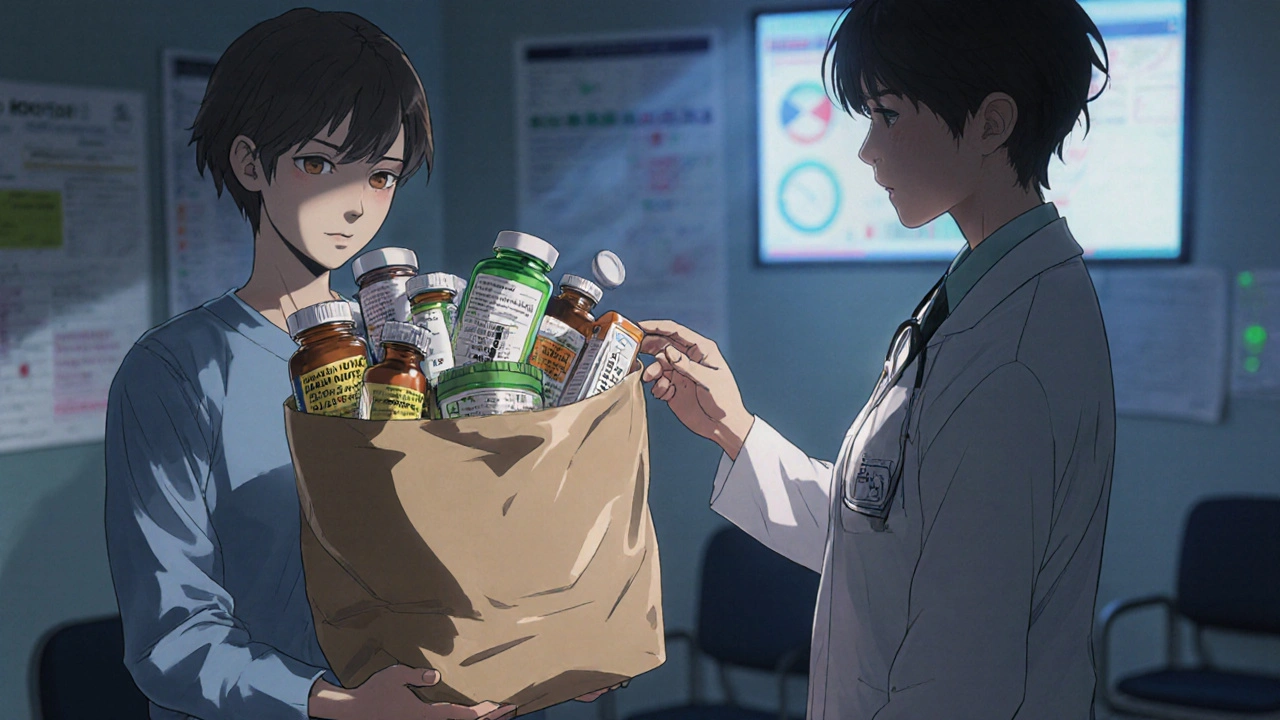
There’s one simple, proven trick that cuts medication errors in half: bring your meds to every appointment. This is called the "brown bag method." You collect all your pills, liquids, patches, and supplements in a bag-even the ones you haven’t used in months-and show them to your provider.
Why does this work?
- You can’t forget what’s right in front of you
- Providers can see expiration dates, dosages, and brand names
- They can spot duplicates (like taking two different painkillers with the same active ingredient)
- It saves time-nurses report reconciliation takes 50% less time when patients bring their bags
Don’t worry if your bag looks messy. It’s better to bring everything than to try to remember. Your provider isn’t judging-you’re helping them keep you safe.

High-Risk Medications: What to Watch Out For
Some drugs are more dangerous than others when mixed or misused. These are called "high-alert medications" by the Institute for Safe Medication Practices. They include:
- Insulin (wrong dose can cause coma or death)
- Blood thinners like warfarin or apixaban (even small interactions can cause bleeding)
- IV oxytocin (used in labor, but can cause fatal heart issues if dosed wrong)
- Chemotherapy drugs and strong painkillers like fentanyl
If you’re on any of these, extra care is needed. Make sure your provider knows:
- Exactly how much you take and when
- If you’ve ever had a reaction
- If you’ve switched pharmacies or providers recently
- Whether you’re taking anything new-even if it’s "just a supplement"
Studies show that when providers flag these drugs during reconciliation, they prevent 47% of severe errors at hospital admission.
What Your Provider Should Be Doing
It’s not just your job to share information-your provider has a responsibility to listen and verify. Here’s what good care looks like:
- They ask open-ended questions: "Tell me about all the medications you take," not "Are you on any pills?"
- They compare your list with pharmacy records and electronic data
- They check for duplicates, interactions, and unnecessary drugs
- They explain why a medication is being added, changed, or stopped
- They use the "teach-back" method: "Can you tell me how to take this?" to confirm you understand
Too often, providers rely on alerts from computer systems. But 49% of medication interaction alerts are ignored because they’re too vague or too frequent. A good provider doesn’t just click "accept"-they talk to you.
When Communication Breaks Down
Real stories show how easily things go wrong. One patient in Halifax was admitted for chest pain. Her list showed three blood pressure pills. The hospital’s system showed only two. Turns out, she’d switched to a generic version and didn’t realize it had a different name. The nurse didn’t catch it. She got an extra dose-and ended up with dangerously low blood pressure.
Another case: a man on warfarin started taking a new turmeric supplement. His doctor didn’t know. His INR (a blood clotting test) spiked. He had a brain bleed. He survived-but only because his daughter found the supplement bottle in his drawer and told the ER.
These aren’t rare. A 2023 survey found that 41% of family caregivers for elderly relatives have experienced at least one medication error in the past year. Most of them happened because no one had a complete, updated list.
What’s Changing in 2025
Things are getting better, slowly. New rules require hospitals to let patients view their full medication list through online portals. By 2025, 85% of U.S. hospitals will have bidirectional systems that update your list in real time when a new prescription is filled. The FDA is also pushing for clearer labeling on high-risk drugs to reduce confusion between look-alike names.
AI tools are being tested to scan your entire history and flag potential risks before a doctor even sees you. One pilot at Johns Hopkins cut reconciliation time by 63% and caught 30% more errors than human staff alone.
But technology alone won’t fix this. The biggest improvement will come when patients stop thinking of medication lists as paperwork-and start seeing them as part of their health routine.
How to Keep Your List Updated
Here’s a simple plan to stay safe:
- Keep a physical or digital list of everything you take. Update it after every doctor’s visit, pharmacy pickup, or new supplement purchase.
- Use your phone’s notes app or a free app like Medisafe or MyTherapy to track doses and refill dates.
- Bring your brown bag to every appointment-even if you think nothing changed.
- Ask your pharmacist to print a current list every time you fill a prescription.
- Share your list with at least one trusted family member or caregiver.
Don’t wait for an emergency. Make this part of your regular health habits-like brushing your teeth or checking your blood pressure.
Final Thought: You’re the Most Important Part of the System
Doctors, nurses, pharmacists-they all want you to be safe. But they can’t read your mind. The most advanced EHR system in the world won’t help if you don’t tell them about the melatonin you take every night. The best AI tool can’t know you stopped your blood pressure pill because it made you dizzy.
Sharing your full medical history isn’t about being perfect. It’s about being honest. It’s about saying, "I’m not sure if this matters, but here it is." That one act can prevent a hospital stay, a bad reaction, or worse.
Your life depends on it. Don’t leave it to chance.
Do I really need to tell my doctor about vitamins and supplements?
Yes. Many supplements interact with prescription drugs. For example, St. John’s wort can reduce the effectiveness of birth control, antidepressants, and blood thinners. Garlic and ginkgo can increase bleeding risk during surgery. Even common ones like calcium or magnesium can interfere with antibiotics. Your provider needs the full picture to keep you safe.
What if I don’t remember all my medications?
That’s normal. Bring your pill bottles, prescription bags, or even photos of your medicine cabinet. You don’t have to memorize names or doses. Just show what you have. Pharmacists can also print you a current list. The goal isn’t perfection-it’s completeness.
Can my provider share my medication info without my permission?
Under HIPAA, providers can share your medication history with other healthcare workers involved in your care-like pharmacists, specialists, or ER staff-without asking you each time. But they can’t share it with employers, insurers, or marketers without your written consent. Your privacy is protected, but your safety comes first.
Why do I get different medication lists from different doctors?
Because each provider only sees what’s in their own system. If you see a cardiologist, a rheumatologist, and a primary care doctor, each might have a different version of your list. That’s why bringing your own updated list is so important-it helps them all see the full picture.
Is medication reconciliation only for hospitals?
No. It’s needed every time you switch care settings: from hospital to home, from specialist to primary care, or even when you change pharmacies. Any time a new provider starts managing your care, they should review your full list. Don’t assume they already know what you’re on.
Next Steps: Make It a Habit
Start today. Grab a bag. Collect every pill, patch, and bottle you take. Write down the name, dose, and why you take it. Keep that list in your wallet or phone. Update it every time something changes. Bring it to your next appointment-even if you think you’re fine.
Medication safety isn’t about trusting the system. It’s about being part of it. You’re not just a patient. You’re the most important link in the chain.





Comments (10)
Victoria Short
I just forget half the stuff I take. Honestly, I don’t even know why I’m on half these pills anymore.
Rebekah Kryger
Let’s be real-the brown bag method is a myth. Most doctors glance at it for 3 seconds and then go back to their screen. The real problem is systemic neglect, not patient forgetfulness. If your EHR can’t sync with your CVS, that’s not your fault-it’s the system’s collapse.
And don’t get me started on "natural supplements." The FDA doesn’t regulate them because they’re not drugs, but they interact like hell with warfarin. So we’re supposed to self-regulate? That’s like asking a toddler to handle a chainsaw.
Meanwhile, the pharmacy networks only track what’s billed. Cash pays? Gone. Online orders from India? Invisible. You think AI is gonna fix this? It’s trained on biased, incomplete data. The algorithm doesn’t know you took that turmeric pill because your cousin said it "cleanses your liver."
And yet, we keep blaming patients. "You didn’t tell them!" Like we’re not drowning in 12 prescriptions, 7 supplements, and a bottle of CBD gummies we bought on a whim. Who has the mental bandwidth to audit their own body like a pharmacist?
It’s not about honesty. It’s about design. If the system required providers to *verify* every med with a patient *out loud* before prescribing, we’d see fewer errors. But that takes time. And time costs money. So we’ll keep pretending it’s the patient’s job to be perfect.
Connor Moizer
Look, I get it-you’re tired. I’m tired. But this isn’t about being lazy. This is about survival. I had my mom in the hospital last year because she didn’t tell them she was taking garlic pills for her "cholesterol." Turned out it was thinning her blood like crazy. She almost bled out during a minor procedure.
Don’t wait for a near-death experience to care. Bring the damn bag. Write it down. Take a picture of your medicine cabinet. Do whatever it takes. Your life isn’t a suggestion box. It’s a priority.
And if your doctor rolls their eyes when you show up with a plastic bag full of bottles? Fire them. You deserve better.
Eric Gregorich
Ah, the great medication paradox: we live in an age of hyperconnectivity, where algorithms know what we want to buy before we do, yet we’re still expected to manually recite the contents of our cabinets to strangers in white coats like we’re confessing sins to a priest.
What if the real issue isn’t patient noncompliance-but the alienation of care? We’ve turned healing into a transactional checklist. The doctor clicks, the nurse scans, the AI flags, and the patient? They’re just a data point with a pulse.
And yet, we call it progress. We marvel at AI cutting reconciliation time by 63%, but never ask: at what cost to human connection? When the machine becomes the gatekeeper of life, do we become less alive? Do we forget that medicine was once a conversation, not a database?
St. John’s wort doesn’t just interfere with antidepressants-it symbolizes the rupture between the body’s wisdom and the system’s ignorance. We’ve outsourced our health to pills and portals, and now we’re surprised when the system fails us?
Maybe the solution isn’t better tech-but deeper presence. Not a brown bag, but a brown moment. Sit with your meds. Feel their weight. Remember why you started taking them. Speak them aloud. Not for the chart. For yourself.
Because the most dangerous drug isn’t warfarin or insulin. It’s the belief that someone else is responsible for your survival.
Koltin Hammer
Man, this hits different when you’ve lived in three countries and seen how healthcare works elsewhere.
In India, people just hand over their pill bottles like it’s normal. No forms, no apps, just: "Here, doctor, this is what I’ve got." And somehow, it works. No EHR needed-just human memory, trust, and a little patience.
Here? We’ve got the most advanced tech on Earth, but we’re terrified to look someone in the eye and say, "I take melatonin because I’m stressed." Why? Because we’ve been trained to see our bodies as problems to be fixed, not stories to be heard.
The brown bag isn’t about technology. It’s about dignity. It says: "I am not a case number. I am the keeper of my own body." And that’s a radical act in a system that wants you to be quiet, compliant, and digitally traceable.
Also, turmeric? Yeah, it’s a blood thinner. But so is ginger. And green tea. And aspirin. And ibuprofen. And garlic. And fish oil. And vitamin E. And holy basil. And cayenne. And... you get the point.
We need a new language. Not just "medication list," but "body narrative." Your pills aren’t just chemicals-they’re chapters of your life. Tell them. Let them hear you.
Phil Best
Oh wow. A whole article about bringing your pills to the doctor. Groundbreaking. I’m sure the FDA will issue a press release tomorrow. "BREAKING: Patient tells doctor what they take. World shocked."
Meanwhile, in the real world, people are dying because their cardiologist doesn’t know they’re on a new supplement from a guy on TikTok who "healed his arthritis with CBD and moonlight." But sure, let’s blame the patient for not being a walking pharmacy.
Here’s a radical idea: what if we made it illegal for doctors to prescribe anything without seeing the actual bottles? No more "I think I took that one..." Nope. Show me the bottle. Or don’t get the script.
And while we’re at it, let’s ban the word "natural" on supplement labels. Nothing that comes in a capsule is natural. It’s marketing. And it’s killing people.
Parv Trivedi
I come from a place where medicine is not always available, so when I get access to pills, I treat them with great care. I write everything down-name, dose, reason, and date I started. I keep a small notebook in my pocket.
I think this is not just about safety, but respect-for your body, for your doctor, for your life. Even if you have only one medicine, it matters.
Many people think it is too much work. But I say: if you can scroll TikTok for hours, you can spend five minutes writing down what you take.
Let us not wait for tragedy. Let us start small. One bottle. One note. One honest conversation.
And if you are afraid your doctor will judge you? Ask them: "Do you take supplements?" You might be surprised. We are all human. We all need help.
Willie Randle
There’s a critical error in the article’s framing: it treats medication reconciliation as a patient responsibility, when it’s a systemic failure of care coordination.
Patients are not pharmacists. We are not trained to recognize drug interactions, understand pharmacokinetics, or interpret complex polypharmacy regimens. Expecting us to self-audit our entire pharmacological history is not empowerment-it’s negligence dressed as education.
The onus should be on providers to request, verify, and reconcile using *all* available data-not just what the patient remembers or brings in a bag. If the system can’t integrate cash-pay prescriptions, overseas purchases, or OTCs, then the system is broken, not the patient.
And yet, we continue to shame people for forgetting melatonin or turmeric, while ignoring that 70% of medication errors occur during transitions of care-when systems fail to communicate with each other.
True safety isn’t a brown bag. It’s interoperable health records, mandatory pharmacist involvement in discharge planning, and standardized medication reconciliation protocols enforced by accreditation bodies.
Until then, yes, bring your bag. But don’t mistake a Band-Aid for a cure.
kanishetti anusha
I’ve been helping my aunt manage her meds since she had her stroke. She takes 14 different things. I used to think I had to memorize them all. Then I started taking pictures of each bottle-front and back-and saved them in a folder on my phone labeled "Auntie’s Meds."
Now, when we go to the doctor, I just pull up the photos. No bag needed. No stress. No guessing.
And guess what? The pharmacist was so impressed, she gave me a printed list every time we filled a script. Now I keep it in her wallet.
It’s not about being perfect. It’s about being prepared. And it’s okay to need help. We all do.
roy bradfield
This whole article is a distraction. The real reason people die from medication errors isn’t because they forgot their turmeric-it’s because the pharmaceutical industry and the FDA are in bed with each other. They approve drugs based on cherry-picked studies, then push them on patients while burying the side effects.
And now they want us to believe that if we just bring our brown bags, everything will be fine? Please. The same companies that sell you ibuprofen also sell you supplements with the same active ingredients under a different name. They profit from confusion.
Who owns Surescripts? Who owns the EHR systems? Big Pharma. They built the system to keep you dependent, not safe.
And don’t get me started on AI. They’re training it on biased data so it recommends more pills, not fewer. The goal isn’t health-it’s profit. Every time you take a pill, someone gets paid.
Bring your bag? Fine. But don’t trust the system. The system is designed to keep you sick. Your only real power is to refuse. Stop taking everything. Question every script. Demand alternatives. Your life isn’t a revenue stream.