
When a pharmacist fills a prescription for combination drug substitution, they’re not just swapping one pill for another. They’re navigating a legal gray zone where two drugs in one tablet can mean the difference between safe care and serious risk. These combination products-like ATRIPLA, which bundles three antiretroviral drugs into a single pill for HIV-are designed to simplify treatment. But when it comes to swapping them out for cheaper alternatives, the rules don’t keep up with the science.
What Exactly Is a Combination Drug?
A combination drug is more than just two pills rolled into one. It’s a single dosage form-tablet, capsule, or injectable-that contains two or more active ingredients, each with its own therapeutic effect. Think of it like a multi-tool: one device, multiple functions. Common examples include blood pressure pills that combine an ACE inhibitor with a diuretic, or diabetes medications that mix metformin with a GLP-1 agonist. The FDA defines these as combination products when they include drugs, biologics, or devices in one unit. Even if the components are sold separately, if the labeling says they’re meant to be used together, they fall under this category.These aren’t new. Fixed-dose combinations (FDCs) became popular in the 1990s for HIV treatment, where patients had to take 10-20 pills a day. Combining them into one or two tablets dramatically improved adherence. Today, over 180 combination products are approved in the U.S., and the global market hit $184 billion in 2022. But the legal system that governs how pharmacists can substitute them was built for single-drug prescriptions.
Generic vs. Therapeutic Substitution: The Critical Difference
Not all substitutions are the same. Generic substitution means swapping a brand-name drug for a chemically identical generic version-same active ingredient, same dose, same manufacturer’s formula. That’s straightforward. Therapeutic substitution is trickier: it means replacing one drug with a different one that’s believed to work the same way, like switching from lisinopril to losartan for high blood pressure.For combination drugs, this gets messy. If a doctor prescribes a pill with two drugs-say, amlodipine and atorvastatin-and the pharmacy runs out, can they give a different combination pill that includes amlodipine plus simvastatin instead? Legally, maybe not. Why? Because simvastatin isn’t atorvastatin. Even if both lower cholesterol, they’re different molecules with different side effect profiles. The FDA requires pharmaceutical equivalence: identical active ingredients, same strength, same dosage form. A combination product must match all components exactly to qualify as interchangeable.
That’s why many state laws, written before combination products became common, don’t allow substitution unless every single active ingredient matches. Some states, like Alberta, explicitly say pharmacists can’t substitute a single drug with a combination product without prescriber approval. That’s because adding a second drug changes the treatment plan. You’re not just substituting-you’re initiating new therapy.
Why State Laws Are Falling Behind
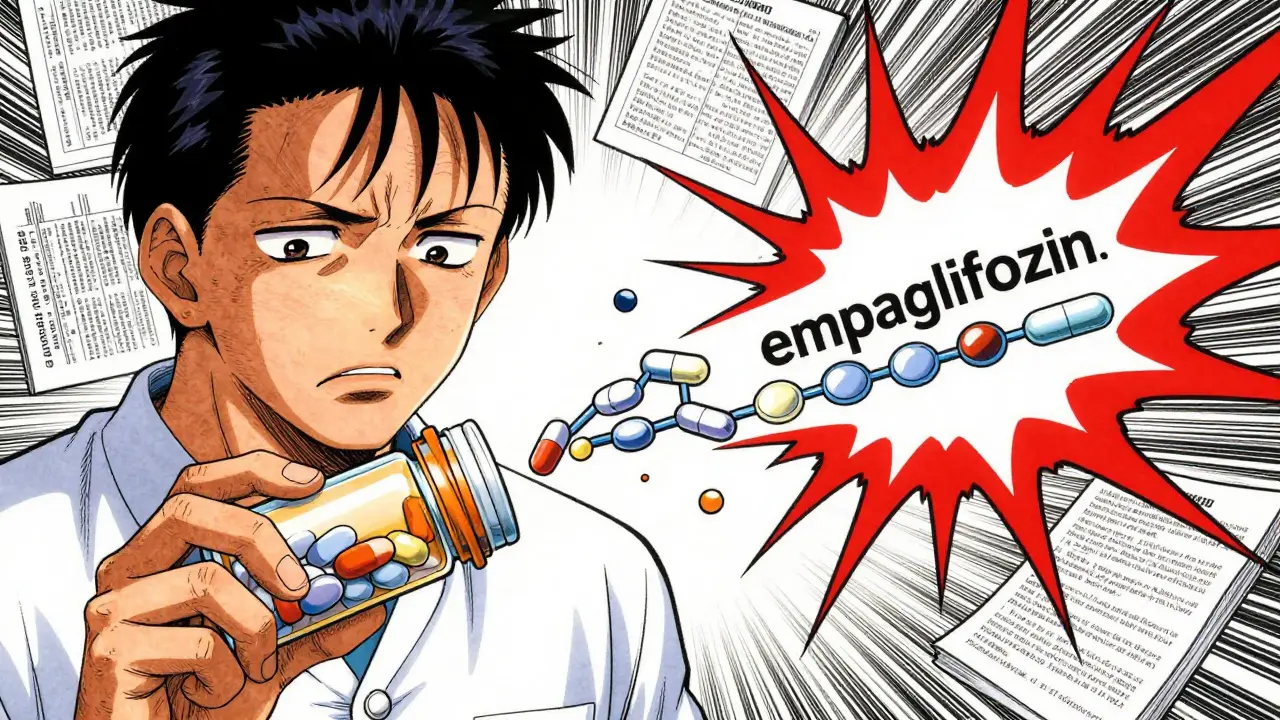
In 2023, a survey of independent pharmacists found that 68% faced a combination drug substitution dilemma at least once a month. Forty-two percent refused to substitute because they weren’t sure if it was legal. The problem? Each state has its own rules. Texas requires specific documentation for substitutions. California allows therapeutic substitution under certain conditions. But in most states, substitution laws were written for single-component drugs and never updated for multi-drug pills.The Alberta College of Pharmacy received multiple complaints from pharmacists who were accused of practicing medicine without a license after substituting a combination product. One case involved a patient on a pill containing metformin and sitagliptin. The pharmacy swapped it for a different combination with metformin and empagliflozin. The patient ended up with severe dehydration. The prescriber hadn’t approved the change. The pharmacist didn’t realize they needed authorization.
The FDA’s 2019 guidance says that even if two combination products have one matching ingredient, they’re not interchangeable unless all components are identical. That’s why ATRIPLA can’t be replaced with a generic version of just one of its three drugs. You can’t break it apart. The formulation, release timing, and interaction between ingredients are part of the approved product. Changing one component changes the whole.
The Financial Pressure and the Safety Trade-Off
There’s no denying the economic pull. Generic drugs make up 90% of prescriptions but only 23% of drug spending. Combination products, especially branded ones, can cost hundreds of dollars a month. Health plans and Medicare Part D are pushing hard for cost savings. The Inflation Reduction Act of 2022 encourages therapeutic substitution where safe. Some insurers will only cover the cheapest version of a combination drug, even if it’s not the one the doctor prescribed.Dr. Jane Chen from ICER estimates that expanding substitution for combination products could cut medication costs by 15-25% for chronic conditions like hypertension or diabetes. That’s billions saved. But the American Heart Association warns that inappropriate substitutions in cardiovascular patients could lead to adverse events in up to 8% of cases-especially among older adults with kidney disease, liver issues, or multiple other medications.
The European Medicines Agency is blunt: don’t substitute complex combination products without a doctor’s approval. That’s especially true for drugs with a narrow therapeutic index, like warfarin or lithium, where tiny changes in blood levels can cause toxicity or treatment failure. Even small differences in absorption or metabolism between two combination pills can have big consequences.
What Pharmacists Are Doing About It
Many pharmacists are stuck in the middle. They want to help patients save money. But they also know the risks. Some are calling prescribers to confirm substitutions. Others are refusing outright. A few are using “adaptation” authority-allowed in some states-to change a prescription at refill, but only if they have additional prescribing credentials.The American Pharmacists Association says adaptation is only allowed for new prescriptions, not refills. That creates a loophole: if a patient runs out of their combination pill, the pharmacist can’t swap it unless they call the doctor. But calling a doctor for every refill isn’t practical. Many doctors won’t respond quickly. Patients go without meds. That’s when they turn to over-the-counter supplements or skip doses entirely.
In 2022, a court case in California-Smith v. CVS Caremark-ruled that pharmacists cannot substitute a combination product that includes extra active ingredients not prescribed. The patient was on a two-drug combo. The pharmacy gave a three-drug combo. The court said that’s prescribing, not dispensing. The pharmacist had no legal authority to add a drug.
The Road Ahead: What’s Changing?
Change is coming, but slowly. In September 2022, the FDA released draft guidance on how to prove therapeutic equivalence for fixed-dose combinations. That’s the first time they’ve laid out clear standards for this. In March 2023, the National Association of Boards of Pharmacy proposed a model law that divides combination products into two categories: simple (two well-known drugs) and complex (novel combinations or those with narrow therapeutic windows). Only simple combinations would be eligible for pharmacist substitution.The European Commission is pushing for harmonized substitution rules across member states. In the UK, NHS England has a formal therapeutic substitution program for cardiovascular combinations that saved £280 million annually since 2019. But in Germany, most substitutions require written doctor approval. The U.S. is stuck in between.
By 2025, experts predict that 35% of all new drug approvals will be combination products. That means more pills with multiple active ingredients. More confusion. More lawsuits. More risk for patients. The system isn’t ready.
What Patients Should Know
If you’re on a combination drug, don’t assume your pharmacist can swap it. Always ask: “Is this the exact same combination?” If the pill looks different, or the name changed, ask for the original. If your insurance pushes a cheaper version, ask your doctor if it’s safe. Never take a substituted combination without confirming the ingredients match exactly.Keep a list of all your medications-including dosages and brand/generic names. Bring it to every appointment. If you’re switched without your knowledge, report it. You have the right to know what you’re taking.
What Prescribers Should Do
Write prescriptions clearly. Use the generic name and list all active ingredients. Don’t just write “ATRIPLA”-write “efavirenz 600 mg, emtricitabine 200 mg, tenofovir disoproxil fumarate 300 mg.” That way, if substitution happens, pharmacists know exactly what they’re replacing.Be aware of your state’s substitution laws. Some states require prescribers to write “Dispense as Written” or “Do Not Substitute.” Use that language if you’re concerned about safety. If you’re prescribing a complex combination-especially for heart disease, epilepsy, or mental health-assume substitution could be dangerous. Flag it.
Can a pharmacist substitute a combination drug without the doctor’s permission?
In most cases, no. Pharmacists can only substitute a combination drug if the alternative contains the exact same active ingredients in the same strengths and dosage form. If the substitute adds, removes, or changes any component, it’s considered a new prescription and requires prescriber authorization. State laws vary, but courts have consistently ruled that adding an unapproved ingredient is practicing medicine without a license.
Why can’t I just switch to a cheaper combination pill if it has one of the same drugs?
Because combination drugs aren’t just the sum of their parts. The way the ingredients interact-how they’re absorbed, how they’re released over time, how they affect each other-matters. Even if one ingredient matches, the other may not. For example, switching from amlodipine/atorvastatin to amlodipine/simvastatin changes the statin’s metabolism, which could increase side effects like muscle damage. The FDA requires full pharmaceutical equivalence for substitution to be legal and safe.
Are generic combination drugs available?
Yes, but they’re rare. Only about 37 combination products were approved between 2015 and 2022, compared to over 1,200 single-drug generics. That’s because proving two or more drugs work together in one pill requires extensive testing. Many combination drugs are still under patent protection. When generics do become available, they must match every ingredient exactly. There’s no such thing as a “partial generic” combination.
What’s the difference between a fixed-dose combination and a loose combination?
A fixed-dose combination (FDC) is two or more drugs in a single pill, tablet, or capsule, with a fixed ratio of ingredients. A loose combination means taking two separate pills at the same time. FDCs are regulated as one product. Loose combinations aren’t. Pharmacists can substitute one loose pill for another if they’re the same drug, but they can’t substitute an FDC unless every component matches exactly.
How do I know if my combination drug was substituted?
Check the pill’s imprint code, color, and shape. Compare it to the original. Look at the label-it should list all active ingredients. If the name changed or there’s an extra ingredient you didn’t expect, ask your pharmacist. They’re required to inform you if a substitution was made. If they didn’t, you have the right to request the original prescription be filled.




Comments (12)
Sachin Bhorde
Man, this is such a mess. Pharmacists are stuck between rock and hard place-insurance wants cheap, patients want meds, and the law? Still stuck in 2005. FDCs are everywhere now, but substitution rules? Barely updated. I’ve seen patients on amlodipine/valsartan get swapped to amlodipine/losartan and end up with angioedema. Not cool. FDA says no unless every component matches, but states? Chaotic. Alberta’s got it right-no swapping combos without prescriber nod. We need federal guidelines, stat.
Joe Bartlett
UK’s been doing this for years. NHS swaps combos like it’s nothing. Saved millions. US is just scared of progress. Pharmacists aren’t doctors-they’re trained professionals. Trust them.
Marie Mee
They’re hiding something. Big Pharma doesn’t want generics for combos because they control the patents. The FDA’s ‘guidance’? A joke. Look at the timeline-right after the Inflation Reduction Act. This is all about profit. They want you dependent on expensive pills. Your insulin combo? Next.
Naomi Lopez
It’s fascinating how regulatory frameworks lag behind pharmacological innovation. The concept of pharmaceutical equivalence simply doesn’t scale to multi-component systems without redefining interchangeability thresholds. The 2019 FDA draft guidance is a start, but it lacks granularity for therapeutic index-sensitive combinations. We need bioequivalence studies on pharmacodynamic endpoints, not just PK parameters.
Victoria Rogers
Why are we even talking about this? Americans can’t even spell ‘pharmacokinetics’ but want to play doctor. Canada and the UK handle this fine. We’re the ones with 100 different state laws. Fix your own house before you lecture the world.
Kaylee Esdale
Imagine if your coffee had two beans in it-espresso and dark roast-and someone swapped one for a totally different bean. You’d taste it. Same with meds. One ingredient changes, the whole experience changes. Don’t let someone play mixologist with your health. Ask for the exact combo. Always.
Jody Patrick
Stop the nonsense. If the doctor wrote ATRIPLA, you get ATRIPLA. No swaps. No excuses. This is America. We don’t play Russian roulette with prescriptions.
Radhika M
My cousin in Mumbai got switched from metformin/sitagliptin to metformin/empagliflozin and had kidney issues. No one told her. She thought it was the same. Don’t assume. Always check the label. Write down the names. Simple.
Jonathan Morris
The court case in California? That was inevitable. Adding an unapproved drug = practicing medicine. That’s not substitution, that’s malpractice. And the FDA’s guidance? Too little, too late. They knew this was coming. They let it happen. Why? Because they’re owned by the same lobbyists who profit from brand-name combos.
CAROL MUTISO
It’s funny how we treat meds like they’re LEGO bricks. You can just swap one piece and the whole thing still works. But your body’s not a toy. It’s a symphony. Change one note, and the whole thing goes off-key. I get the cost savings. But is a $20 discount worth a trip to the ER? Maybe for some. Not for me.
Erik J
Does anyone have data on how many adverse events were reported post-substitution in states that allow it? I’m curious if the 8% AHA estimate holds up in real-world settings.
BETH VON KAUFFMANN
Let’s be real-this whole thing is a regulatory dumpster fire. The FDA’s definition of pharmaceutical equivalence is a relic. They’re still using 1980s standards for 2020s science. And the states? Playing jurisdictional ping pong. Meanwhile, patients are the ones getting caught in the crossfire. Someone needs to blow this up and start over.