
SSRI Side Effect Management Guide
Find Your Side Effect Solutions
When you start taking an SSRI for depression or anxiety, you’re not just hoping for better mood-you’re also signing up for a list of possible side effects. Some are mild and fade. Others stick around. A few can be serious. And yet, many people aren’t warned about them before they begin.
Over 13% of U.S. adults take antidepressants, and SSRIs make up the majority of those prescriptions. They’re popular because they’re safer than older antidepressants, but that doesn’t mean they’re harmless. In fact, a study of 401 patients found that 86% experienced at least one side effect. Half of them found it hard to go about daily life because of it.
Common Mild Side Effects: What You’ll Likely Feel First
When you start an SSRI, your body isn’t ready for the sudden flood of serotonin. That’s why the first few weeks are often the toughest. Nausea hits about half of users. It’s not just a little upset stomach-it can be enough to make you skip meals or cancel plans. Dizziness, dry mouth, and headaches are also common. These aren’t signs you’re allergic. They’re your nervous system adjusting.
Insomnia or drowsiness? Both happen. Some SSRIs, like fluoxetine, tend to keep people awake. Others, like paroxetine, make you feel like you’re dragging through the day. The trick? Take it in the morning if it’s making you tired. Take it at night if it’s keeping you up. Most people find a rhythm within 3 to 6 weeks.
Sexual side effects are the most reported-and the most under-discussed. Up to 56% of users say they lose interest in sex. Men may have trouble getting or keeping an erection. Women may struggle to reach orgasm. For some, it’s temporary. For others, it lasts months or even years after stopping the drug. A 2023 Reddit survey found 42% of users still had these issues after six months. It’s not just a side effect-it’s a life change.
Weight Gain: It’s Not Just in Your Head
Weight gain is another big one. About 49% of people on SSRIs gain weight over time. It’s not just from overeating. SSRIs can slow your metabolism and increase cravings for carbs. Fluoxetine users report weight gain in 37% of cases. Paroxetine? Nearly half of users gain weight. And it’s not always small-some gain 10, 20, even 30 pounds.
But here’s the thing: it’s not inevitable. A 2023 meta-analysis showed that people who added regular exercise and structured eating gained 3.2 kilograms less over six months than those who didn’t. You don’t need a gym membership. Just 30 minutes of walking five days a week makes a measurable difference.
Serotonin Syndrome: When It Turns Dangerous
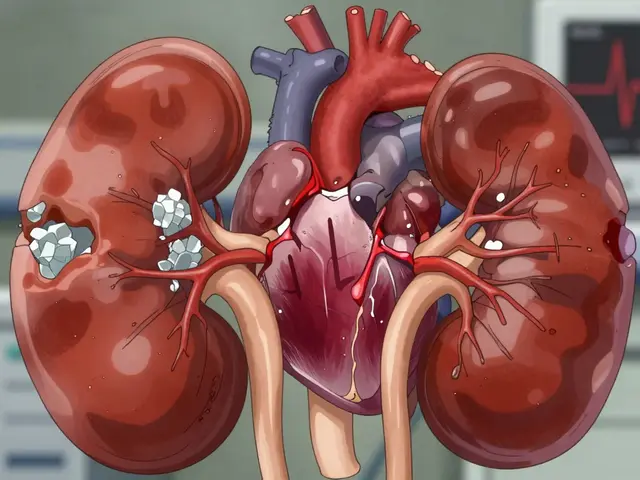
Most side effects fade. But serotonin syndrome is different. It’s rare-less than 1% of users-but it can kill you if you don’t act fast. It happens when too much serotonin builds up, usually because you’ve mixed SSRIs with other drugs. Think migraine meds like triptans, certain painkillers like tramadol, or even herbal supplements like St. John’s wort.
Early signs: sweating, shivering, fast heartbeat, muscle twitching. Later signs: confusion, high fever, seizures. If you feel any of these after starting or increasing an SSRI, go to the ER. Don’t wait. Don’t call your doctor tomorrow. Go now.
Hyponatremia: A Silent Risk, Especially for Older Adults
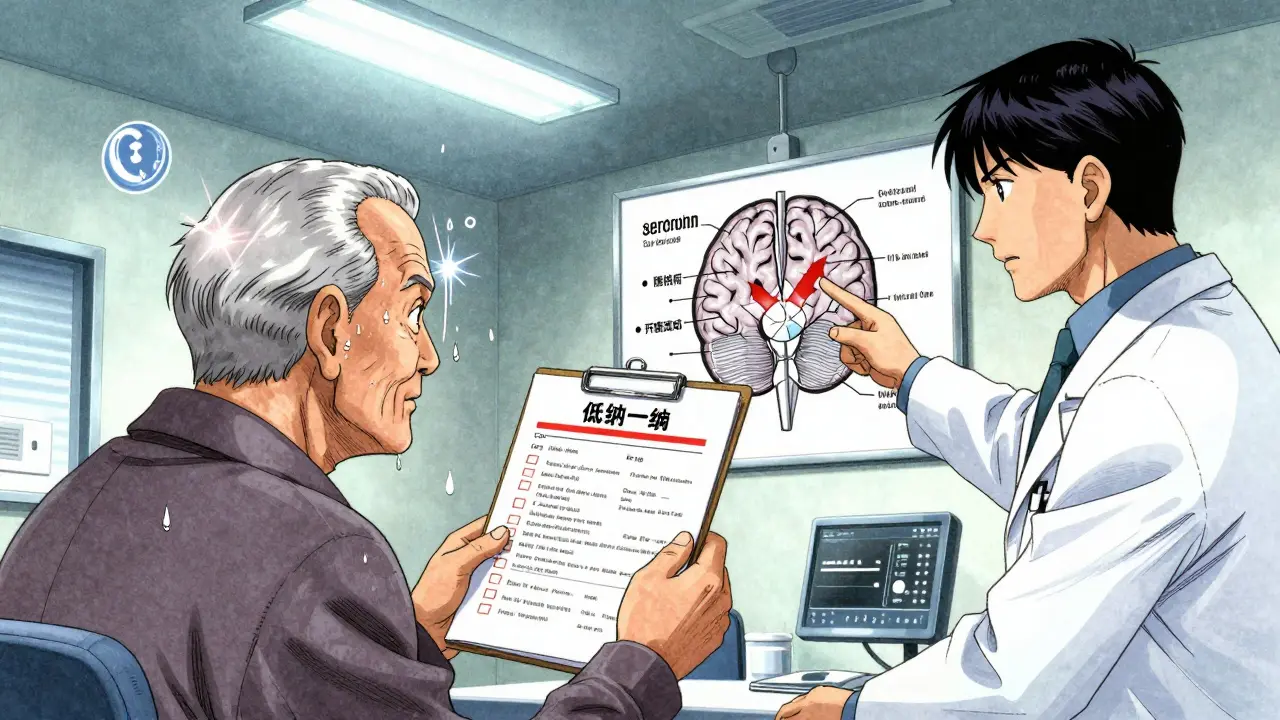
SSRIs are the most likely antidepressants to cause low sodium in the blood-a condition called hyponatremia. It’s more common in people over 65, women, and those who are dehydrated or taking diuretics. Symptoms are easy to miss: nausea, confusion, headaches, weakness. But if it gets worse, you can have seizures, coma, or even die.
Doctors check sodium levels before and after starting SSRIs in older patients. If you’re over 60, ask your doctor if you need a blood test. It takes five minutes. It could save your life.
Extrapyramidal Symptoms: Movement Disorders You Didn’t Expect
SSRIs aren’t just for your brain-they can affect your body too. Some people develop movement problems called extrapyramidal symptoms (EPS). The most common is akathisia: an inner restlessness that makes you feel like you can’t sit still. You pace. You fidget. You feel anxious even when you’re calm.
Dystonia? That’s when your muscles spasm suddenly-your neck twists, your eyes roll back. Parkinsonism? Tremors, stiff limbs, slow movements. These are more common in older adults and people with Parkinson’s. If you notice any of these, tell your doctor. Sometimes lowering the dose helps. Sometimes switching SSRIs does.
Discontinuation Syndrome: Why You Can’t Just Quit
Stopping an SSRI cold turkey is a bad idea. Even if you feel fine, your brain has adapted to the drug. When you pull it away, you get withdrawal symptoms. This isn’t addiction. It’s your nervous system rebalancing.
Symptoms hit within days: dizziness, electric-shock feelings in your head, nausea, insomnia, anxiety. They’re worse with SSRIs that leave your system fast-like paroxetine and fluvoxamine. That’s why doctors recommend tapering slowly. Cut your dose by 10% to 25% every two to four weeks. If you feel symptoms returning, slow down even more. Some people need to taper over months.
Metabolic Changes: The Hidden Risk of Long-Term Use
Most people think SSRIs only affect mood. But long-term use can mess with your metabolism. Research from Virginia Commonwealth University shows SSRIs can alter how your muscles use energy, increase insulin resistance, and raise your risk of type 2 diabetes. The FDA added a warning in June 2023: long-term SSRI users have a 24% higher relative risk of developing diabetes than those on other antidepressants.
That doesn’t mean you can’t take them. But if you’re on an SSRI for more than a year, get your blood sugar checked yearly. Watch your waistline. Move more. Eat less sugar. These aren’t just good habits-they’re medical necessities.

Managing Side Effects: What Actually Works
Not everyone needs to quit. Most side effects can be managed. Here’s what works, based on real patient data:
- Nausea? Take your pill with food. 63% of users say this helps.
- Diarrhea? Loperamide (Imodium) helps in 65% of cases.
- Sexual dysfunction? Dose reduction works for 40%. Adding bupropion (Wellbutrin) helps 50%. Sildenafil (Viagra) improved function in 67% of men in a clinical trial.
- Insomnia? Avoid caffeine after noon. Try melatonin. Don’t take SSRIs at night unless they make you sleepy.
- Weight gain? Combine diet changes with 150 minutes of walking per week. You’ll gain less.
Some people switch SSRIs. Citalopram is generally the best tolerated. Fluoxetine and sertraline are next. Paroxetine and fluvoxamine? They cause the most side effects and are hardest to quit.
When to Switch or Stop
Not every side effect means you need to stop. But some do. If you have:
- Severe serotonin syndrome symptoms
- Significant hyponatremia (low sodium)
- Uncontrollable movement disorders
- Depression getting worse instead of better
-then it’s time to talk to your doctor about alternatives. You might try a different class of antidepressant, like SNRIs or bupropion. Or explore therapy, exercise, or light therapy.
A 2022 NAMI survey found that 31% of patients quit their first SSRI within three months because side effects were unbearable. That’s not failure. That’s data. Your body is telling you what it needs.
What’s Changing Now
Science is catching up. In 2023, researchers identified genetic markers linked to SSRI-induced sexual dysfunction. That means one day, a simple blood test might tell you if you’re likely to have trouble with a certain drug.
Pharmaceutical companies are testing new SSRIs with lower rates of sexual side effects. One drug in Phase III trials showed 37% less sexual dysfunction than standard SSRIs.
And doctors are finally talking more. In 2023, 78% of psychiatrists said they now discuss side effects in detail before prescribing. 63% use genetic testing to predict who’s more likely to have bad reactions.
It’s not perfect. But it’s getting better.
Can SSRI side effects go away after stopping the medication?
Most mild side effects like nausea, dizziness, and headaches fade within weeks after stopping. But sexual dysfunction and weight gain can persist for months or longer. Some people report lasting sexual issues even after stopping SSRIs for over a year. There’s no guaranteed timeline-everyone’s body responds differently.
Which SSRI has the fewest side effects?
Citalopram is generally considered the best tolerated, with the lowest rates of side effects in clinical studies. Fluoxetine and sertraline follow closely. Paroxetine and fluvoxamine tend to cause more side effects and are harder to discontinue due to withdrawal symptoms.
Why do SSRIs cause weight gain?
SSRIs affect serotonin receptors that regulate appetite and metabolism. They can increase cravings for carbohydrates and slow down how your body burns energy. Some SSRIs, like paroxetine, are more likely to cause weight gain than others, like fluoxetine. Lifestyle changes like diet and exercise can help offset this.
Is sexual dysfunction from SSRIs permanent?
For most people, sexual side effects improve after stopping the medication. But a small percentage report persistent issues, sometimes for years. This is called Post-SSRI Sexual Dysfunction (PSSD). It’s rare but real. If you’re concerned, talk to your doctor before starting treatment.
Can I take supplements to reduce SSRI side effects?
Some supplements may help, but others can be dangerous. Omega-3s and vitamin D may support mood without interfering. But St. John’s wort can cause serotonin syndrome when mixed with SSRIs. Always check with your doctor before adding anything to your regimen.
How long do SSRI side effects last?
Most mild side effects peak in the first 1-2 weeks and fade within 4-6 weeks. Sexual dysfunction, weight gain, and metabolic changes can develop over months or years. Discontinuation symptoms last 1-3 weeks after stopping, but can linger longer if you quit too quickly.
Are SSRIs safe for long-term use?
SSRIs are generally safe for long-term use, but they require monitoring. Long-term use increases the risk of metabolic changes, including insulin resistance and weight gain. Regular blood sugar checks, weight tracking, and lifestyle habits are essential. Many people take SSRIs for years with no major issues-especially when side effects are managed early.
SSRIs changed how we treat depression. But they’re not magic pills. They’re tools-with real risks and real benefits. The key isn’t avoiding them. It’s knowing what to expect, how to respond, and when to speak up. Your mental health matters. So does your physical health. Don’t let silence cost you both.




Comments (14)
Arlene Mathison
Just started sertraline last week and honestly? The nausea hit like a freight train. Took it with food like they said and boom-90% better. Still got the dry mouth though, and my coffee tastes like cardboard now. 😅
Emily Leigh
Ugh. Another ‘SSRIs are fine!’ article. Where’s the data on the 20% who never recover their libido? Where’s the warning that this isn’t just ‘adjusting’-it’s rewriting your brain’s wiring? 🤡
Carolyn Rose Meszaros
Thank you for writing this. I’ve been on citalopram for 3 years. Weight gain? Yep. Sexual side effects? Still there. But my anxiety? Gone. I’d take the trade. 💚
Greg Robertson
Hey, I just wanted to say I really appreciated the part about tapering. I tried quitting fluoxetine cold turkey once-felt like my head was full of static for weeks. Took 3 months to taper down slowly. No regrets, but it’s not easy. 🙏
Courtney Carra
It’s funny how we treat SSRIs like they’re either miracle cures or demonic potions. They’re just chemicals interacting with a biological system that’s still half mystery. We need more nuance-not fear, not fanboyism. Just honest science. 🤔
Renee Stringer
They didn’t mention how SSRIs can make you emotionally numb. Not depressed-just… flat. Like you’re watching life through a fogged-up window. And no one talks about that. Ever.
Jacob Cathro
Okay so like SSRIs cause metabolic syndrome? Bro. That’s not a side effect-that’s a full system override. And they just say ‘eat less sugar’? That’s like telling someone with lung cancer to stop smoking and call it a day. 🤦♂️
thomas wall
It is deeply irresponsible to suggest that weight gain and sexual dysfunction are ‘manageable’ without acknowledging the profound psychological toll they exact. To dismiss these as ‘common’ is to trivialize the lived reality of thousands. One cannot simply ‘walk it off’ when one’s identity is eroded.
clifford hoang
Did you know the FDA knew about PSSD since 2002 but buried the data because Big Pharma didn’t want panic? 🕵️♂️ They’re testing ‘new SSRIs’? Yeah, right. Same company. Same lab. Same profit motive. Wake up, sheeple.
Nadia Watson
I’m 68 and started sertraline last year. My doctor checked my sodium levels before and after. It was fine. But I didn’t know to ask. Please, older folks: ask for the blood test. It’s five minutes. It could save your life. 🙏
Paul Barnes
Correction: The 2023 Virginia Commonwealth study found a 24% relative risk increase, not absolute. That’s not ‘high risk’-it’s statistically significant but clinically modest. Please don’t misrepresent data.
Art Gar
So you recommend switching to bupropion? That’s like trading a slow leak for a burst pipe. I gained 40 pounds on paroxetine, then went on Wellbutrin and developed mania. You don’t get to say ‘it’s just a different side effect.’
Shane McGriff
Hey, I’ve been through all of this. Nausea, weight gain, sexual dysfunction, withdrawal hell. But I’m 4 years sober from SSRIs now and finally feel like me again. It took time, therapy, yoga, and zero shame. You’re not broken-you’re just healing. Keep going.
Edith Brederode
My mom took citalopram for 12 years. She said the only thing that made her feel human again was finally talking to someone who didn’t judge her for crying at the grocery store. SSRIs aren’t the cure-but they gave her the space to find one. ❤️