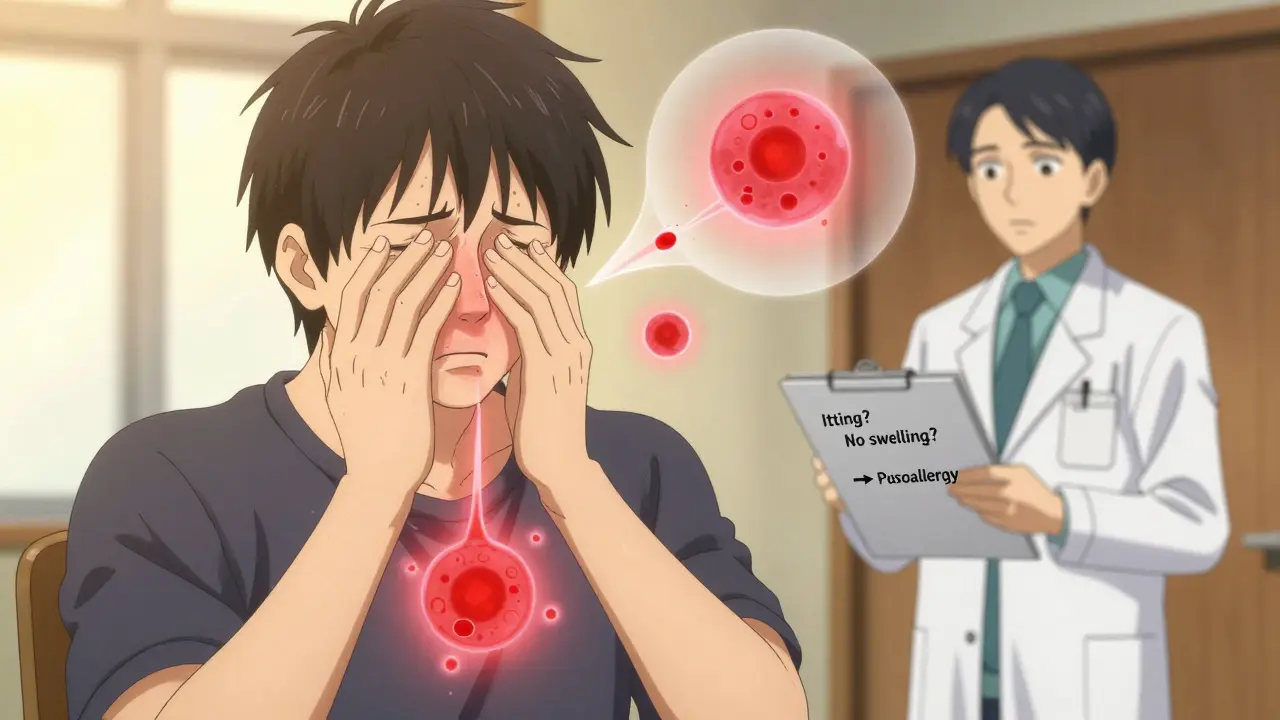
Itching after taking an opioid like morphine doesn’t mean you’re allergic. In fact, it’s probably not an allergy at all. Around 70-80% of people who say they’re allergic to opioids are actually experiencing a pseudoallergic reaction - a common side effect caused by histamine release, not an immune response. This misunderstanding leads to unnecessary pain, higher costs, and fewer treatment options. If you’ve been told you’re allergic to opioids because you got itchy, you might be missing out on effective pain relief - and you’re not alone.
What’s Really Happening When You Itch After an Opioid?
Opioids like morphine and codeine trigger mast cells in your skin to dump histamine. That’s it. No immune system involvement. No antibodies. No memory cells. Just a chemical reaction. The result? Flushing, warmth, and that relentless itch - especially on the nose, face, and chest. This isn’t a rash you can scratch away. It’s a signal your body is responding to the drug’s chemistry, not fighting it.
Studies show morphine releases 3 to 4 times more histamine than hydromorphone at the same pain-relieving dose. Fentanyl? Almost none. Methadone? Very little. That’s why some people itch badly on morphine but feel fine on fentanyl or oxycodone. It’s not about being allergic - it’s about which opioid you’re getting.
The itch isn’t even always from histamine. Some research points to a spinal cord pathway involving gastrin-releasing peptide receptors (GRPR). Even when antihistamines don’t help, the itch stays. That’s why simply taking Benadryl doesn’t always fix it - and why doctors need to look deeper.
True Opioid Allergy: Rare, But Dangerous
True opioid allergies are rare - affecting only 0.1% to 0.3% of people who take them. But they’re serious. These are IgE or T-cell mediated immune reactions. They don’t just cause itching. They cause hives, swelling of the lips or throat (angioedema), wheezing, dropping blood pressure, or even anaphylaxis.
These reactions happen fast - usually within minutes of the first dose. They’re not dose-dependent. Even a tiny amount can trigger a life-threatening response. A 2022 Mayo Clinic case report described a woman who went into anaphylaxis after her first morphine injection. Her blood pressure crashed to 70 mmHg. She needed epinephrine and ICU care. That’s a true allergy. That’s not itching.
True allergies also tend to involve more than one system. Skin + breathing + low blood pressure? That’s a red flag. Just itching? Almost certainly not.
Why Mislabeling Matters
If you’re labeled “allergic to opioids” based on itching, you’re stuck with weaker painkillers, higher doses, or risky alternatives like NSAIDs - which aren’t always safe for chronic pain. You might get stuck with expensive, less effective drugs like tramadol or tapentadol. Or worse - you might not get enough pain control at all.
The cost? About $1,200 extra per patient per year in the U.S. That adds up to $24-36 billion annually across the healthcare system. And it’s preventable.
One study of 1,247 patients found that 87% of those who claimed an opioid allergy only reported itching, nausea, or dizziness - all common side effects, not allergies. Yet they were still labeled allergic and denied appropriate treatment.
How to Tell the Difference
Here’s a simple way to tell if it’s a pseudoallergic reaction or a true allergy:
- Itching only? No swelling, no trouble breathing? No drop in blood pressure? → Likely pseudoallergic.
- Itching + hives + swelling of face/tongue + wheezing + dizziness? → Could be true allergy. Seek help immediately.
- Does the itch get worse with higher doses or faster IV pushes? → Classic pseudoallergy.
- Did it happen the first time you took the drug? → True allergies usually need prior exposure to develop. But not always - rare cases can happen on first use.
Doctors use tools like the Opioid Allergy Assessment Tool - developed at MD Anderson - which looks at symptom timing, dose link, and response to antihistamines. It correctly identifies pseudoallergies in 92% of cases.

What to Do If You Get Itchy
If you’re on an opioid and start itching, don’t assume you’re allergic. Talk to your provider. Here’s what works:
- Reduce the dose. Lowering the opioid by 25-50% often cuts the itching in half.
- Use an H1 antihistamine. Diphenhydramine (Benadryl) 25-50 mg IV or oral, given 30 minutes before the opioid, helps in 80-90% of cases.
- Switch opioids. Move from morphine or codeine to fentanyl, methadone, or hydromorphone. Fentanyl causes 3-4 times less histamine release than morphine. Methadone? Even less. Studies show switching reduces itching from 30-40% to 10-15%.
- Try a different route. Oral or patch forms (like fentanyl patch) release the drug slowly, lowering histamine spikes.
For cancer patients or those with chronic pain, this approach works. One Harvard study found 78% of patients labeled “opioid allergic” tolerated alternative opioids after antihistamine premedication. Only 5% had true allergic reactions.
What If You Have a True Allergy?
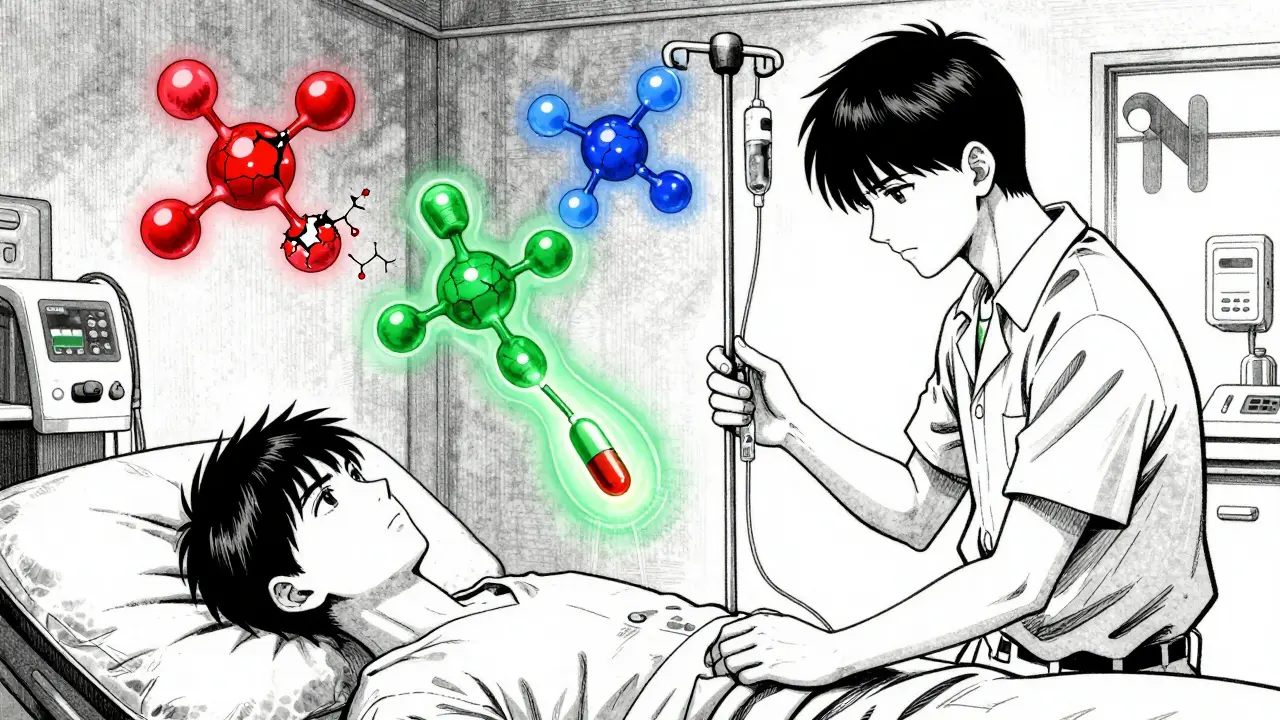
If you’ve had a real allergic reaction - swelling, breathing trouble, anaphylaxis - avoid that opioid and any structurally similar ones. Morphine, oxycodone, and hydrocodone are all phenanthrenes. They can cross-react.
Fentanyl, methadone, and meperidine are chemically different. They rarely cause cross-reactions. In fact, cross-reactivity between phenanthrenes and phenylpiperidines is less than 5%.
Desensitization is an option if you absolutely need the drug. A 12-step IV morphine protocol over 4-6 hours has a 95% success rate. But this should only be done under strict medical supervision.
What’s New in Treatment
There’s promising research on drugs that target the itch without blocking pain. Nalfurafine, approved in Japan since 2009 and in Phase 3 trials in the U.S., reduces opioid-induced itching by 70% without reducing pain relief. It works on kappa opioid receptors - a completely different pathway than morphine.
Other drugs in development, like CR845 (korsuva) and NOP receptor agonists, are showing 80% reduction in itching in clinical trials. These could be game-changers for cancer patients and those on long-term opioids.
Genetic testing might soon help predict who’s at risk. Variants in the HTR7 serotonin gene are linked to stronger histamine release. In the future, a simple blood test could tell you if you’re likely to itch on morphine.
What Patients Are Saying
On Reddit’s r/painmanagement, users share real experiences:
“I was told I was allergic to all opioids because I got itchy on morphine. I tried fentanyl patch with Benadryl - no itch, no problem. Now I’m on it full time.” - u/PainWarrior2022
But others warn:
“I had swelling and couldn’t breathe after one shot of morphine. They said it was just itching. I almost died. Don’t ignore real symptoms.”
The message is clear: Don’t dismiss itching - but don’t panic either. Know the difference.
What Doctors Should Do
Health systems are catching on. Epic’s electronic health record system now flags reaction types - separating “itching” from “anaphylaxis.” Hospitals using this saw a 45% drop in incorrect allergy labels.
The American Society of Health-System Pharmacists recommends teaching patients to recognize the difference. When patients understand that itching ≠ allergy, they’re less likely to refuse pain meds - and more likely to report real emergencies.
Stop labeling. Start evaluating. Use the tools. Ask: Was it dose-dependent? Did antihistamines help? Was it isolated itching? If yes - it’s not an allergy. You can fix it.
Bottom Line
Most opioid itching isn’t an allergy. It’s a chemical side effect. You can manage it. You can switch drugs. You can get relief without risking your pain control. Don’t let a mislabeling stop you from getting the care you need. If you’re itchy on opioids, talk to your doctor - don’t assume you’re allergic. And if you’ve been told you are, ask for a second look. You might be able to take opioids safely after all.



Comments (14)
Roshan Joy
I got itchy on morphine after surgery and thought I was allergic. Turned out it was just histamine. Switched to fentanyl patch + Benadryl before dose - no more itch, no more fear. 🙌
Michael Patterson
Okay so let me get this straight - you’re telling me that 80% of people who say they’re allergic to opioids are just getting histamine flushes? Like, the same thing that happens when you eat shrimp or drink wine? But we’re labeling people allergic based on itching? That’s like calling someone allergic to sunlight because they get a sunburn. The medical system is still stuck in the 1980s. I swear if I see one more chart that says "opioid allergy - itching" I’m gonna scream. Also typo: morphine releases 3-4x more than hydromorphone - not "same pain relieving dose" - that’s not how pharmacology works. Fix your shit.
Matthew Miller
This is why medicine is broken. You let patients self-diagnose allergies based on itching? Are you kidding me? I’ve seen people refuse every pain med because they "got itchy once" and now they’re on gabapentin at 3000mg/day. That’s not treatment - that’s chemical cowardice. Stop letting people make medical decisions based on Reddit posts. You think your itch is special? It’s not. It’s biology. Learn it.
Madhav Malhotra
In India, we call this "dard ki chhutti" - pain’s little break. But honestly, I’ve seen so many people avoid opioids because of this myth. My uncle was told he was allergic after a little itch post-surgery - ended up with terrible pain for weeks. He switched to hydromorphone and now he’s back to gardening. Simple fix, big difference. 🌿
Priya Patel
I used to HATE opioids because I’d itch like crazy after morphine… like, full-body, can’t-sleep, want-to-scratch-my-skin-off crazy. Then my nurse said, "Try Benadryl 30 mins before." I did. And it was like a miracle. I cried. Not from pain. From relief. I wish someone had told me this sooner. You’re not allergic. You’re just sensitive. And that’s okay. 💛
Jason Shriner
So let me get this straight. The entire medical establishment is wrong about opioid allergies… because of itching? And now we’re supposed to trust a "tool" from MD Anderson? I’m sure they didn’t just make that up after lunch. /s. Also, "fentanyl causes 3-4x less histamine" - yeah, because it’s basically a chemical ghost. No personality. No drama. Just pain. Perfect for a society that wants to numb everything.
Alfred Schmidt
I had a real allergic reaction. Swelling. Tongue. Breathing. ICU. They told me it was "just itching". I almost died. So don’t you dare tell me to "just try fentanyl". Not everyone’s itch is harmless. Not everyone’s story ends with a Benadryl and a pat on the head. I don’t need your "educational post". I need you to LISTEN. And if you’re going to write about this - stop pretending all itching is the same. It’s not. It’s not.
Vincent Clarizio
Look, I get it - you want to reduce mislabeling. But you’re oversimplifying. The body doesn’t care about your nice little flowchart. I had itching, then hives, then swelling, then wheezing - all within 10 minutes. You call that pseudoallergic? That’s not a side effect - that’s your immune system screaming. And now you want me to trust a "tool" that says "if no BP drop, it’s fine"? What if I’m a slow reactor? What if my anaphylaxis comes at 45 minutes? You can’t reduce life-or-death reactions to a checklist. This isn’t a tech blog. This is human biology. And humans are messy. Stop trying to code them.
Sam Davies
Ah yes, the classic Western medical narrative: "It’s not an allergy, it’s histamine." As if that somehow makes it less real. You might as well say "it’s not a hurricane, it’s just wind and rain." The symptom is still the same. The suffering is still the same. And the patient still can’t take morphine. So what’s the point of your taxonomy? To make doctors feel smarter? Or to make patients feel like their pain is just a glitch in the system?
Christian Basel
The pseudoallergic paradigm is a useful heuristic but lacks mechanistic granularity. Histamine-mediated PRs are heterogenous - GRPR involvement, non-histaminergic spinal pathways, and mast cell heterogeneity aren’t accounted for in most clinical algorithms. Also, the 92% accuracy claim from MD Anderson is based on retrospective chart review - selection bias is likely. We need prospective biomarker validation before scaling this as standard.
Alex Smith
I used to be the guy who said "I’m allergic to everything" because I got itchy. Then I learned the difference. Now I’m the guy who tells people on Reddit: "Try Benadryl first. Try fentanyl. Don’t quit opioids because of a scratch." You’re not broken. You’re just misinformed. And that’s fixable.
Adewumi Gbotemi
In Nigeria, we don’t have much opioids, but when we do, people avoid them because of itching. My cousin said he can’t take painkillers - he gets itchy. I told him, "Maybe it’s not the drug, maybe it’s how it’s given." He tried oral codeine - no itch. He’s back to sleeping. Simple things matter.
Jennifer Littler
I work in oncology. I’ve seen patients refuse morphine because they were labeled allergic after one itchy episode. Then they’re in pain all day, crying, begging for something - anything. We give them tramadol, which barely touches the pain. Then we wonder why they’re depressed. This isn’t just about drugs. It’s about dignity. Don’t let a label steal someone’s comfort.
Sean Feng
The author is right. Most itching isn't allergy. Switch opioids. Use antihistamines. Done. Stop overthinking it. This post is 90% common sense. Why does it need to be 2000 words?