
Why Accurate Dosing Matters for Kids
Giving your child the wrong amount of medicine can be dangerous. Too little might not help with a fever or infection. Too much could cause serious side effects-or worse. Children’s bodies are small, and their doses are calculated by weight, often as little as 0.05 to 0.2 mL per kilogram. That’s why using the right tool isn’t just helpful-it’s life-saving.
Studies show that over 40% of parents make dosing mistakes with liquid medications when using household spoons or measuring cups. The American Academy of Pediatrics (AAP) and the FDA both agree: oral syringes are the safest, most accurate way to give liquid medicine to kids. They’re not optional. They’re essential.
What’s the Difference Between a Dosing Syringe and an Oral Dispenser?
Most people use these terms interchangeably, but there’s a small distinction. A dosing syringe is a plastic syringe without a needle, designed specifically for oral use. It has clear, precise markings in milliliters (mL) and a plunger you pull back to draw the right amount. An oral dispenser can refer to any device that delivers liquid medicine into the mouth-this includes syringes, cups with spouts, and even some droppers. But when doctors and pharmacists say "use an oral dispenser," they almost always mean the syringe.
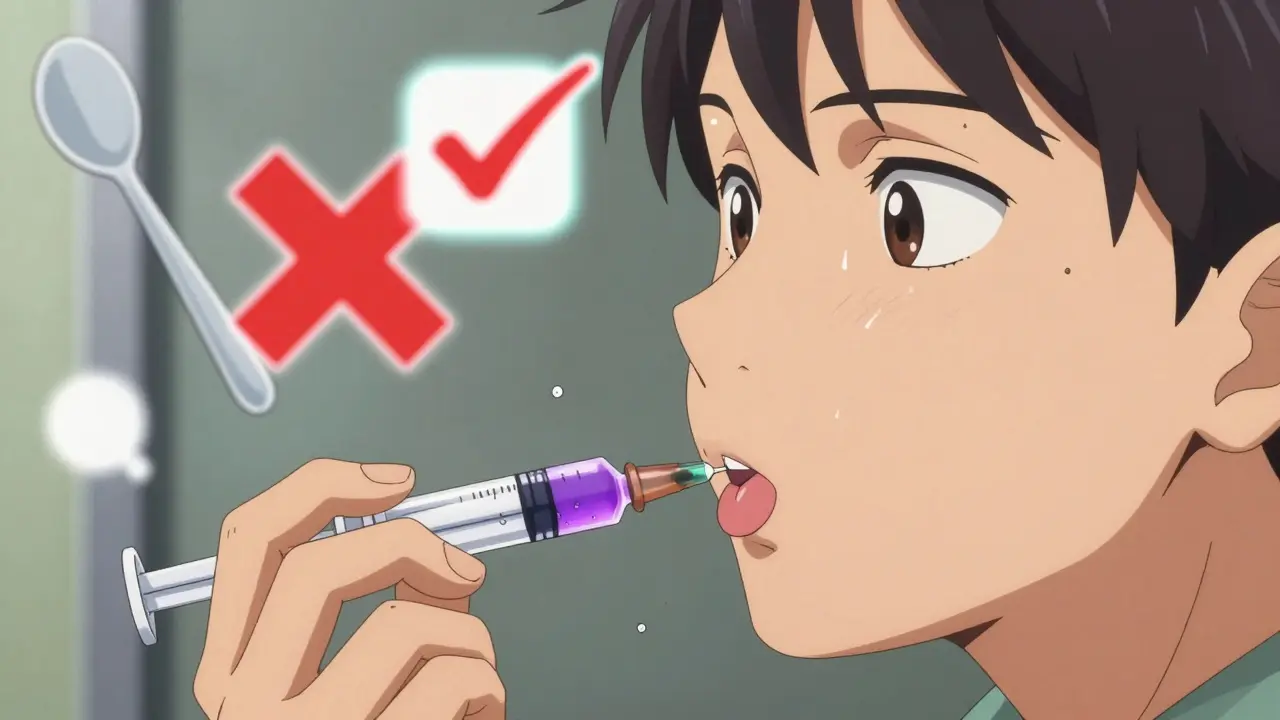
Forget the teaspoon. A kitchen teaspoon holds anywhere from 2.5 to 10 mL-over 400% variation. That’s not a measurement. That’s luck. Oral syringes, on the other hand, are accurate within ±5% of the exact dose. For a 2 mL dose of acetaminophen, that difference could mean the difference between relief and harm.
Choosing the Right Syringe Size
Not all syringes are made the same. The size you need depends on the dose your child is prescribed. Using the wrong size makes accuracy harder.
- 1 mL syringe: Best for doses under 1 mL. Marked in 0.01 mL increments. Used for newborns or very small doses of antibiotics.
- 3 mL syringe: Ideal for doses between 1-3 mL. Marked in 0.1 mL increments. Most common for toddlers on ibuprofen or amoxicillin.
- 5 mL syringe: For doses between 3-5 mL. Marked in 0.2 mL increments. Good for older kids on higher doses.
- 10 mL syringe: Only for doses over 5 mL. Marked in 0.5 mL increments. Useful for larger volumes but less precise for small doses.
Pro tip: Always use the smallest syringe that can hold your child’s dose. A 10 mL syringe for a 1.5 mL dose is like using a ruler to measure a coin-too coarse. The 3 mL syringe is the sweet spot for most pediatric meds.
How to Use a Dosing Syringe Step by Step
It’s simple-but only if you do it right. Here’s how:
- Shake the bottle. Liquid medicines often settle. Shake it for 10-15 seconds to mix the medication evenly.
- Remove the cap. Never leave the cap on the syringe tip-it’s a choking hazard. Always check before use.
- Insert the syringe. Screw or push the syringe tip into the bottle’s opening. Don’t force it. Some bottles have special adapters.
- Draw the dose. Pull the plunger slowly until the top edge of the plunger lines up with your child’s dose. Don’t guess. Don’t eyeball. Look at the markings from eye level.
- Remove the syringe. Wipe the tip with a clean tissue if needed. Don’t rinse it unless the label says to.
- Position your child. Sit them upright. Never lie them flat. This prevents choking and helps them swallow.
- Administer slowly. Place the syringe tip between the cheek and gum-not at the back of the throat. Push the plunger in small 0.5 mL bursts, pausing 5-10 seconds between each. Let them swallow naturally.
- Wait. Don’t rush. If they spit some out, wait a few minutes before giving more. Never give a second dose unless your doctor says so.
Common Mistakes (And How to Avoid Them)
Even experienced parents make these errors. Here’s what goes wrong-and how to fix it:
- Using the wrong syringe size. A 10 mL syringe for a 1.2 mL dose? You’ll misread it. Stick to the 3 mL syringe unless the dose is over 5 mL.
- Not checking the markings. Some syringes have markings on the side, others on the plunger. Know which one you’re reading. Always read from the top edge of the plunger, not the bottom.
- Injecting too fast. Pushing the plunger quickly makes kids gag or spit it out. Slow is better. Think of it like feeding a baby with a spoon-not pouring.
- Putting it in the throat. This is the #1 cause of choking. Always place the syringe in the cheek pouch. The tongue naturally moves the liquid back.
- Using kitchen spoons. Even "medicine spoons" that come with the bottle can be off by 20%. Don’t risk it.
What About Thick Medications Like Amoxicillin?
Some antibiotics, like amoxicillin suspension, are thick and sticky. Drawing them into the syringe can be frustrating. Here’s how to make it easier:
- Shake the bottle extra well-up to 30 seconds.
- Let the bottle sit upright for 30 seconds after shaking. This lets bubbles rise and makes drawing smoother.
- Use a 3 mL or 5 mL syringe. Smaller ones (1 mL) can clog.
- If it’s still hard, try warming the bottle slightly in your hand. Cold medicine thickens. Warm it up, but don’t microwave it.
- Some pharmacies offer pre-filled syringes for thick meds. Ask if they’re available.
What to Do If Your Child Spits Out the Medicine
It happens. A lot. Don’t panic. Don’t immediately give another full dose.
Wait 15-20 minutes. If they spit out most of it (more than half), call your pharmacist or doctor. They’ll tell you whether to give a replacement dose. Many medications are absorbed quickly, so even if they spit some out, they may have already swallowed enough. Giving extra can lead to overdose.
Some parents try mixing medicine with juice or food. Don’t. It can change how the drug works, and your child might not finish the whole cup. Always give it straight from the syringe.
Why Color-Coded Syringes Are a Game-Changer
Many brands now make syringes with color-coded plungers: green for acetaminophen, purple for ibuprofen, blue for antibiotics. This isn’t just marketing-it’s safety.
One parent on Reddit shared that switching to color-coded syringes stopped them from accidentally giving ibuprofen instead of Tylenol. That kind of mix-up can be dangerous. If your pharmacy offers them, ask for them. They’re often free with prescriptions.

What’s New in Pediatric Dosing Tools
Technology is catching up. In 2023, the FDA approved the first color-changing syringe-it turns from blue to green when you’ve drawn the right dose. Clinical trials showed a 37% drop in dosing errors.
By late 2025, smart syringes with Bluetooth will hit the market. They’ll connect to your phone, remind you when to give the next dose, and log whether it was given correctly. Some pharmaceutical companies are already testing QR codes on medicine bottles that link to video tutorials on proper syringe use.
The World Health Organization now requires oral syringes for all liquid children’s medicines globally. By 2027, they project this will prevent 250,000 dosing errors a year.
When to Use a Cup Instead of a Syringe
Syringes are best for doses under 5 mL. For older kids (over 4 years) who can drink from a cup, a dosing cup is fine for larger doses-say, 10 mL of cough syrup.
But even then, use a cup with clear metric markings. Never use a regular cup or glass. And always double-check the dose. Studies show dosing cups still have an 8% error rate for 10 mL doses-better than spoons, but not as good as syringes.
Final Advice: Practice Makes Perfect
Most parents learn how to use a dosing syringe in 8-12 minutes. But it’s worth practicing before you need it. Try filling it with water. Draw 2 mL. Then 1.5 mL. Watch how the plunger moves. Learn where the markings are.
Ask your pharmacist to show you how to use it. Most will do it for free. If you’re still unsure, ask for a return demonstration-repeat the steps back to them. Research shows this cuts errors from 58% down to 11%.
Medication safety isn’t about being perfect. It’s about being careful. And with the right tool and technique, you’re already doing better than most.
Can I reuse a dosing syringe?
Yes, you can reuse a dosing syringe for the same medication, as long as you clean it properly. Rinse it with warm water after each use, then let it air dry. Don’t boil it or put it in the dishwasher unless the manufacturer says it’s safe. Never use the same syringe for different medicines unless you’ve washed it thoroughly-cross-contamination can be dangerous.
Why do dosing syringes say "for oral use only"?
This is a safety requirement from the FDA. Between 2001 and 2009, over 130 children were accidentally given liquid medicine through IV lines because someone used an oral syringe by mistake. Oral syringes are designed to be too wide to fit into IV ports, but the label makes it impossible to miss. Never, ever use an oral syringe for anything other than the mouth.
My child won’t swallow the medicine. What do I do?
Don’t force it. Try giving it slowly in small 0.5 mL bursts. Let them swallow between each. If they’re old enough, offer a cold treat like a popsicle right after to mask the taste. Some pharmacies sell flavor packets you can mix in. Never mix medicine with juice unless your doctor says it’s safe. If your child consistently refuses, talk to your pediatrician-there may be an alternative form, like a chewable or dissolvable tablet.
Are oral syringes covered by insurance?
Yes, most insurance plans cover oral syringes when prescribed with a medication. Many pharmacies give them for free with a prescription. If you’re asked to pay, ask if they have a sample from the manufacturer. Some brands like BD, Medline, and CareTouch offer free syringes with prescriptions. Don’t buy them at a convenience store-they’re often inaccurate or poorly made.
How do I know if my child got the right dose?
The best sign is improvement in symptoms. If their fever goes down, they stop crying from pain, or they start eating again, they likely got the right dose. If you’re unsure you measured correctly, call your pharmacist. They can help you calculate the dose based on your child’s weight. Never guess. Always check the label and the syringe twice.
What to Do Next
Before the next dose, grab the syringe and the medicine bottle. Read the label again. Check the dose. Pull the plunger slowly. Make sure the mark lines up. Then give it slowly, between the cheek and gum.
Keep a log: date, time, dose, and how your child reacted. It helps your doctor spot patterns. If your child’s symptoms don’t improve-or get worse-call your provider. Don’t wait. Don’t double the dose. Don’t guess.
Accurate dosing isn’t complicated. It just takes attention. And with the right tool, you’re already doing more than most parents ever will.





Comments (9)
Bobby Collins
I heard the FDA is secretly using these syringes to track kids' meds through microchips. They're also linked to the 5G towers. Don't believe the hype, but why do they need to know how much Tylenol you give your kid? 🤔
Donna Peplinskie
This is so important! I used to use a teaspoon until my toddler nearly choked on a dose of amoxicillin. Now I use a 3 mL syringe every single time-no exceptions. I even keep a spare in my diaper bag. Small steps, big safety wins. 💕
Liam George
The real issue isn't syringes-it's the pharmaceutical-industrial complex weaponizing pediatric dosing to normalize compliance. Color-coded plungers? That's behavioral conditioning disguised as safety. The WHO's 2027 projection? A distraction from the fact that they're standardizing control. We're being trained to trust the syringe, not our instincts.
sharad vyas
In India, many parents still use spoons because syringes are not always available. But I always teach my neighbors: even a clean spoon with a line marked by a pen is better than guessing. Safety starts with awareness, not tools alone.
Dusty Weeks
i just use the dropper that comes with the bottle lol why make it so hard? 🤷♂️😂
Sally Denham-Vaughan
I used to think this was overkill until my 2-year-old threw up half a dose of ibuprofen and I panicked. Now I practice with water every time we get a new prescription. It’s like brushing your teeth-just do it. And yes, the color-coded ones are a game-changer. My kid even helps me pick the right color now 😊
Bill Medley
Accurate dosing is a non-negotiable standard of care. The evidence is unequivocal. Use a syringe. Always.
Richard Thomas
There's something deeply human about the ritual of measuring medicine for a child. It's not just about volume-it's about presence. The slow pull of the plunger, the eye-level reading, the pause between bursts... these aren't steps in a protocol. They're acts of love made tangible. In a world that rushes everything, this moment-this tiny, precise act-becomes sacred. We don't just give medicine. We give attention. And that's what heals as much as the drug itself.
Paul Ong
Just use the syringe dont overthink it the color coding is genius and yes you can reuse it clean it with water and youre good to go