
You take a deep breath. Instead of relief, your chest tightens. Your throat feels like it’s closing up, and that familiar wheeze starts. If this happens after you’ve been around pets, walked through grass on a spring day, or cleaned the attic, you might not just have regular asthma. You likely have allergic asthma, which is a specific type of asthma triggered by an immune system overreaction to harmless substances in the environment. It is the most common form of asthma, affecting about 60% of adults and over 80% of children with the condition. The good news? Because we know exactly what triggers it, we can manage it far better than non-allergic types.
This isn't just about carrying an inhaler. It’s about understanding why your body attacks pollen or dust mites as if they were dangerous invaders. When you understand the mechanism, you stop guessing and start controlling. We will look at the science behind the reaction, how to spot your specific triggers, practical ways to avoid them, and whether treatments like immunotherapy could actually change your long-term health.
How Allergic Asthma Works: The IgE Connection
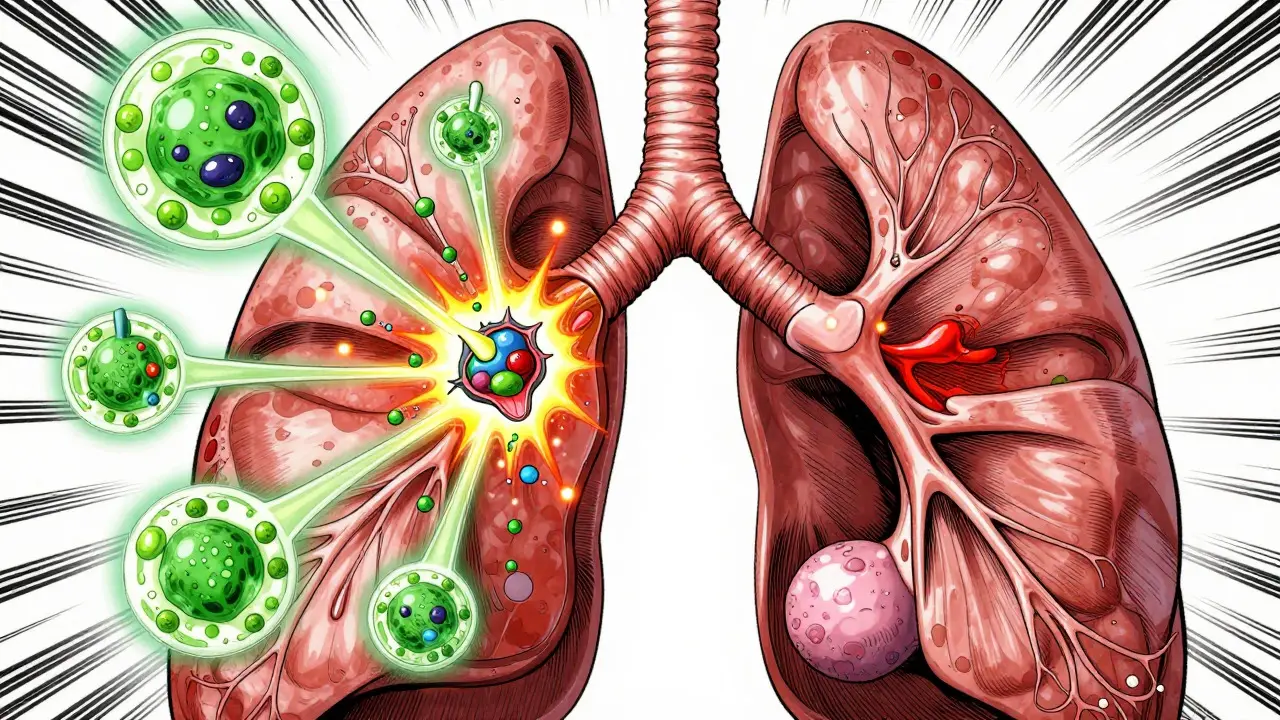
To get allergic asthma under control, you first need to see what is happening inside your lungs. In a person without allergies, breathing in cat dander or tree pollen does nothing. Your immune system ignores it. But in allergic asthma, your immune system has misidentified these safe particles as threats.
The culprit is a protein called Immunoglobulin E (IgE), which is an antibody produced by the immune system in response to allergens. Here is the step-by-step process:
- Sensitization: The first time you are exposed to an allergen (like dust mites), your body produces specific IgE antibodies. These attach themselves to mast cells in your airways. You feel fine here; this is just your body setting a trap.
- Exposure: Next time you breathe in that same allergen, it binds to the IgE antibodies on those mast cells.
- Reaction: The mast cells burst open (degranulation) and release inflammatory chemicals like histamine. This causes your airway muscles to tighten (bronchoconstriction) and the lining to swell and produce mucus.
Dr. Kimishige Ishizaka identified this role of IgE antibodies in the 1970s, distinguishing allergic asthma from other forms. Today, doctors use blood tests to measure total IgE levels. A level above 100 kU/L often suggests an allergic component, while severe cases can exceed 400 kU/L. Knowing this helps explain why standard anti-inflammatories sometimes aren’t enough-you need to address the trigger itself.
Identifying Your Specific Triggers
Not all asthma triggers are created equal. Some are seasonal, some are year-round, and some depend entirely on where you live. Identifying yours is the single most important step in management. According to the Global Initiative for Asthma (GINA) guidelines, proper diagnosis involves skin prick tests or specific IgE blood tests to pinpoint exactly what you are reacting to.
| Trigger Type | Peak Season / Time | Key Indicator |
|---|---|---|
| Tree Pollen | February - April (Peak: March) | Counts of 10-20 grains/m³ in temperate regions |
| Grass Pollen | May - July (Peak: June) | Counts reaching 50-100 grains/m³ |
| Ragweed Pollen | August - October (Peak: September) | Counts exceeding 100 grains/m³ |
| Dust Mites | Year-round (Worse in humid weather) | Found in 84% of homes with humidity >50% |
| Cat Dander (Fel d 1) | Year-round | Levels >8 µg/g in 79% of U.S. homes |
| Mold Spores (Alternaria) | Late Summer / Thunderstorms | ED visits increase 3.5x when counts >500 spores/m³ |
Notice the pattern with mold? Dr. James T.C. Li from Mayo Clinic highlights the "epithelial barrier hypothesis," noting that pollutants like PM2.5 can weaken the lining of your airways, making it easier for allergens like mold spores to penetrate and cause damage. If you notice your symptoms spike during thunderstorms in late summer, Alternaria mold is likely the culprit.
Allergen Avoidance: Practical Strategies That Work
Avoidance sounds simple: "Just stay away from cats." But life doesn’t work that way. You live in a house. You go outside. The goal is reduction, not perfection. However, small changes yield big results. A 2021 Cochrane review found that targeted avoidance strategies can reduce medication dependence significantly when done correctly.
For Dust Mites
Dust mites thrive in humidity. They don’t bite you; their waste products cause the reaction. To fight them:
- Control Humidity: Keep indoor relative humidity between 30% and 50%. An indoor air study showed that maintaining 45% RH reduces dust mite allergen from 20 µg/g to just 0.5 µg/g. Use a hygrometer to monitor this.
- Encase Bedding: Use allergen-proof covers for pillows and mattresses. One user on Reddit reported increasing their peak flow from 380 to 470 L/min after switching to AllerZip Pro covers and using a HEPA vacuum.
- Hot Washes: Wash bedding weekly in water hotter than 130°F (54°C). This kills mites and removes allergens effectively.
For Pollen
Pollen is airborne and hard to escape completely. Timing is everything.
- Check Counts: Keep windows closed when pollen counts exceed 9.7 grains/m³ for tree pollen. Many weather apps now include this data due to new FDA labeling requirements.
- Shower Immediately: If you’ve been outside, shower before bed. This prevents you from transferring pollen onto your pillow, where you would breathe it in for eight hours straight.
- Mask Up: Wearing an N95 mask during yard work can reduce pollen exposure by 85%, according to a 2022 Annals of Allergy study.
For Pet Dander
If you are allergic to cats but love your pet, you don’t necessarily have to rehome them. Cat allergen (Fel d 1) sticks to surfaces and hair. Vacuuming with a HEPA filter twice a week can reduce cat allergen levels by 42%. Consider creating a "pet-free zone" in the bedroom to give your lungs a break while you sleep.
Immunotherapy: Changing Your Immune Response
Avoidance and inhalers manage symptoms, but they don’t fix the underlying problem. Allergen Immunotherapy (AIT) is a treatment that gradually desensitizes the immune system to specific allergens. It is one of the few disease-modifying treatments available for asthma.
Instead of suppressing the immune system, immunotherapy retrains it. You receive small, increasing doses of the allergen you are sensitive to. Over time, your body stops producing excessive IgE antibodies against that substance. The American Academy of Allergy, Asthma & Immunology (AAAAI) notes that AIT provides 30-50% greater symptom reduction compared to pharmacotherapy alone.
Subcutaneous Immunotherapy (SCIT)
This is the traditional "allergy shot" method. It involves injections given in a clinical setting.
- Build-up Phase: Weekly injections for 4-6 months, gradually increasing the dose.
- Maintenance Phase: Monthly injections for 3-5 years.
- Effectiveness: Studies show that after 3-5 years, many patients maintain remission even after stopping treatment. A case series from the Asthma and Allergy Foundation of America documented a child whose IgE levels dropped from 120 kU/L to 15 kU/L after three years of cat dander shots.
Sublingual Immunotherapy (SLIT)
SLIT involves placing a tablet or drop under the tongue daily. It is more convenient but requires strict adherence.
- Convenience: Taken at home, no clinic visits needed.
- Side Effects: Oral itching is common in the first month (reported in 78% of users), but usually subsides.
- Efficacy: The MILO trial showed a 35% reduction in symptom scores for house dust mite allergy compared to 15% for inhaled corticosteroids alone.
While SCIT has a slightly higher efficacy rate, SLIT is safer for home use. About 15% of allergic asthma patients in the U.S. currently receive immunotherapy, a number that is rising as awareness grows.

Biomarkers and Precision Medicine
We are moving away from one-size-fits-all treatments. Doctors now look at biomarkers to predict who will benefit most from advanced therapies. Dr. Mario Castro’s research indicates that type 2 inflammation biomarkers-specifically blood eosinophils >300 cells/µL and FeNO (fractional exhaled nitric oxide) >25 ppb-predict 83% of allergic asthma exacerbations.
If your biomarkers are high, you might be a candidate for biologic drugs like omalizumab (Xolair), which targets IgE directly. The EXCELS study showed these biologics reduce exacerbations by 49% in allergic asthma patients. However, caution is advised: Dr. Sally Wenzel warns that over 30% of patients diagnosed with allergic asthma based only on symptoms actually have non-type 2 inflammation. Treating them with expensive biologics ($30,000-$40,000 annually) yields little benefit. Always ask for biomarker testing before starting costly long-term treatments.
Living with Allergic Asthma: Next Steps
Managing allergic asthma is a marathon, not a sprint. Start by getting tested to identify your specific triggers. Then, implement the avoidance strategies that fit your lifestyle. If avoidance isn’t enough, discuss immunotherapy with your allergist. It takes time, but it offers the best chance at long-term freedom from symptoms.
Technology is also helping. New tools like AI-powered platforms can integrate local pollen forecasts with your personal history to predict flare-ups days in advance. By combining old-school avoidance with modern medical science, you can keep your airways open and your life active.
What is the difference between allergic and non-allergic asthma?
Allergic asthma is triggered by external allergens like pollen, dust, or pet dander, causing an IgE-mediated immune response. Non-allergic asthma is triggered by factors like stress, exercise, cold air, or viral infections, without an allergic component. Allergic asthma typically starts earlier in life (average age 12.3 vs 34.7 for non-allergic) and responds better to immunotherapy and biologics.
How long does immunotherapy take to work?
Most patients begin to see clinical benefits within 12-18 months of consistent treatment. However, for lasting remission, the AAAAI recommends continuing therapy for 3-5 years. Stopping early may lead to symptoms returning once the protective effect wears off.
Can I still have pets if I have allergic asthma?
Yes, but it requires strict management. Keep pets out of the bedroom, use HEPA air purifiers, vacuum frequently with a HEPA-filtered vacuum, and consider immunotherapy to reduce your sensitivity over time. Washing pets regularly can also help reduce dander, though its effectiveness varies by animal.
What are the side effects of sublingual immunotherapy (SLIT)?
The most common side effect is oral itching or swelling in the mouth and throat, especially during the first month of treatment. This usually decreases over time. Serious systemic reactions are rare but possible, so the first dose should always be taken under medical supervision.
When should I see an allergist instead of a general practitioner?
You should see an allergist if your asthma is not controlled with standard inhalers, if you suspect specific environmental triggers, or if you are considering immunotherapy. Allergists can perform detailed skin prick tests and blood tests to identify exact triggers and tailor a personalized management plan.