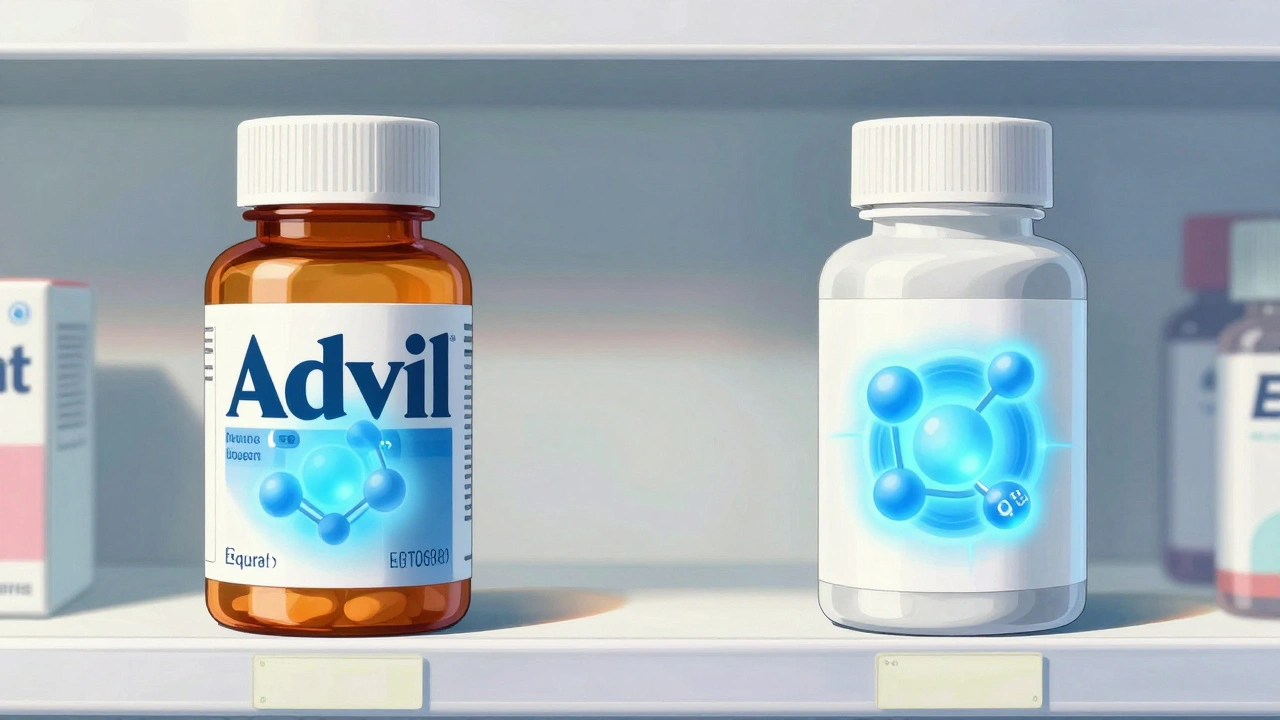
Every year, Canadians spend billions on over-the-counter (OTC) medications - pain relievers, allergy pills, antacids, cough syrups. But what if you could cut those costs by up to 85% without sacrificing effectiveness? The answer isn’t a coupon or a loyalty program. It’s something far simpler: store brand OTC medications.
What Exactly Is a Store Brand Medication?
Store brand medications - also called generic or private label drugs - are made by the same manufacturers that produce name brands like Advil, Tylenol, or Claritin. They contain the exact same active ingredient, in the same strength, and in the same form. That means CVS Health ibuprofen has the same ibuprofen as Advil. Walmart’s Equate acetaminophen is chemically identical to Tylenol. The FDA requires it. The difference? Packaging. Color. Shape. Inactive ingredients. And price. The FDA’s 2023 guidelines confirm that store brands must meet the same strict standards as name brands. They must deliver the same amount of active ingredient into your bloodstream at the same rate. In fact, studies show the average difference in absorption between generic and brand-name drugs is just 3.5%. That’s within the FDA’s acceptable range of 80-125%.How Much Money Can You Really Save?
The savings aren’t small. They’re massive. A bottle of 100 generic ibuprofen tablets (200 mg) at Walmart costs around $4. The same size bottle of Advil? Around $20. That’s an 80% savings. Same for acetaminophen: $3 for CVS Health vs. $15 for Tylenol. Loratadine (Claritin’s active ingredient) runs $7 for a 30-count store brand vs. $25 for the name brand. According to IQVIA’s 2023 report, store brands make up 67% of all OTC units sold in Canada and the U.S. - but they only account for about 33% of total revenue. Why? Because they’re so much cheaper. Retailers like Walmart, Target, and Costco have built entire OTC lines - Equate, Up & Up, and Costco’s Kirkland Signature - offering over 900 products each. CVS Health’s private label now makes up 37% of their OTC sales. For families buying pain relievers, cold meds, or antacids every month, switching to store brands can save $300-$500 a year. That’s a vacation. A new pair of winter boots. Or just breathing easier when the bills come due.Are Store Brands Really Just as Safe and Effective?
Yes. And the evidence is overwhelming. The FDA inspects generic drug factories just as often as brand-name ones - about 3,500 inspections a year. The same quality controls apply. The same testing. The same safety standards. Pharmacists know this better than anyone. A 2023 Pharmacy Times survey found that 92% of pharmacists feel confident recommending store brands. And here’s the kicker: 89% of pharmacists and 82% of physicians use store brand OTC meds for themselves and their families. Reddit threads, Amazon reviews, and Facebook groups are full of similar stories. One user wrote: “I’ve used CVS ibuprofen for five years. Couldn’t tell the difference from Advil.” Another said: “My kid’s allergies are under control with the generic loratadine. Saved $18 a month.” Consumer Reports surveyed 1,200 people in 2023. The majority reported no noticeable difference in how well store brands worked. The average rating for store brands? 4.3 stars. Name brands? 4.4 stars.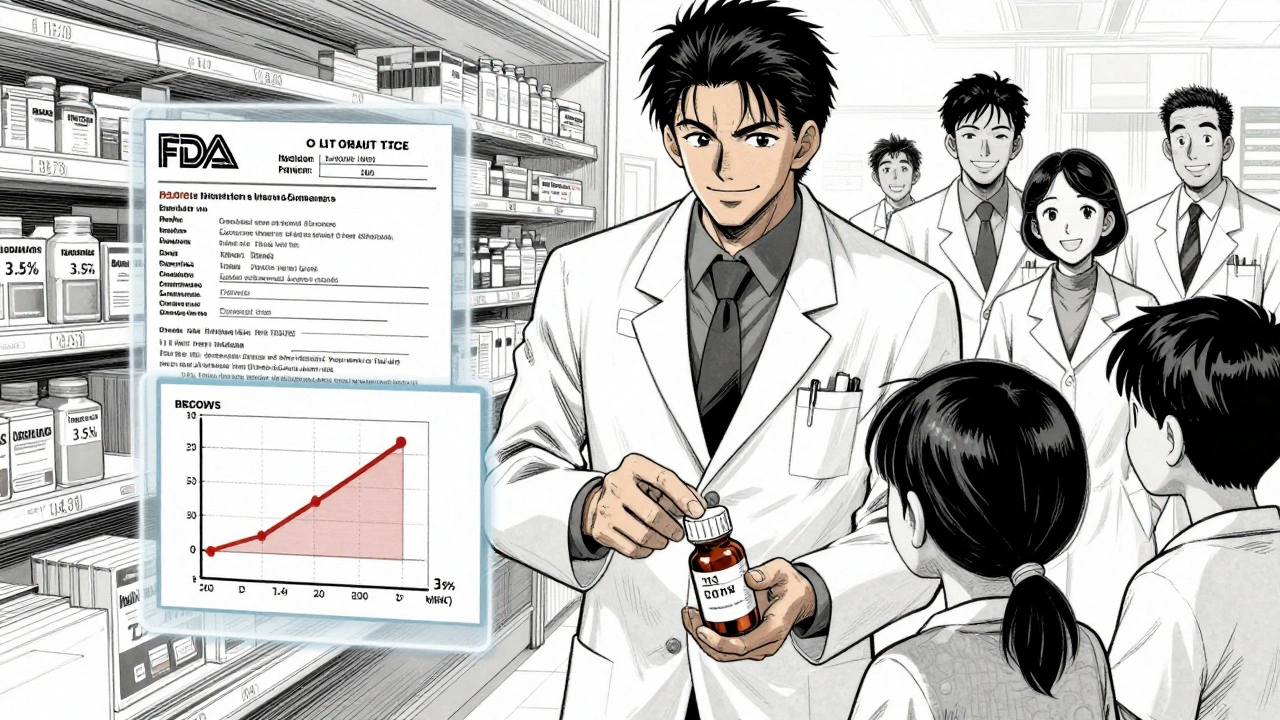
When Might You Need the Name Brand?
There’s one real exception: inactive ingredients. Active ingredients do the healing. Inactive ingredients are the fillers, dyes, flavors, and preservatives. They don’t treat your headache. But they can irritate your stomach, trigger allergies, or taste awful. If you’re allergic to red dye #40, and the name-brand syrup has it but the store brand doesn’t - you might prefer the brand. If your kid refuses to take a bitter generic cough syrup but will swallow the cherry-flavored name brand? That’s a valid reason to stick with the original. The FDA’s Adverse Event Reporting System shows only about 0.7% of users report reactions tied to store brands - and nearly all of those are due to inactive ingredients, not the medicine itself. If you have a reaction, switch back. But don’t assume the medicine didn’t work. It probably did. Something else just didn’t agree with you.How to Choose the Right Store Brand
It’s easier than you think. Just follow these three steps:- Look at the Drug Facts label - the first thing listed is the active ingredient. Match it exactly to the name brand. If it says “ibuprofen 200 mg,” you’re good.
- Check the dosage form. Is it tablet, capsule, liquid, or chewable? Make sure it matches what you’re used to.
- Compare the strength. A 100-count bottle of 200 mg is better than a 50-count of 100 mg, even if the price looks similar.




Comments (15)
kevin moranga
Love this post! I switched to Equate ibuprofen last year and haven’t looked back. My back pain? Gone. My wallet? Thanking me. Seriously, why pay extra for a logo when the chemical is identical? It’s like buying the same coffee beans but in a fancy mug-same brew, higher price.
My mom used to swear by Tylenol until I showed her the label. Now she buys CVS Health like it’s a superpower. And guess what? She hasn’t had a single side effect. The only thing different is how much change she has left at the end of the month.
Also, pharmacists? They’re the real MVPs. Ask one what they take at home. I bet 9 out of 10 say store brand. That’s not marketing-that’s lived experience.
Stop letting branding fool you. Your body doesn’t care if it’s printed with a red cap or a white label. It just cares if the ibuprofen gets to the inflammation. And it does. Every time.
Lara Tobin
This made me cry a little 😭 I’ve been using store brands since college and people always act like I’m taking ‘fake medicine’… but I’ve saved over $400 a year and my migraines are just as controlled. Thank you for saying this out loud.
Scott Butler
Let’s be real-this is just another liberal ploy to get Americans to accept inferior goods. You think the FDA’s standards are the same? Ha. They’re cutting corners to save money. Meanwhile, China and India are manufacturing these generics under conditions that would make a Canadian nurse gag. Name brands have legacy. Reputation. Quality control that isn’t outsourced to a warehouse in Bangalore.
And don’t even get me started on ‘pharmacists recommend them.’ They’re paid by the store to push private labels. Same as the Walmart greeter telling you the $2 chicken is ‘gourmet.’
Emma Sbarge
Oh wow, so now we’re supposed to trust a label that says ‘ibuprofen’ but has no history? No brand equity? No R&D investment? This isn’t about savings-it’s about surrendering to corporate capitalism. The fact that you’re proud of buying ‘Equate’ is a tragedy. You’re not saving money-you’re being manipulated.
And yes, I know the science says it’s the same. But science doesn’t pay for my anxiety when my headache doesn’t go away. I pay for peace of mind. And that’s worth $16.
Richard Ayres
This is one of the most well-researched and balanced takes on OTC generics I’ve seen in years. The FDA’s bioequivalence standards are not a suggestion-they’re a legal requirement. The 3.5% absorption variance you cited? That’s less than the natural variation in how your body processes the same pill on different days.
What’s more, the fact that 89% of pharmacists use these themselves is the most compelling data point. If a profession that lives and breathes drug interactions and pharmacokinetics trusts these products, why shouldn’t we?
Also, thank you for highlighting the inactive ingredient risk. That’s the real nuance most people miss. It’s not about efficacy-it’s about individual tolerance. And that’s a personal choice, not a systemic failure.
Lauren Scrima
Wow. You literally wrote a 2,000-word essay on how to buy ibuprofen. And I’m here for it. 🙌
Also, yes. The $20 Advil bottle? That’s just $16 for the box and $4 for the emotional support logo. I’m switching. And I’m telling my entire family. You’re a saint, honestly.
Casey Mellish
As an Australian, I’ve been buying Chemist Warehouse’s own brand for years. Same active ingredients, same manufacturing (often the same factories as the global brands), and half the price. We don’t have the same brand loyalty here because we’ve been conditioned to value value.
Fun fact: the ‘Kirkland Signature’ ibuprofen sold at Costco in the US? Made in the same Ohio plant as Advil. Just repackaged. The only difference? The label.
It’s not ‘generic.’ It’s ‘identical.’ And we’re all just paying extra for marketing.
Tyrone Marshall
I’ve been thinking about this for years. It’s not just about money-it’s about rethinking what ‘value’ means. We’ve been trained to equate price with quality. But in medicine? That’s a myth. The body doesn’t care if the pill says ‘Advil’ or ‘Equate.’ It cares about the milligrams of ibuprofen.
And honestly? The fact that we even debate this says more about our consumer culture than about pharmacology.
Let me ask you this: if you bought a generic battery that lasted just as long as a Duracell, would you still pay double? No. So why do it with medicine?
It’s not about being cheap. It’s about being rational.
Emily Haworth
Wait… are you telling me the government is lying to us? 😳
What if the store brands are secretly laced with microchips to track our health data? I read on a forum that Target is partnering with Palantir to collect OTC usage patterns. And what about the dyes? Red 40 is linked to ADHD… and Walmart’s generic cough syrup has it!
Also, I think Big Pharma is paying the FDA to make this look legit. I’ve got screenshots. Want me to send them? 🤫
My cousin’s neighbor’s dog got sick after taking a generic flea pill. Coincidence? I think not.
Tom Zerkoff
This is the most important public health message of the decade. The average American spends $500 a year on OTC meds. That’s $2000 over four years-enough to cover a dental implant or a month of rent.
And yet, we’re told to ‘buy the name’ because ‘it’s better.’ But better for whom? Not for the patient. Not for the family. Only for the shareholders.
Thank you for giving people permission to be smart. The FDA doesn’t lie. Pharmacists don’t lie. The data doesn’t lie.
Stop paying for advertising. Start paying for results.
Yatendra S
It is not merely the medication that one purchases, but the metaphysical assurance of brand identity that one truly buys. The pill is a symbol, a ritual of trust in the invisible hand of corporate benevolence. To choose the generic is to reject the sacred contract between consumer and corporate oracle.
Yet… I still use Equate. For the money. But I feel guilty. Like I am betraying the ancestors who suffered through the Great Cold of ’09 with only aspirin and prayer.
Alvin Montanez
Let me break this down for you, because clearly you haven’t thought this through. You say store brands are ‘just as effective’? Fine. But effectiveness isn’t the only metric. What about consistency? What about batch-to-batch reliability? What about the fact that name brands have been tested over decades on millions of people? Generic manufacturers? They’re lucky if they’ve sold 50,000 units before someone files a complaint.
And don’t even get me started on the fact that these generics are often made in countries with no real oversight. You think the FDA can inspect every single facility in India? Please. They inspect one plant every five years. The rest? Paperwork.
So sure, maybe your headache goes away. But what about the 0.1% of people who get a rare reaction? Who’s accountable then? The pharmacist? The store? Or you, for being too cheap to pay for peace of mind?
And don’t give me that ‘pharmacists use them too’ nonsense. They’re paid by the store. They’re incentivized. They’re not your friends. They’re salespeople with a white coat.
Himmat Singh
While the empirical evidence presented in this communication appears to substantiate the equivalence of therapeutic outcomes between proprietary and generic pharmaceutical formulations, one must not overlook the epistemological framework underpinning consumer trust. The symbolic capital invested in brand nomenclature serves a sociological function beyond pharmacokinetics. The perceived reliability of name-brand products is not a fallacy, but a heuristic rooted in historical institutional credibility. To dismiss this as mere marketing is to misunderstand the phenomenology of health behavior. One does not merely ingest a molecule; one engages in a ritual of confidence. The cost differential, while quantifiable, is negligible in the context of existential health security.
Shelby Ume
I’m a nurse. I’ve seen people skip doses because they can’t afford the name brand. I’ve seen people take half a pill because they’re afraid to spend $20 on ibuprofen.
This isn’t about saving $300 a year. It’s about making sure people can actually treat their pain, their allergies, their heartburn.
Store brands aren’t ‘cheap.’ They’re accessible. And in a country where healthcare is a luxury, accessibility isn’t a bonus-it’s a lifeline.
So thank you. For reminding us that medicine isn’t a status symbol. It’s a tool. And tools don’t need logos to work.
Jamie Clark
You call this ‘smart’? You call this ‘responsible’? This is surrender. This is the death of standards. You’re not ‘saving money’-you’re accepting mediocrity. You’re trading quality for convenience and calling it wisdom.
And you know what? I don’t care if the FDA says it’s the same. I don’t care if your pharmacist uses it. I don’t care if your kid’s allergies are ‘controlled.’
Because if you’re willing to compromise on something as basic as your painkiller, what’s next? Your insulin? Your blood pressure med? Your antibiotics?
This isn’t frugality. It’s fatalism.
And I’m not here to comfort you. I’m here to wake you up.