Reversal Agent Decision Tool
Click on the appropriate card below to see the recommended reversal agent and key statistics.
Dabigatran
(Pradaxa)
Patient is taking Dabigatran and requires immediate reversal.
Factor Xa Inhibitors
(Xarelto, Eliquis, Savaysa)
Patient is taking Rivaroxaban, Apixaban, or Edoxaban.
Unknown Drug / No Specific Agent
(General Emergency)
Drug unknown, or specific antidotes unavailable/unaffordable.
Agent Name
Brand NameHow it Works
Description of mechanism goes here.
Key Considerations
- • Note 1
Imagine you are on a blood thinner to prevent a stroke. It’s working perfectly-until it isn’t. A fall, a surgery, or an unexpected bleed turns that life-saving medication into a ticking time bomb. For decades, doctors had few options to stop the bleeding quickly if patients were on newer drugs like Eliquis or Xarelto. Today, we have specific antidotes, but they come with steep prices, complex protocols, and serious risks of their own.
This guide breaks down exactly how these reversal agents work, which one is right for which drug, and what happens in those critical first hours of an emergency. We will look at the hard numbers behind survival rates, the cost barriers hospitals face, and why 'one size fits all' doesn't apply when seconds count.
Why Reversal Matters More Than Ever
Blood thinners, medically known as anticoagulants, are essential for millions of people living with atrial fibrillation (AFib). They keep blood from clotting inside your heart or veins. But when major bleeding occurs-whether from a gastrointestinal tear or a brain hemorrhage-the same property that prevents strokes becomes deadly.
The landscape changed dramatically with the rise of Novel Oral Anticoagulants (NOACs). Unlike older drugs like warfarin, which had a well-known reversal method using vitamin K, NOACs such as dabigatran (Pradaxa), rivaroxaban (Xarelto), apixaban (Eliquis), and edoxaban (Savaysa) worked too fast and too strongly for traditional methods to catch up. Until recently, doctors were essentially waiting for the drug to wear off while trying to stabilize the patient.
That gap closed with two major FDA approvals:
- Idarucizumab (Praxbind): Approved in October 2015 specifically for dabigatran.
- Andexanet alfa (AndexXa): Approved in May 2018 for Factor Xa inhibitors (rivaroxaban, apixaban, edoxaban).
These aren't just supplements; they are targeted molecular keys designed to unlock the anticoagulant effect immediately. Without them, more than 100,000 hospitalizations annually in the U.S. related to NOAC bleeding would have far higher mortality rates.
The Specific Antidotes: How They Work
Not all reversal agents are created equal. In fact, giving the wrong one can be useless or even dangerous. The choice depends entirely on which blood thinner the patient is taking.
| Agent Name | Target Drug(s) | Mechanism | Key Trial Result |
|---|---|---|---|
| Idarucizumab (Praxbind) |
Dabigatran (Pradaxa) |
Monoclonal antibody fragment that binds directly to dabigatran | 100% median reversal rate in RE-VERSE AD trial |
| Andexanet alfa (AndexXa) |
Rivaroxaban, Apixaban, Edoxaban |
Recombinant modified Factor Xa molecule that sequesters the inhibitor | 83% effective hemostasis in ANNEXA-4 trial |
| 4F-PCC (Kcentra, etc.) |
All types (Non-specific) | Replaces clotting factors depleted by anticoagulants | 77% efficacy for intracranial hemorrhage |
Idarucizumab: The Dabigatran Specialist
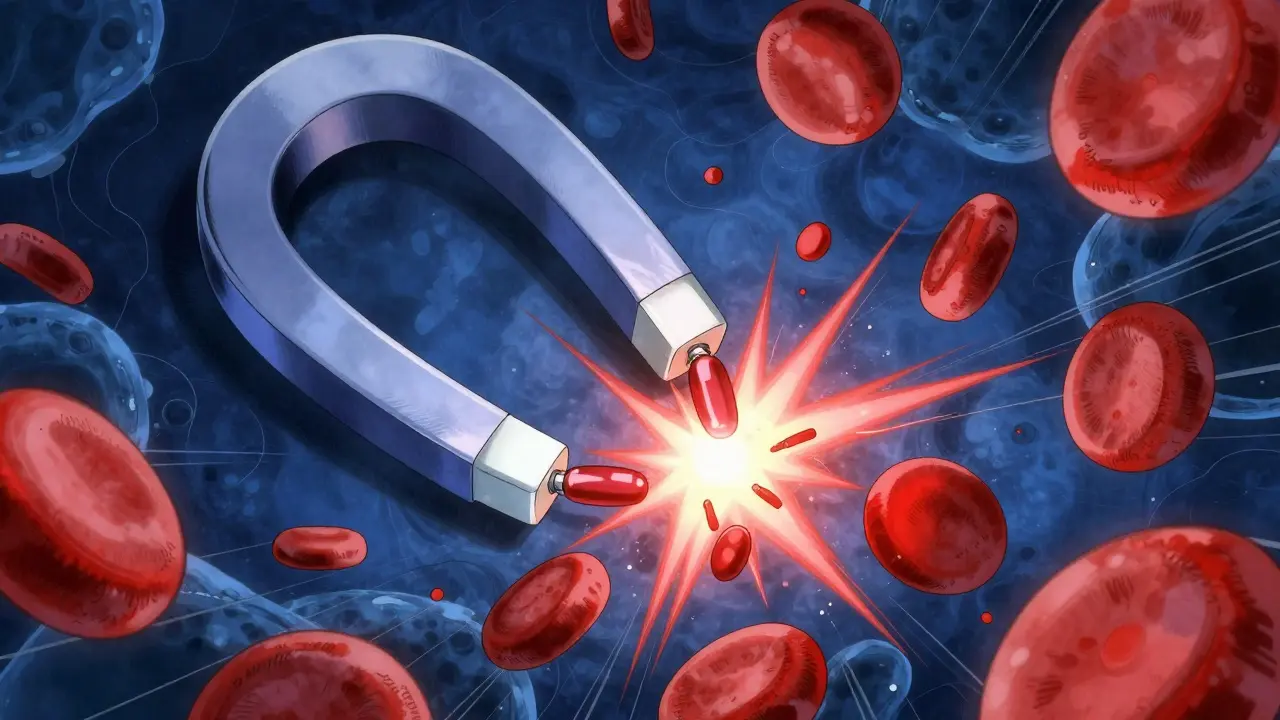
Developed by Boehringer Ingelheim, idarucizumab is a monoclonal antibody fragment. Think of it as a magnet for dabigatran. When injected intravenously, it binds to the dabigatran molecules in the bloodstream with much higher affinity than dabigatran binds to thrombin (the protein it normally blocks). This neutralizes the drug's effect almost instantly.
In the pivotal RE-VERSE AD trial, patients received two 2.5g IV boluses no more than 15 minutes apart. The result? 100% median maximum percentage reversal of dabigatran's anticoagulant effect. Unbound dabigatran levels dropped below 20 ng/ml-the threshold for minimal activity-in most patients within minutes.
However, there is a catch. Idarucizumab has a shorter half-life than dabigatran. In about 23% of patients, dabigatran levels re-elevated after 24 hours because the body cleared the antidote faster than the remaining drug. This led to recurrent bleeding in some cases, requiring additional doses.
Andexanet Alfa: The Factor Xa Counterpart
For patients on Xarelto, Eliquis, or Savaysa, the target is different. These drugs inhibit Factor Xa, a key enzyme in the clotting cascade. Andexanet alfa, developed by Portola Pharmaceuticals (now part of Bristol Myers Squibb), acts as a decoy. It is a modified version of Factor Xa itself. It lures the anticoagulant drug away from the natural Factor Xa, allowing the body's clotting process to resume.
The ANNEXA-4 trial showed that andexanet alfa stopped bleeding in 83% of participants. The median time to cessation was 2.5 hours for gastrointestinal bleeding and similar for intracranial hemorrhage. While effective, the protocol involves a complex infusion regimen-a bolus followed by a continuous two-hour drip-which requires careful monitoring in an intensive care setting.
The Non-Specific Alternative: 4F-PCC
If a hospital doesn't have Praxbind or AndexXa on hand, or if the specific drug isn't known, doctors turn to Four-Factor Prothrombin Complex Concentrate (4F-PCC). Products like Kcentra contain concentrated clotting factors (II, VII, IX, and X).
4F-PCC works by flooding the system with the building blocks needed to form clots, overwhelming the anticoagulant's blocking effect. It is non-specific, meaning it works for warfarin, dabigatran, and Factor Xa inhibitors alike. However, it is less precise. A 2022 meta-analysis in JAMA Network Open found that while 4F-PCC achieved effective hemostasis in 77% of intracranial hemorrhage cases, it carried a higher risk of thromboembolic events compared to idarucizumab.
Despite this, 4F-PCC remains a cornerstone of emergency medicine due to its lower cost ($1,500-$3,000 per treatment) and wider availability. Many community hospitals rely on it as the first line of defense before specific agents can be sourced.
Safety, Risks, and the Thrombosis Trade-Off
Reversing a blood thinner is a double-edged sword. You stop the bleeding, but you also restore the body's ability to clot-sometimes too aggressively. This creates a risk of thromboembolic events, such as heart attacks, strokes, or pulmonary embolisms, especially in patients who were on blood thinners for a reason (like AFib).
The data highlights distinct safety profiles:
- Idarucizumab: Shows a relatively low thromboembolic complication rate of 5% (95% CI: 3%-8%) in patients with intracranial hemorrhage. Mortality was around 11%.
- Andexanet alfa: Carries a higher thromboembolic event rate of 14%, compared to 8% for 4F-PCC. The FDA issued a warning in 2021 regarding this risk. Mortality rates were similar between andexanet (24%) and 4F-PCC (26%).
- Overall Mortality: Across all reversal methods, the average mortality rate remains high at approximately 17.7%. This underscores that reversal agents address the symptom (bleeding) but not the underlying trauma or disease.
Dr. Antonio Gómez-Outes, in a 2021 meta-analysis, noted that failure to achieve hemostatic efficacy correlates with more than a 3-fold increase in mortality. Therefore, choosing the agent with the highest likelihood of stopping the bleed quickly is often prioritized over theoretical long-term thrombosis risks in acute emergencies.
Cost Barriers and Hospital Protocols
Money plays a significant role in emergency decision-making. The price tags for specific reversal agents are staggering:
- Idarucizumab: Approximately $3,800 per 2.5g vial. Since the standard dose is two vials, one treatment costs around $7,600.
- Andexanet alfa: About $17,900 per full treatment course.
Compare this to 4F-PCC, which costs between $1,500 and $3,000. Consequently, 43% of hospital pharmacists reported in 2022 that their institutions restricted andexanet alfa use to only the most severe, life-threatening cases. Academic medical centers, with larger budgets, use specific agents in 92% of eligible cases, compared to just 67% in community hospitals.
This disparity means that a patient's access to the "best" reversal agent can depend heavily on where they receive care. Insurance coverage varies, and prior authorization processes can delay administration-a luxury no emergency room can afford during active hemorrhage.

What Happens in the ER: Step-by-Step
If you or a loved one arrives at the emergency department with major bleeding while on a blood thinner, here is what typically happens:
- Immediate Assessment: Doctors confirm the type of anticoagulant. This is crucial. If the patient carries a wallet card or medical alert bracelet stating "On Pradaxa" or "On Eliquis," it saves vital minutes.
- Laboratory Confirmation: While waiting for labs, treatment may begin based on history. Tests include dilute thrombin time (for dabigatran) or anti-Factor Xa activity (for Xa inhibitors). Note: Standard INR tests do not accurately measure NOAC levels.
- Discontinuation: The blood thinner is stopped immediately.
- Administration of Reversal Agent:
- If on dabigatran: Idarucizumab is given via IV push.
- If on apixaban/rivaroxaban/edoxaban: Andexanet alfa infusion starts, or 4F-PCC is used if andexanet is unavailable.
- Monitoring for Rebound: Patients are monitored for 24-48 hours. Because idarucizumab wears off faster than dabigatran, doctors watch for rising drug levels that could cause re-bleeding.
The American College of Cardiology recommends that clinicians undergo specialized training to interpret these coagulation tests correctly, as misinterpretation can lead to under- or over-treatment.
The Future: Universal Reversal Agents?
The current system is fragmented. You need one drug for Pradaxa and another for Eliquis. Researchers are working on a universal solution. Ciraparantag (PER977), developed by Perosphere Pharmaceuticals, is a small molecule that binds to multiple anticoagulant classes, including heparin, low-molecular-weight heparin, and direct oral anticoagulants.
In Phase II trials completed in 2023, ciraparantag reversed edoxaban within 5-10 minutes at doses of 100-300 mg, with effects lasting up to 24 hours. If Phase III trials prove successful, this could simplify emergency protocols significantly, eliminating the need to identify the specific drug before administering the antidote. As of 2026, the industry watches closely for final regulatory decisions on this potential game-changer.
Frequently Asked Questions
Can I reverse blood thinners at home?
No. Reversal agents like idarucizumab and andexanet alfa are strictly hospital-administered intravenous medications. They require continuous cardiac and neurological monitoring due to the risk of clotting complications. If you experience signs of major bleeding (such as vomiting blood, black stools, or severe headache), call emergency services immediately.
What is the difference between Praxbind and AndexXa?
They target different drugs. Praxbind (idarucizumab) is the specific reversal agent for dabigatran (Pradaxa). AndexXa (andexanet alfa) is the specific reversal agent for Factor Xa inhibitors, including rivaroxaban (Xarelto), apixaban (Eliquis), and edoxaban (Savaysa). Giving the wrong one will not work.
Is 4F-PCC as good as specific reversal agents?
4F-PCC is effective but less specific. Studies show it achieves hemostasis in about 77% of intracranial hemorrhage cases, compared to higher rates for specific agents. However, it carries a slightly higher risk of thromboembolic events than idarucizumab and is significantly cheaper. It is often used when specific agents are unavailable or unaffordable.
How long does it take for the reversal agent to work?
Idarucizumab works almost immediately, with complete biochemical reversal within minutes of IV administration. Andexanet alfa typically stops bleeding within a median of 2.5 hours. Clinical improvement (stopping visible bleeding) may take longer depending on the severity of the injury.
What are the risks of using reversal agents?
The primary risk is thromboembolism-forming new clots that can cause heart attacks, strokes, or pulmonary embolisms. Andexanet alfa has a reported thromboembolic event rate of 14%, while idarucizumab is lower at 5%. Doctors weigh this risk against the immediate threat of fatal bleeding.
Will insurance cover the cost of reversal agents?
Coverage varies by plan and provider. Due to the high cost (up to $17,900 for AndexXa), many insurers require prior authorization or restrict use to life-threatening scenarios. Hospitals may also have internal formularies limiting which agents are stocked. Always check with your insurance provider and healthcare team regarding coverage policies.