
Your heart is a pump, and its valves are the doors that keep blood flowing in the right direction. When those doors get stuck open or shut tight, your heart has to work overtime. This isn't just a minor inconvenience; it's a serious medical condition affecting millions of people worldwide. In fact, about 2.5% of the U.S. population-roughly 8.3 million people-lives with significant valvular heart disease, a condition where one or more of the heart's four valves malfunction. If you’ve been told you have a murmur, or if you’re feeling unusually tired after walking up stairs, understanding what’s happening inside your chest is the first step to getting better.
How Heart Valves Work (and What Goes Wrong)
To understand the problem, you need to know how the system works. Your heart has four main valves: the aortic valve, mitral valve, tricuspid valve, and pulmonary valve. Their job is simple but critical: ensure unidirectional blood flow. They open to let blood through and close tightly to prevent backflow. When they fail, two main things happen: stenosis or regurgitation.
Stenosis means the valve leaflets become stiff and narrow. Imagine trying to walk through a doorway that’s slowly shrinking. The heart muscle has to squeeze much harder to push blood through that tiny opening. Over time, this extra effort thickens the heart muscle and can lead to heart failure. The most common form is aortic stenosis, which affects 2% of adults over 65. It’s often caused by age-related calcification, where calcium builds up on the valve like limescale in a kettle.
Regurgitation, on the other hand, is when the valve doesn’t close all the way. Blood leaks backward instead of moving forward. Think of a door that won’t latch. With every heartbeat, some blood spills back into the chamber it just left. This forces the heart to pump the same blood twice, causing volume overload. For example, in mitral regurgitation, blood leaks from the lower left chamber back into the upper left chamber. This can cause fatigue and shortness of breath long before you realize there’s a problem.
Spotting the Signs: Symptoms You Can’t Ignore
The tricky part about valve disease is that it often creeps up on you. Many people live for years without symptoms because the heart compensates well at first. But when symptoms do appear, they’re red flags you shouldn’t ignore. The classic triad for severe aortic stenosis includes angina (chest pain), syncope (fainting), and heart failure. About 54% of patients experience chest pain, while 33% report fainting spells. These aren’t normal aging signs-they’re warnings that your heart is struggling to meet demand.
If you have regurgitation, the symptoms might feel different. You might notice dyspnea on exertion (shortness of breath when active) or palpitations. In mitral stenosis, pulmonary congestion is common, leading to orthopnea-difficulty breathing when lying flat. One patient shared on a health forum that she went from hiking three miles daily to barely making it to the mailbox before her diagnosis. That drastic drop in energy level is a huge clue. If you find yourself needing to rest frequently during routine tasks, or if you wake up gasping for air at night, talk to your doctor immediately.
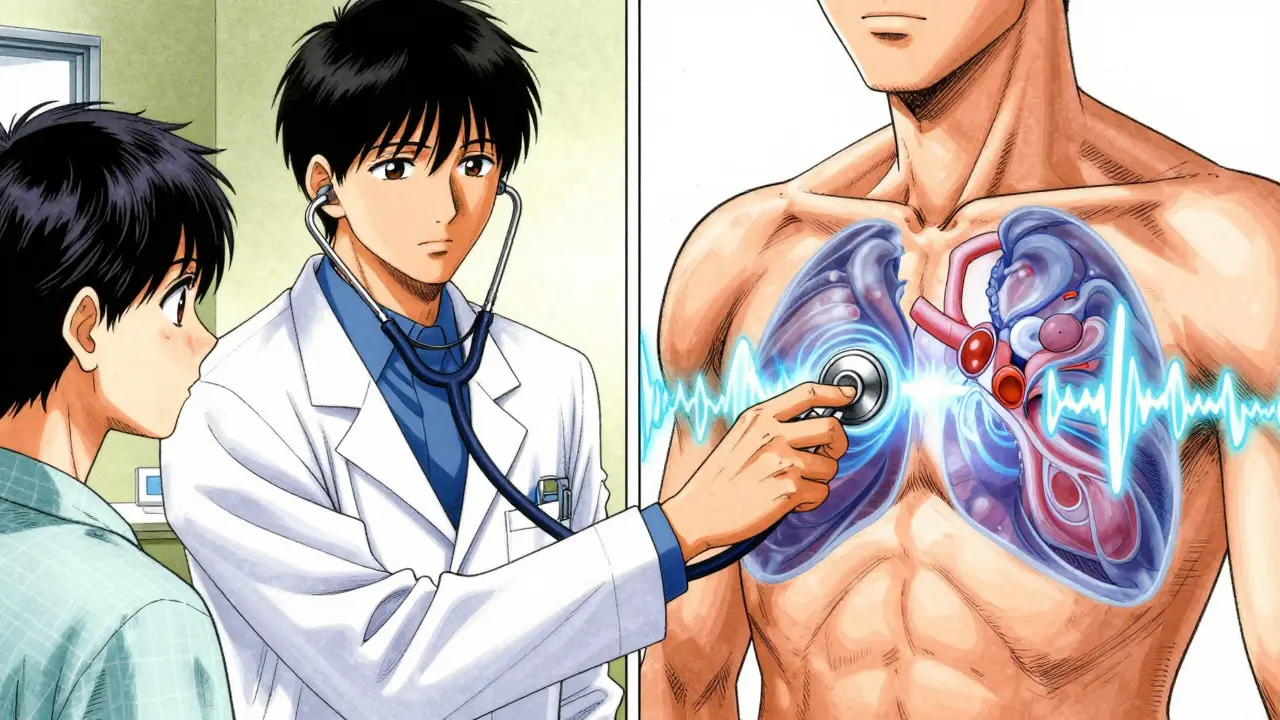
Diagnosing Valve Disease: Beyond the Stethoscope
Doctors didn’t always have high-tech tools to detect these issues. René Laennec invented the stethoscope in 1819 specifically to hear the characteristic murmurs associated with valve dysfunction. Today, we still listen for those sounds, but we rely heavily on imaging to confirm the severity. An echocardiogram is the gold standard. It uses sound waves to create a moving picture of your heart, allowing doctors to measure exactly how wide the valve opens and how much blood is leaking back.
For aortic stenosis, specific measurements determine severity. A valve area smaller than 1.0 cm², a mean pressure gradient greater than 40 mmHg, or a peak jet velocity over 4.0 m/s indicates severe disease. For mitral stenosis, a valve area below 1.5 cm² is considered severe. These numbers matter because they dictate whether you need medication, monitoring, or surgery. Don’t be afraid to ask your cardiologist to explain these metrics. Knowing your numbers helps you understand why a certain treatment plan was chosen.
Treatment Options: From Monitoring to Surgery
If your valve disease is mild, your doctor might just monitor it with regular echocardiograms every six to twelve months. Medication can help manage symptoms like high blood pressure or fluid retention, but pills cannot fix a broken mechanical valve. Eventually, intervention becomes necessary. The good news? Treatment options have evolved dramatically in recent years.
Traditionally, surgical valve replacement involved open-heart surgery. The surgeon would replace the damaged valve with either a mechanical valve or a bioprosthetic (tissue) valve. Mechanical valves last longer but require lifelong blood thinners (anticoagulants) to prevent clots. Bioprosthetic valves don’t require long-term blood thinners but may wear out after 10-15 years. Recovery from open-heart surgery typically involves a hospital stay of 5-7 days and several weeks of limited activity due to sternotomy pain-the healing of the breastbone incision.
However, a revolution is underway. Transcatheter Aortic Valve Replacement (TAVR) has changed the game. Instead of cutting open the chest, cardiologists insert a new valve through a catheter in the groin artery. This minimally invasive procedure has a shorter recovery time and lower risk for older patients. As of 2023, TAVR accounts for 65% of aortic valve replacements in the U.S. for patients over 75. Recent trials show it’s even effective for lower-risk patients aged 60-80, offering survival rates comparable to traditional surgery.
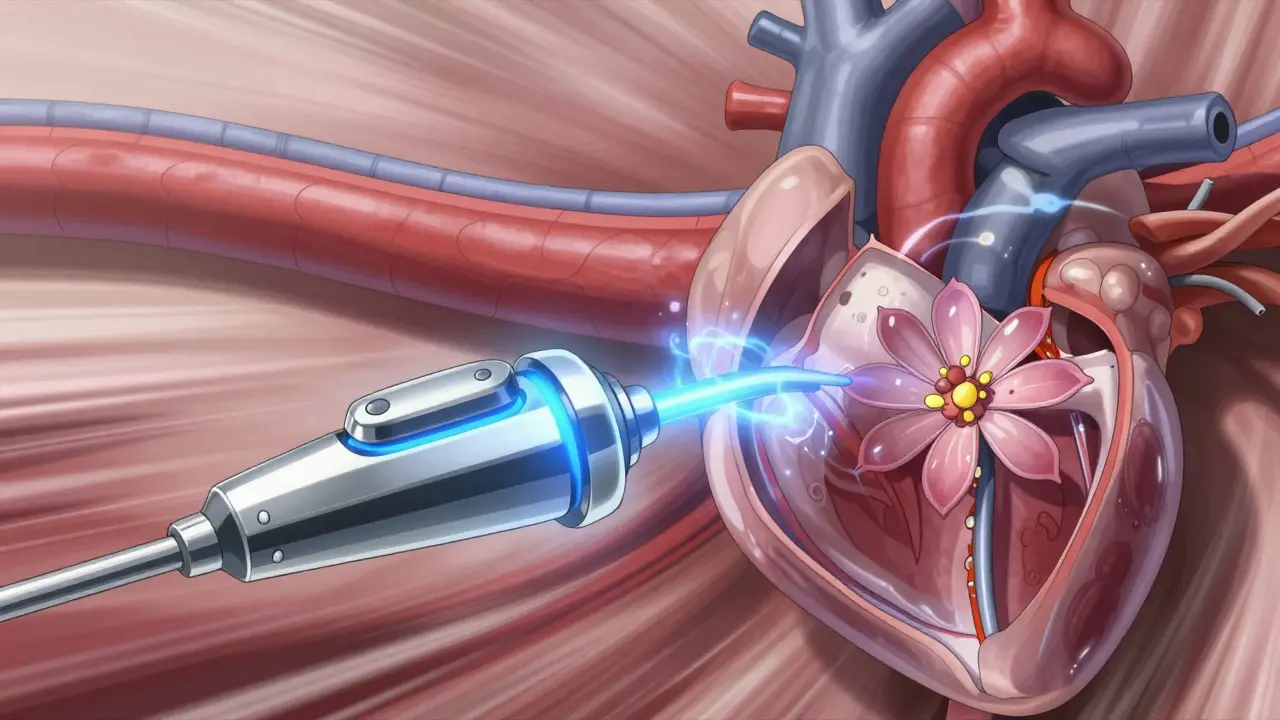
Mitral Valve Interventions: Repair vs. Replace
While TAVR dominates aortic treatments, mitral valve disease requires a different approach. For mitral regurgitation, repair is often preferred over replacement. The MitraClip procedure allows doctors to clip the leaking valve leaflets together using a catheter. The COAPT trial showed this reduced mortality by 32% compared to medical therapy alone for functional mitral regurgitation. For primary mitral regurgitation, surgical repair remains superior, with 90% ten-year survival rates versus 75% with medical management alone.
New technologies are expanding options further. The Evoque tricuspid valve system received FDA approval in March 2023, bringing transcatheter solutions to the right side of the heart. Systems like Cardioband and Harpoon are also in advanced trials, promising less invasive repairs for complex cases. By 2030, experts predict 80% of valve procedures will be transcatheter-based, driven by improved device durability and expanded eligibility criteria.
| Treatment Type | Invasiveness | Recovery Time | Blood Thinners Needed? | Best For |
|---|---|---|---|---|
| Surgical Replacement | High (Open Chest) | 5-7 Days Hospital + Weeks Rest | Yes (if mechanical) | Younger patients, complex anatomy |
| TAVR | Low (Catheter-based) | 1-2 Days Hospital + Days Rest | No (usually) | Older/high-risk patients, aortic stenosis |
| MitraClip | Low (Catheter-based) | 1-2 Days Hospital + Days Rest | No (usually) | Mitral regurgitation, poor surgical candidates |
| Balloon Valvuloplasty | Moderate (Catheter-based) | 2 Days Hospital | No | Mitral stenosis (temporary relief) |
Living with Valve Disease: Quality of Life After Treatment
Getting treated isn’t just about extending life; it’s about reclaiming it. Before intervention, 87% of severe aortic stenosis patients reported markedly reduced ability to perform daily activities. After TAVR, 92% reported significant improvement in energy levels within 30 days. One patient described going from struggling to walk to the mailbox to hiking three miles daily within two months of a MitraClip procedure. These aren’t outliers; they’re typical outcomes when timely care is provided.
Post-procedure life does require adjustments. If you receive a mechanical valve, you’ll need regular INR monitoring to keep your blood thinner levels in check. Target ranges are usually 2.5-3.5 for mitral valves and 2.0-3.0 for aortic valves. Even with tissue valves, follow-up echocardiograms are crucial to monitor for structural deterioration. Current data shows 21% of surgical bioprostheses deteriorate at 15 years, though next-generation tissues may extend this to 25+ years.
Anxiety is common. About 63% of new posts in online heart valve communities mention fear of surgical risks. It’s natural to worry, but remember that untreated severe aortic stenosis has a 50% five-year survival rate. With timely valve replacement, that jumps to 85%. The risk of doing nothing is far greater than the risk of modern interventions.
What is the difference between stenosis and regurgitation?
Stenosis means the valve narrows and restricts forward blood flow, forcing the heart to pump harder. Regurgitation means the valve leaks, allowing blood to flow backward, causing the heart to pump the same blood repeatedly. Both strain the heart but in different ways.
When should I consider surgery for heart valve disease?
Intervention is recommended when symptoms develop (like chest pain, fainting, or shortness of breath) or when diagnostic measurements show severe disease (e.g., aortic valve area <1.0 cm²). Waiting for symptoms in severe aortic stenosis reduces 2-year survival to 50%, so early action is key.
Is TAVR safer than open-heart surgery?
For older patients or those with high surgical risk, TAVR is significantly safer with lower mortality and faster recovery. Recent trials show it’s also non-inferior to surgery for lower-risk patients aged 60-80, making it a viable option for a broader range of people.
Do I need blood thinners after valve replacement?
It depends on the valve type. Mechanical valves require lifelong anticoagulants (blood thinners) to prevent clots. Bioprosthetic (tissue) valves generally do not require long-term blood thinners, though short-term use may be needed initially.
Can heart valve disease be cured without surgery?
No. Medications can manage symptoms and slow progression, but they cannot fix a structurally damaged valve. Once the valve is severely narrowed or leaking, mechanical intervention (repair or replacement) is the only definitive cure.




Comments (11)
mardy duffy
Another wall of text for people who can't read the actual medical journals.
Warren Brewer
I think this is actually a really helpful summary for folks who are scared to ask their doctors questions.
We often feel lost when we get diagnosed with something like stenosis, so breaking it down into simple terms helps us understand what the heart is doing wrong. It reminds me that we should all pay attention to our bodies and not ignore those little signs of fatigue or shortness of breath. Let's support each other in learning more about our health so we can make better choices together.
Mark Ronson
As a cardiologist, I appreciate the effort here but there are some nuances missing regarding TAVR vs surgical AVR.
The statement that TAVR accounts for 65% of replacements in patients over 75 is accurate for high-risk cohorts, but recent trials like PARTNER 3 have expanded indications to low-risk patients under 80. However, long-term durability data beyond 10 years for transcatheter valves remains less robust than surgical bioprosthetics. Also, the claim that mechanical valves require lifelong anticoagulation is true, but DOACs are generally contraindicated; warfarin remains the standard. The section on MitraClip correctly cites COAPT, but one must distinguish between primary degenerative MR (where surgery is preferred) and secondary functional MR (where Clip shines). Great overview though, keep up the good work in patient education.
charles robert
The irony of discussing 'doors' while ignoring the existential dread of mortality is palpable 🚪💀. We are merely meat pumps destined to fail, yet we cling to these metallic prosthetics as if they grant immortality. The calcification of the valve mirrors the calcification of the soul in modern society-stiff, narrow, and resistant to flow. To undergo sternotomy is to invite death into your chest cavity, hoping the gods of medicine spare you. 😔🏥
Mollie Louise
This is such an incredibly important topic and I am so glad we are having this conversation because knowledge truly is power when it comes to our heart health! ❤️✨ I have seen so many friends struggle with undiagnosed valve issues until it was too late, which is why spreading awareness about symptoms like fainting or extreme fatigue is absolutely crucial for everyone to know. The part about TAVR being less invasive gives me so much hope for older patients who might otherwise be deemed too risky for open-heart surgery, and it just shows how far medical science has come in such a short amount of time! 🙌 We need to encourage our loved ones to listen to their bodies and seek help immediately if they experience any red flags, because early detection can literally save lives and improve quality of life significantly! 💪🩺
Dana Ellington
OMG thank you for posting this!! 😭 My mom has been complaining about getting tired just walking around the grocery store and i thought she was just getting old but now im worried its her valves! This article made me realize how serious it can be even without chest pain. I'm going to print this out and take it to her doctor next week because she needs answers ASAP! Please stay strong everyone dealing with this stuff, you are warriors! 💖🏥
Mikey Mann
It is fascinating to consider the heart not just as a biological pump, but as a metaphor for resilience. When the valves stiffen or leak, the heart compensates, thickening its walls to meet the demand-a physical manifestation of enduring pressure. Perhaps we, too, build thicker emotional walls when life’s flow becomes restricted. But unlike muscle, tissue wears out. The shift from open surgery to catheter-based interventions like TAVR suggests a philosophical evolution: we no longer need to tear ourselves apart to fix what is broken. We can heal through smaller openings, with less trauma, embracing change rather than resisting the inevitable decay of the physical form. There is beauty in that adaptation.
Emma Olliff
Oh, please. Do you really think the average person needs a primer on basic hemodynamics? This reads like a brochure for a charity gala, replete with condescending analogies about 'doorways' and 'kettles.' If you cannot comprehend the pathophysiology of aortic stenosis without such patronizing simplifications, perhaps you should reconsider your educational pursuits. The statistics cited are rudimentary at best, and the dismissal of surgical risks as mere 'anxiety' is profoundly ignorant. One does not simply 'reclaim' life after a sternotomy; one endures a prolonged recovery that tests the very limits of human fortitude. Spare us the platitudes.
Christina Moran
i never knew that mitral regurgitation could cause such fatigue before realizing there was a problem. it sounds scary but also relieving to know there are options like the Mitraclip now. my uncle had surgery years ago and he was in hospital for weeks so hearing about the shorter recovery times for newer procedures makes me hopeful for the future. thanks for sharing this info!
Yuvraj Singh
This is a well-structured overview. In India, we are seeing a rapid increase in rheumatic heart disease affecting younger populations, which contrasts with the age-related calcification mentioned here for Western countries. While TAVR is becoming more accessible globally, cost remains a significant barrier for many patients in developing nations. Surgical repair remains the gold standard for rheumatic mitral disease where feasible. It is encouraging to see advancements in transcatheter therapies, but equitable access to these technologies is still a major challenge worldwide.
Desirea Gaona
It is imperative that individuals recognize the gravity of valvular pathology and adhere strictly to medical advice. The progression from asymptomatic murmurs to symptomatic heart failure is often insidious, necessitating vigilant monitoring via echocardiography. Patients must not underestimate the significance of diagnostic metrics such as valve area and pressure gradients. Furthermore, the decision between mechanical and bioprosthetic valves requires careful consideration of lifestyle factors and anticoagulation requirements. One must approach this condition with utmost seriousness and compliance to ensure optimal outcomes.